"Gold Raiders" (Three Stooges, 1951)
A couple of years after the Iverson Movie Ranch Western street was built, someone decided to add a building at the south end of town. I call this building Rainbow Mine Co., referencing its high-profile role in Gold Raiders."
I would be remiss if I failed to give a shout-out to Clem Bevans, one of the Quintessential Geezers of movies and TV — that's him on the front deck of the Rainbow Mine Co.
"The Twinkle in God's Eye" (1955) — Clem Bevans with Mickey Rooney
You've almost certainly seen Bevans in movies or on TV. He was in a string of feature films from the '30s through the '50s before becoming a familiar face on early TV. He was one of those actors who seemed to be "born old," playing a series of memorable geezers, codgers, old-timers and coots in B-Westerns, sitcoms, you name it.
"The Real McCoys" (1959) — Clem Bevans, right, with Walter Brennan
On an episode of "The Real McCoys," Bevans played Floyd Armbruster opposite the patron saint of the Quintessential Geezers,
Walter Brennan. Both men put in ample time at Iverson during their long careers.
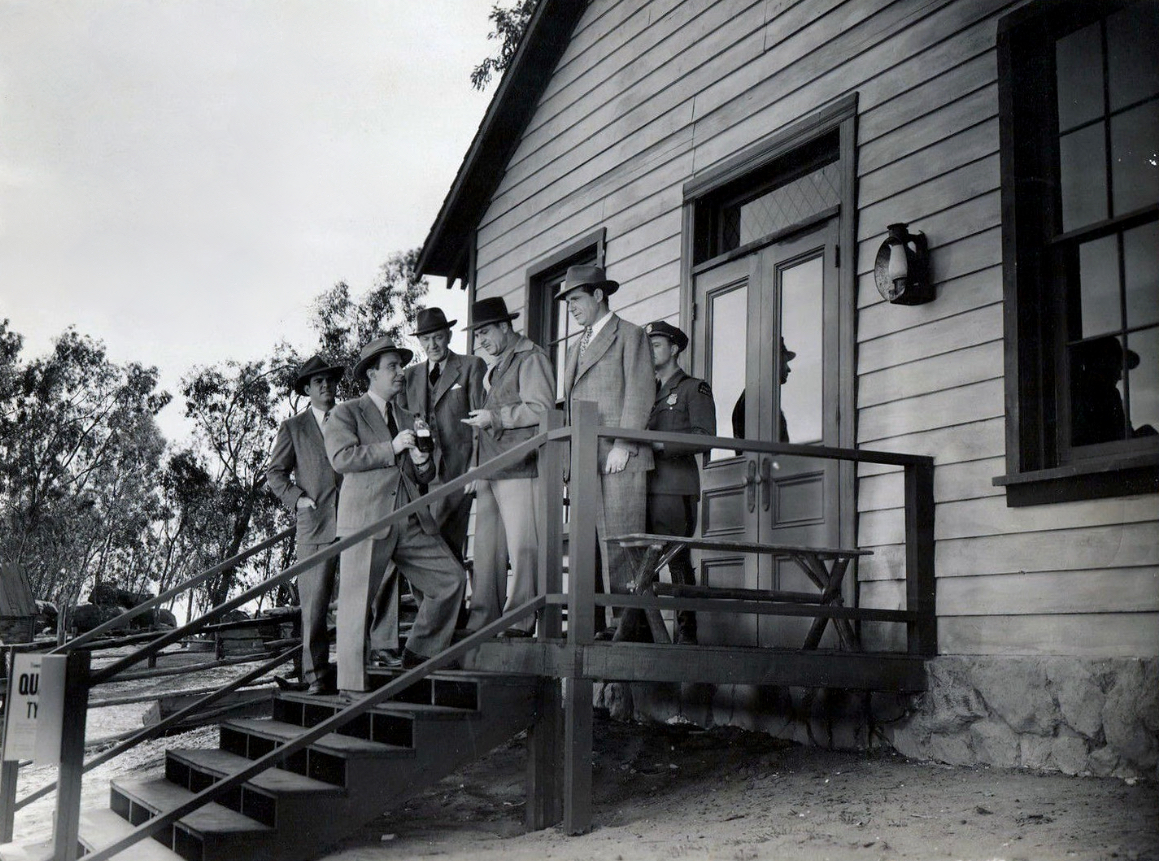
"The Millerson Case" (1947): Two new buildings at the south end of town
The Rainbow Mine Co. first surfaced in 1947, with "The Millerson Case" marking one of its earliest appearances. It was one of two new buildings to go up around the same time at the south end of town, along with the Church.
The Rainbow Mine Co. probably predates the Church by only a few months, or even as little as a few weeks. The Church, which was a schoolhouse when it made its first screen appearance in "The Millerson Case," lasted only a couple of years, but the Rainbow Mine Co. became a part of the permanent
town set.
"Bat Masterson" TV series (footage from 1947, aired in 1961)
Some
filming took place during the brief period in 1947 between the time the Rainbow Mine Co. was built and the construction of the Church. The best example
I've found of this footage surfaced years later, in a 1961 episode of
"Bat Masterson." (The black bar along the left edge of
the frame is part of the original footage, presumably created by the
edge of a building on the east side of the street.)
The "Bat Masterson" footage, from the episode
"The Fatal Garment," establishes that the Rainbow Mine Co. building was
in place before the Church was built. This shot includes a portion of the rock Gumdrop, which was
located directly behind the Church and would be largely blocked from
view once the Church was in place.
"Bat Masterson" episode "The Fatal Garment"
I don't know the origin of the "Bat Masterson" footage that was
recycled from 1947, but it may have originally been filmed for "Ghost Town
Renegades," which did a major shoot on the Western street around the same
time — after the Rainbow Mine Co. building was put up but before construction of the Church.
One of the distinguishing features of the Rainbow Mine Co. was its orientation. The building was offset from the rest of the town,
facing almost directly south.
"The Millerson Case" (1947)
An unusual view of the Rainbow Mine Co. building appears in "The Millerson Case," which was another movie that featured Clem Bevans. That's Bevans, as sheriff of Brook Falls, in the middle of this shot of the town taken with the camera aimed almost due north — a rarely used vantage point, as most of the street was oriented at an angle.
The Rainbow Mine Co., which faced toward the south, is seen at the left of the frame, and is the only building in town that faces the camera from this angle.
"The Lone Ranger" TV series (1949): "The Legion of Old Timers"
Because of its offset angle to the rest of the street, the Rainbow Mine Co. building allowed filmmakers, if they were so inclined, to create slightly more artistic shots than just the usual straight shot looking up the street. This example comes from a fondly remembered early episode of the TV series "The Lone Ranger."
"The Legion of Old Timers," in which the Rainbow Mine Co. plays the Mesa City Stage Depot, was the fourth episode of "The Lone Ranger," premiering Sept. 8, 1949. "The Lone Ranger," one of the earliest success stories on the still-new medium of television in the late 1940s and early 1950s, shot extensively at Iverson.
"The Lone Ranger" TV series — "Finders Keepers" (1949)
In an episode later in season one, "The Lone Ranger" was back on the Iverson Western street. In this shot, the Ranger takes a look around from the front deck of the Rainbow Mine Co. building, unaware that he's being spied on from across the street.
If you're wondering about the large "blob" near the center of the frame, it's a rock. Because this rock marks the southern end of the Western street, I've taken to calling it South Rock in my research.
"The Range Rider" TV series (1953)
South Rock bears some similarity to Pond Rock at the opposite end of the street — especially in terms of its position next to the front walkway of a major building. The two rocks are remarkably similar in their orientation, creating "bookends" at the northeast and southwest corners of town.
Bookends: Pond Rock, at the northeast corner of town, and South Rock at the southwest corner
Here's a look at the two "bookend" rocks side-by-side. It's easy to confuse the Rainbow Mine Co. and its nearby South Rock, at the southwest corner of town, with the General Store and Pond Rock, located on the northeast corner of the street — especially given the similarity in the two buildings' front columns.
"El Paso" (1949): South Rock in background
When I first spotted the above shot in the movie "El Paso," I thought I was seeing the General Store, and I was excited to see people sitting on top of what I thought was Pond Rock. As it turned out, however, the crowd was gathered in front of the Rainbow Mine Co. and the girls were sitting on South Rock.
It's been a while now since I watched the movie, but if I'm remembering it right, the crowd is gathered to watch a hanging. The fact that South Rock is incorporated into the scene makes the sequence even more interesting than if it had included Pond Rock, as it's far less common to find South Rock in productions.
"Silver Canyon" (1951): Rainbow Mine Co. and South Rock
One of the biggest differences between South Rock and Pond Rock is that while Pond Rock is a true "stacked rock," with a pronounced overhang, South Rock has a more traditional rounded boulder shape.
"Check Your Guns" (1948)
Here's another unusual view of the town, from the Eddie Dean movie "Check Your Guns." The camera is shooting toward the east, with the Livery Stable in full view on the right. A small wooden well can be seen at the left of the frame, along with South Rock and a partial view of the Rainbow Mine Co.
"Night Raiders" (filmed in 1951, released in early 1952)
The Rainbow Mine Co. building is featured prominently in the Whip Wilson movie "Night Raiders," from Monogram. The building plays the Bitter Springs Loan & Title Co.
Along with South Rock, the movie provides a glimpse of a rarely seen taller rock behind it.
"Outlaw Gold" (1950) — a rare look at the rock behind South Rock
This shot of the front of the Rainbow Mine Co. building provides one of the few substantial views I've seen of the taller rock that is South Rock's "camera-shy" neighbor.
The shot comes from the Johnny Mack Brown Western "Outlaw Gold," from Monogram.
"The Lone Ranger" — "The Legion of Old Timers"
The rarely seen taller rock looms behind a couple of henchmen lurking around the Rainbow Mine Co. in "The Lone Ranger" in 1949. That's perennial bad guy Lane Bradford on the right, with Sandy Sanders.
Future "Star Trek" mainstay DeForest Kelley, right, makes an early TV appearance in the same episode. Here he's seen in front of the Stage Depot — the Rainbow Mine Co. building — with shady character Norman Willis.
DeForest Kelley
Kelley was a regular in early TV Westerns — on both sides of the law — before making his mark on popular culture in the 1960s as "Star Trek's" Dr. "Bones" McCoy.
"The Lone Ranger" — "Finders Keepers"
One of the Rainbow Mine Co.'s most readily identifiable features is the wide set of steps along the east side of the building's front deck area.
"State Department: File 649" (1949)
Those same steps help identify the Rainbow Mine Co. building in the spy movie "State Department: File 649," starring William Lundigan and Virginia Bruce. The Iverson Western street is made up to look like a small Chinese village in the film, from PRC spinoff Sigmund Neufeld Pictures.
Another shot from "State Department: File 649" provides an unusual view of the town. A wall at the south end of the street separates the village from the outside world, with the Livery Stable on the right and the Rainbow Mine Co. on the left being the two most prominent buildings seen in the shot.
Also appearing in the shot is the Harness Maker building. But what makes this shot special is what's going on in the space between the Western street's main buildings.
The gap between the Rainbow Mine Co. and the Harness Maker, like some of the other nooks and crannies along the west side of the street, offered occasional glimpses of the old "Wee Willie Winkie" buildings to the west of the town, which are visible again in the background in "State Department: File 649."
"Night Raiders": Wall between the Rainbow Mine Co. and the Harness Maker
By 1952 the problem of old "Wee Willie Winkie" buildings sneaking into the shot appeared to be solved — at least between the Rainbow Mine Co. building, on the left, and the Harness Maker, on the right.
Thanks to this seemingly low-key shot from "Night Raiders," we know that a wall was built between the two buildings, presumably to conceal the old India Fort buildings. The design of the new construction appears to match that of the Rainbow Mine Co. building.
"The Lone Ranger" TV series: "Ghost Town Fury" (aired March 28, 1957)
The Rainbow Mine Co.'s trademark steps appear again in a shot from the final season of "The Lone Ranger" — the only season of the series that was shot in color. This shot offers a look at some of the rocks to the south and southwest of the town set, hinting at the proximity of the Western street to other widely used filming areas.
While Gumdrop typically marked the south end of the town set, the other areas noted above had "movie careers" independent of the Western street. During the peak filming years on the Iverson Movie Ranch, you could almost literally turn over a rock and find another movie shoot in progress.
"The Iverson Movie Ranch Western street, one building at a time" is a series of posts on the movie and TV history of each
of the major structures making up Iverson's town set,
which stood from 1944 to 1957 and appeared in hundreds of productions.

To see all of the posts in the series on the Iverson Western street, please click on the following links:
Part I: Casa Grande
Part II: The Livery Stable
Part III: The Saloon
Part IV: The Hotel
Part V: The General Store
Part VI: The Barn
Part VII: The Sheriff's Office
Part VIII: The North and South Adobes
Part IX: The Lost Dutchman
Part X: The original north end of town
Part XI: The North and South Towers
Part XII: The Harness Maker
Part XIII: Rainbow Mine Co.
Part XIV: The Church/Schoolhouse
Part XV: The Corral Rocks Shack
Part XVI: The decline and fall of the Western street