Why we love old movie locations — especially the Iverson Movie Ranch

For an introduction to this blog and to the growing interest in historic filming locations such as the Iverson Movie Ranch — the most widely filmed outdoor location in movie and TV history — please read the site's introductory post, found here.
• Your feedback is appreciated — please leave comments on any of the posts.
• To find specific rock features or look up movie titles, TV shows, actors and production people, see the "LABELS" section — the long alphabetical listing on the right side of the page, below.
• To join the MAILING LIST, send me an email at iversonfilmranch@aol.com and let me know you'd like to sign up.
• I've also begun a YouTube channel for Iverson Movie Ranch clips and other movie location videos, which you can get to by clicking here.
• Readers can email the webmaster at iversonfilmranch@aol.com
.

Showing posts with label Zorro's Cave. Show all posts

Sunday, February 18, 2018

A tale of two ranches: How movie stars Joel McCrea and Frances Dee found love, survived Hollywood and lived their cowboy dream

"Wells Fargo" (1937), starring Joel McCrea and Frances Dee — filmed on the Iverson Movie Ranch

Actors Joel McCrea and Frances Dee were that rare exception in Hollywood: a marriage that lasted. One of the secrets to their success may have been their decision to live outside the glare of Hollywood stardom.

Frances Dee and Joel McCrea on their Thousand Oaks ranch

McCrea was a cowboy and a rancher at heart, and never quite warmed up to being a movie star. In 1933 the couple bought a ranch in Thousand Oaks, Calif. — just 40 minutes west of Hollywood, but a world apart.

The McCrea Ranch in modern times

They lived on the Ventura County ranch throughout their 57-year marriage, and Dee continued to live there after McCrea's death in 1990. Today their former ranch remains a Thousand Oaks landmark.

The McCrea Ranch will host a presentation March 3 on the history of the Iverson Movie Ranch and the many connections between the McCreas and the Iverson Ranch.

If you can find this spot, you're there — but it's a small room, and advance reservations are recommended. They can apparently be made through the Conejo Recreation and Park District. (See the flier above.)

Frances Dee in 1933 with "another man" — Buster Crabbe, aka "The Lion Man"

The couple's history with the Iverson Movie Ranch goes back at least as far as 1933, when Frances Dee starred alongside Buster Crabbe in Paramount's "King of the Jungle," filmed in part on the Iverson Ranch.

It was still fairly early in the sound era when "King of the Jungle" was in production in 1932. The movie would be released to a warm reception in March 1933.

Some of the marketing for "King of the Jungle," while artistic, was primitive by later Hollywood standards. I have to wonder whether expressions like "charging hell of wild beasts" really brought people into the theaters.

Buster Crabbe and Frances Dee — promo still for "King of the Jungle"

More likely, what brought a lot of them in was the beautiful Frances Dee, who couldn't help being glamorous even in a faux-tattered jungle dress.

The producers made the most of Dee — her face lit up a series of promotional shots for "King of the Jungle."

Buster Crabbe stands on the Gorge Arch on the Lower Iverson

Also receiving plenty of exposure in the movie's marketing was the athletic Buster Crabbe. Here he monitors the action from a perch on the late, lamented Lower Iverson rock feature known as the Gorge Arch.

Buster Crabbe and a young cast member — promo still for "King of the Jungle"

Crabbe's "Lion Man" character was briefly a rival for MGM's megahit "Tarzan" series, which had just introduced Johnny Weissmuller in 1932's "Tarzan the Ape Man" — also filmed on the Iverson Ranch.

Behind-the-scenes photo of lions assembled on the Iverson Ranch for "King of the Jungle"

A large group of lions was brought to the Iverson Ranch for the "King of the Jungle" shoot. In this behind-the-scenes photo, I count at least 15 lions gathered just outside Zorro's Cave on the Lower Iverson.

To make sure I don't give readers the wrong impression, I've identified Zorro's Cave here, along with a small prop "lions' den" that was installed for the production.

This is the same area where the lions were filmed for "King of the Jungle," as it appears in 2018.

More than 85 years after the "King of the Jungle" shoot, we can still find artifacts from the filming, although they're not easy to spot. Note the area highlighted by the red circle.

I believe these recessions in the rock mark one of the spots where fencing was attached to keep the lions from going rogue. This area would have been just out of view of the camera in the shot of the lions.

Bits of wire can also still be found in the area. We have no way of knowing for sure, but I would be willing to bet that this was also part of the fencing used for the "King of the Jungle" shoot.

Frances Dee and Joel McCrea

The year "King of the Jungle" was released, 1933, was a big year for Joel McCrea and Frances Dee. It was the same year they met, had a whirlwind romance, got married and bought their ranch in Thousand Oaks.

Promotional photo for "One Man's Journey" (1933): Dee and McCrea

They were co-starring in movies from the beginning — in fact, they met on the set of a movie, "The Silver Cord," released in May 1933. That same year they worked together again in "One Man's Journey."

"Wells Fargo" (1937)

In 1937 Dee and McCrea co-starred in the Paramount Western "Wells Fargo," a movie that once again connected them with the Iverson Movie Ranch.

"Wells Fargo's" unusual opening credits

"Wells Fargo" deserves a place of honor among Iverson Ranch aficionados for its unique title sequence, in which the opening credits are made to appear as though they're painted on the rocks of the Lower Iverson.


The above clip shows "Wells Fargo's" title sequence, filmed entirely on the Iverson Ranch. I discussed this sequence in detail in a blog post a few years ago, which you can read by clicking here.

Lobby card for "The Virginian" (1946): Brian Donlevy, Barbara Britton and Joel McCrea

Joel McCrea was back on the Iverson Ranch in 1946 to film Paramount's Technicolor Western "The Virginian" — one of many film and TV adaptations of the 1902 Owen Wister novel "The Virginian — A Horseman of the Plains."

"The Virginian": Joel McCrea and Barbara Britton ride off into the sunset on the Iverson Ranch 

The closing sequence from "The Virginian" features a classic "riding off into the sunset" shot in which Joel and his leading lady set out to begin their new life together. The scene takes place on the Iverson Ranch.

The same sunset location in 2016

The same location continues to yield spectacular sunsets today. This is a photo I took on the ranch in 2016.

Notice the rocky flat-top profile of the hill near the right of the shot.

Sunset sequence in "The Virginian"

The same hill can be seen in the closing shot from "The Virginian" — with the sun setting right behind it.

This hill can also be seen in the daytime, when it's easily spotted as one leaves the San Fernando Valley headed west on the 118 Freeway toward Simi Valley and Ventura County — the same direction Joel and his real-life leading lady headed when they left Hollywood back in '33 to start their new life together on the ranch.

"Three Ages" (Buster Keaton/Metro Pictures, 1923)

Like almost everything on and around the Iverson Ranch, that hill to the west has a long history in the movies. Here it sneaks into the background in the silent Buster Keaton comedy "Three Ages" in 1923.

"The Grapes of Wrath" (1940)

The same hill appears next to Jane Darwell's head in 1940 in "The Grapes of Wrath," just as she's about to tell the family some bad news about Grandma. Darwell won an Oscar for her performance as Ma Joad in the film.

"Ghost Valley Raiders" (Republic, 1940)

Not all of the hill's appearances are in Oscar winners — it turns up in its share of B-Westerns too. The same year the hill appeared in "The Grapes of Wrath" it was also seen in the Iverson showpiece "Ghost Valley Raiders."

"Wanted: Dead or Alive" (1958)

The flat-top hill's work as a background feature continued into the TV era. Here it turns up in an episode of the Steve McQueen series "Wanted: Dead or Alive" called "Die by the Gun," which premiered on Dec. 6, 1958.

"The Jungle Book: Mowgli's Story" (Disney, 1998)

As recently as the late 1990s, the hill continued to do background work in Hollywood productions. Here it can be seen in a sequence featuring wolves howling in Disney's "Jungle Book" sequel "Mowgli's Story."

"Mowgli's Story": The same shot as it appeared in the movie

The sequence was shot "day for night," appearing much darker in the actual movie. The wolf is seen in silhouette and the background is obscured, making the point that the wolf is howling as night falls.

As a footnote to Joel McCrea's "The Virginian," it's worth noting that another famous film version of the story, an early talkie from 1929, starred Gary Cooper and was also filmed on the Iverson Ranch.

James Drury as "The Virginian," near the Iverson Ranch's Hangover Shack in the NBC TV series (1963)

Modern audiences know the story of the Virginian mainly through the TV series, which ran for nine seasons on NBC, from 1962-1971. In its early seasons the TV series also filmed regularly on the Iverson Ranch.

Joel McCrea had another interesting sojourn to the Iverson Ranch, for his 1950 Western "Saddle Tramp."

Joel McCrea rides past Wrench Rock on the Upper Iverson in "Saddle Tramp"

The movie features a lavish six-minute opening segment filmed on the Upper Iverson, loaded with nice Technicolor shots of the ranch in spring. "Saddle Tramp's" opening shot is this striking portrait of Wrench Rock.

Wrench Rock in recent times — toward the right of the frame

An attempt to match the shot in modern times runs into a common obstacle: Today a tree has attached itself to the eastern profile of Wrench Rock, effectively blotting out this view of the the rock.

"Saddle Tramp" opening sequence

McCrea whistles as he rides the ranch in the "Saddle Tramp" sequence, and appears to be taking in the scenery.

Notice the rock at the left of the frame, which would later come to be known as "Gold Raiders Rock." This is one of the last times we see this rock in its natural configuration.

"Gold Raiders" (Three Stooges, 1951)

When the same rock appears the following year in the Three Stooges movie "Gold Raiders," it has a smaller rock cemented on top of it. "Stacked rocks" like this one can be found in several places on the former movie ranch, and are among the more intriguing artifacts of the site's filming legacy.

The creation of stacked rocks on the Iverson Ranch is known to have taken place as early as the 1920s, but we see signs of a flurry of this type of cement work around 1950 to 1951.

Gold Raiders Rock in modern times

The rock remains intact today — including the smaller rock on top, still cemented in place.

I believe the surge in rock stacking in the early 1950s was part of an effort by the Iverson family to spruce up the location ranch for the increased business that was starting to come in from the new medium of television.

Frances Dee and Joel McCrea

For readers who are intrigued by the exploits of Joel McCrea and Frances Dee, or the history of the Iverson Ranch — or if you just want to say howdy — I hope you can make it to the presentation March 3 at the McCrea Ranch.

Wyatt McCrea — Joel McCrea and Frances Dee's grandson

I understand the McCreas' grandson Wyatt McCrea, who still lives on the McCrea Ranch, will also be on hand to answer questions about his famous grandparents.

Full disclosure: I didn't have any luck when I tried the website listed on the flier. You might want to try the phone number, or poke around the Conejo Rec & Parks website to find other ways to sign up. Good luck!


Sunday, October 9, 2016

An Iverson Movie Ranch mystery solved: Here's what happened to the "Hangman's Tree"

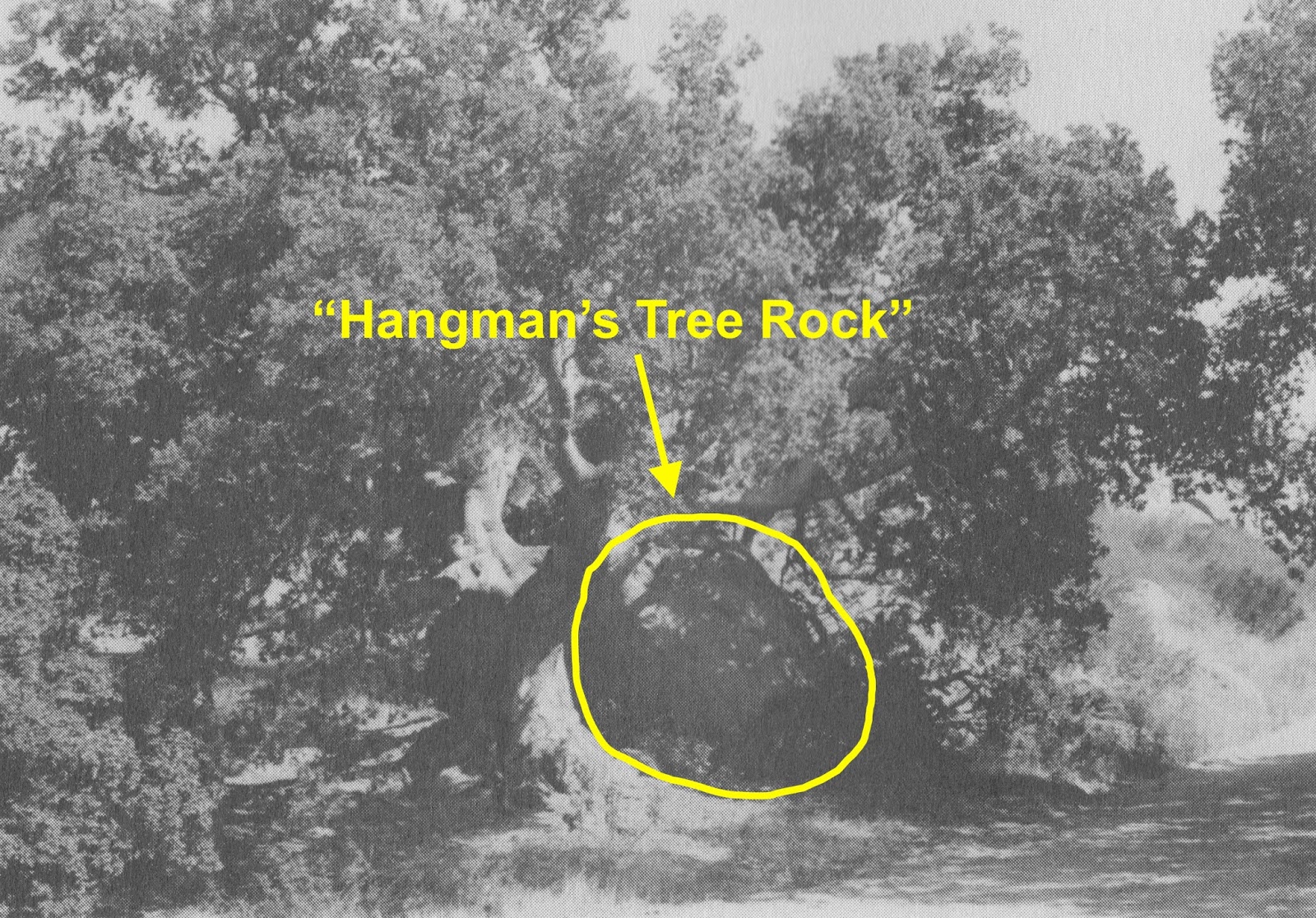
"Hangman's Tree" on the Lower Iverson Movie Ranch in 1981 
(photo from "An Ambush of Ghosts," by David Rothel)

I've been obsessing for a while over this photo of what's been called the "Hangman's Tree." And after several months, my obsessing finally paid off.

"Hangman's Tree" location in 2016

On a recent visit to the former Iverson Movie Ranch, I was able to pinpoint the location where the Hangman's Tree once stood. Unfortunately, the tree is long gone.

"Pioneer Justice" (1947): The Hangman's Tree

As is usually the case, it took multiple sources of information to crack the mystery. In this instance, the biggest clue surfaced in the Lash LaRue movie "Pioneer Justice."

I couldn't match the tree in "Pioneer Justice" directly with the tree in Rothel's book, but it has all the hallmarks of a good hanging tree. And it's right next to a rock that looks like it might be easy to find.

Another great clue lurks in the background of the "Pioneer Justice" shot — something that looks suspiciously like Zorro's Cave. That would be the first place I'd look.

Hangman's Tree area, including "Hangman's Tree Rock," in 2016

When I arrived at the target area, everything was right where it was supposed to be — except the tree. "Hangman's Tree Rock" has survived, and still looks exactly as it did in "Pioneer Justice."

The tree and rock in 1981, in "An Ambush of Ghosts"

The rock is easy to miss in Rothel's landmark Western locations book, but it's there, hidden in the shadows. As the only surviving feature in the shot, the rock holds the key to locking down the spot.

"Pioneer Justice"

As a bonus, I was able to identify a couple of other rocks seen in "Pioneer Justice," still in place today and further pinpointing the tree's former location.

The same area, photographed in 2016

Those same two rocks can be identified today, still in the same positions.

It's no longer possible to see Zorro's Cave from this vantage point, but it's back there and can be seen from other angles.

Hangman's Tree Rock in 2016 (angle approximates the 1981 photo)

The final puzzle piece is to see whether "Hangman's Tree Rock" matches the rock in the 1981 photo when they're shot from approximately the same angle.

It does. The key markers are noted here in the 1981 photo, with the rock's vertical face and its sloping profile being especially important.

While I couldn't match the high angle of the 1981 shot, all of the same markers can be found on the rock today even from ground level.

If the Hangman's Tree were still in place, this is about where it would be standing. The tree apparently did not fit in with the landscapers' vision for the Cal West Townhomes.

Nearby Zorro's Cave can still be found, but today it has a metal gate blocking the west entrance and is situated on private property adjacent to the condos.

The former Hangman's Tree area also stands on private property, at an intersection of driveways among the condos on the former Lower Iverson.


Click on the link above to go to Amazon.com to learn more about David Rothel's excellent book on Western movie locations, "An Ambush of Ghosts." You may or may not be able to purchase a copy depending on availability.