Why we love old movie locations — especially the Iverson Movie Ranch

For an introduction to this blog and to the growing interest in historic filming locations such as the Iverson Movie Ranch — the most widely filmed outdoor location in movie and TV history — please read the site's introductory post, found here.
• Your feedback is appreciated — please leave comments on any of the posts.
• To find specific rock features or look up movie titles, TV shows, actors and production people, see the "LABELS" section — the long alphabetical listing on the right side of the page, below.
• To join the MAILING LIST, send me an email at iversonfilmranch@aol.com and let me know you'd like to sign up.
• I've also begun a YouTube channel for Iverson Movie Ranch clips and other movie location videos, which you can get to by clicking here.
• Readers can email the webmaster at iversonfilmranch@aol.com
.

Showing posts with label Lillian Gish Rocks. Show all posts

Sunday, April 26, 2020

Harnessing the power of "Stay at Home" orders: The Lillian Gish mystery is solved!

Roy Barcroft and George Chesebro adapt to the latest bandana-mask requirements

The longer the COVID-19 pandemic drags on, the more some of us are finally getting some work done.

Lillian Gish at Chatsworth's "Lillian Gish Rocks" (promo still from the early silent movie era)

One movie researcher who's putting his "stay at home" orders to good use is Tyler Malone, who sent word that he had tracked down the story behind an old Lillian Gish photo that was the focus of a blog post here in 2017.

Last time around, we reported on the rocks' location on Baden Avenue and some of the other details found in the photo — including the bluffs in the background and the historic Miranda Adobe, which is still standing today.

Chatsworth's "Lillian Gish Rocks" in 2020 (Jerry Condit photo)

Photographer Jerry Condit stopped off at the site earlier this year and was able to snap a nice shot of the rocks, even though today they're behind a fence and are usually somewhat hidden from view.

Lillian and her artsy admirer: Who was that unmasked man?

We knew the original photo was from about 1915-1917 and came from Triangle Films. What we didn't know was the name of the movie or the identity of the guy with the receding hairline who's also in the shot.

Alfred Paget

Mystery solved: Tyler figured out that the guy is Alfred Paget, a silent film actor who appeared in more than 225 short features and was close to wrapping up his career at the time he ventured into the tall grass with Lillian.

Alfred Paget

Born in London in 1879, Paget had been appearing on the silver screen since way back in 1908. He was apparently already dealing with that hairline situation by the time he started having publicity shots taken.

"Pathways of Life" (1916): Lillian Gish departs the "Hotel Abandon"

The movie is one that most or all of us have probably never heard of: A 1916 short feature called "Pathways of Life," directed by Christy Cabanne.

D.W. Griffith with Lillian Gish in 1922

Even though the movie is pretty obscure, it has some interesting bloodlines. D.W. Griffith, who was one of the top movers and shakers at Triangle Film Corp., oversaw the project — he's officially listed as the film's "supervisor."

D.W. Griffith points the finger at Lillian Gish as actor Robert Harron stays out of the way

Griffith had a long-running professional relationship with Gish, and there were rumors that at times it was more than just professional — know what I mean, nudge-nudge, wink-wink, say no more.

Lillian and Dorothy Gish in "An Unseen Enemy" (1912); the sisters were about 18 and 14 at the time

Griffith began putting the Gish sisters in his movies in 1912, with "An Unseen Enemy" — the first film role for both Lillian and her kid sister Dorothy. Lillian Gish would go on to work with Griffith in almost 50 films, while Dorothy ... well, let's just say she might have dodged a bullet by being underage at the time.

Lillian Gish rubs elbows with the Klan in "The Birth of a Nation" (1915)

The highest-profile Gish-Griffith collaboration, the pro-Ku Klux Klan landmark "The Birth of a Nation," would stir up a controversy that continues to haunt the legacies of both D.W. Griffith and Lillian Gish to this day.

2019 Deadline article on the Bowling Green-Lillian Gish controversy

The racist aftertaste of "The Birth of a Nation" reared its head again just last year when Bowling Green State University in Ohio removed Lillian Gish's name from its campus theater because of her involvement in the movie.

The theater had been known as "The Gish," in honor of Ohio natives Lillian and Dorothy Gish, since 1976. But the backlash heated up in early 2019 after the school moved the theater to a prominent site in the Student Union.

Students read a notice about the Gish Theater name controversy at Bowling Green State

Almost as soon as the new site opened for business, a big orange notice went up announcing that the school was having second thoughts about the theater's name.

Running under a headline reading "Building a Just Learning Community," the notice gives a pretty good idea of which direction school administrators were leaning. You can click on the photo if needed to read the text.

Hollywood responds to the controversy

The Hollywood community came out with a show of support for keeping the name, with insiders including James Earl Jones, Martin Scorsese, Helen Mirren, Peter Bogdanovich, Malcolm McDowell and Lauren Hutton among those signing off on a letter aimed at convincing the school to keep the Gish name.

The former Gish Theater — now the BGSU Film Theater

In the end, though, the school went with a rename and the Gish display went dark.

Lillian Gish handles the honorary Oscar she received in 1971

Controversy or not, Lillian Gish became known as the First Lady of American Cinema and had one of the most celebrated careers in Hollywood history. It was also one of the longest, spanning 75 years.

"The Whales of August" (1987): Lillian Gish, left, and Bette Davis

She packed it in after the 1987 feature "The Whales of August," in which she and Bette Davis starred as aging sisters reflecting on their lives. Gish was 93 and Davis was 78 years young at the time.

"Pathways of Life" (1916): Lillian Gish with W.E. Lawrence (left) and Spottiswoode Aitken

The "Pathways of Life" mystery from 71 years earlier (wow!) broke when Tyler found the promo still seen here, in which Gish appears in the same dress she was wearing in the "Lillian Gish Rocks" photo.

Lillian Gish in the same outfit in two promo stills for "Pathways of Life"

The shading on Gish's dress looks much darker in the second photo. But knowing what we know about the "Lillian Gish Rocks," it does appear that the two pictures may have been taken in the same general area.

"Pathways of Life": The "Hotel Abandon" promo still

Gish appears in a similar costume in the "Hotel Abandon" promo still, but if we look closely we can see that that this is not her free-flowing "Lillian Gish Rocks" dress. The devil is in the details.

Once Tyler had the movie pinpointed, along with a short cast list that includes Alfred Paget, it didn't take long to zero in on Paget as the previously unknown receding hairline guy.

"Intolerance" (1916): Alfred Paget as Belshazzar

A little more research on Paget confirmed his history with D.W. Griffith — Paget worked with Griffith on almost 200 movies from 1908-1916, including playing Prince Belshazzar in Griffith's epic "Intolerance."

"Martyrs of the Alamo" (1915): Alfred Paget, center, as Jim Bowie

Paget also had a history with Christy Cabanne, the director of "Pathways of Life," including playing Jim Bowie the previous year in Cabanne's "Martyrs of the Alamo."

"Pathways of Life" director Christy Cabanne

I felt compelled to include Cabanne's photo here, mainly because he has such a classically villainous look.

Snidely Whiplash

Come to think of it, has anyone ever seen Christy Cabanne and Snidely Whiplash in the same room?

Intrepid LAPD Det. Harry Bosch (Titus Welliver)

Nice detective work, Tyler. Thanks for all of your contributions to the research!

Sunday, August 20, 2017

A century-old photo of Lillian Gish reveals secrets to Chatsworth's past (Off the Beaten Path)

Promo still of Lillian Gish and unknown actor, circa 1915-1917 (Bison Archives)

A mysterious promotional photo from early in Hollywood's silent movie era has had film historians stumped for a while, but just in the past few weeks some of the photo's biggest mysteries have been solved.

The photo, which features Lillian Gish with an actor who has yet to be identified, dates from circa 1915-1917 and is thought to be associated with the Triangle Film Corp. — the D.W. Griffith-Thomas Ince-Mack Sennett partnership.

My hunch is that the actor in the shot is Wilfred Lucas, which would suggest the photo was taken for the 1917 feature "Souls Triumphant." At this point it's only a theory, and I would love to hear what readers think.

As soon as I received the photo I began trying to determine where it was taken. I concentrated initially on the bluffs in the background, which I thought almost "had to be" somewhere in the hills west of Chatsworth, Calif.

Zoomed-in shot of the background bluffs

This is what I was looking for, and it only took a couple of expeditions to the "edge of civilization" — along the perimeter of Chatsworth at the far west end of the San Fernando Valley — before it turned up.

The same bluffs as they appear today

The sandstone outcroppings were located on the side of an east-facing slope a short distance southwest of the Iverson Movie Ranch.

The key to identifying the rocks was this "face," which appears when the outcroppings are captured in the right light. To me it bears a strong resemblance to an Egyptian mummy.

The same "mummy-faced" rock can be seen in the background of the Lillian Gish photo.

The Kestrel, west of Chatsworth

The formation with the mummy-like rock is part of a section of the Santa Susana Mountains known as "The Kestrel." The formation was recognized by the both the Native American inhabitants of the region and early Spanish settlers, and has also been called "Gavilan" or "the Hawk."

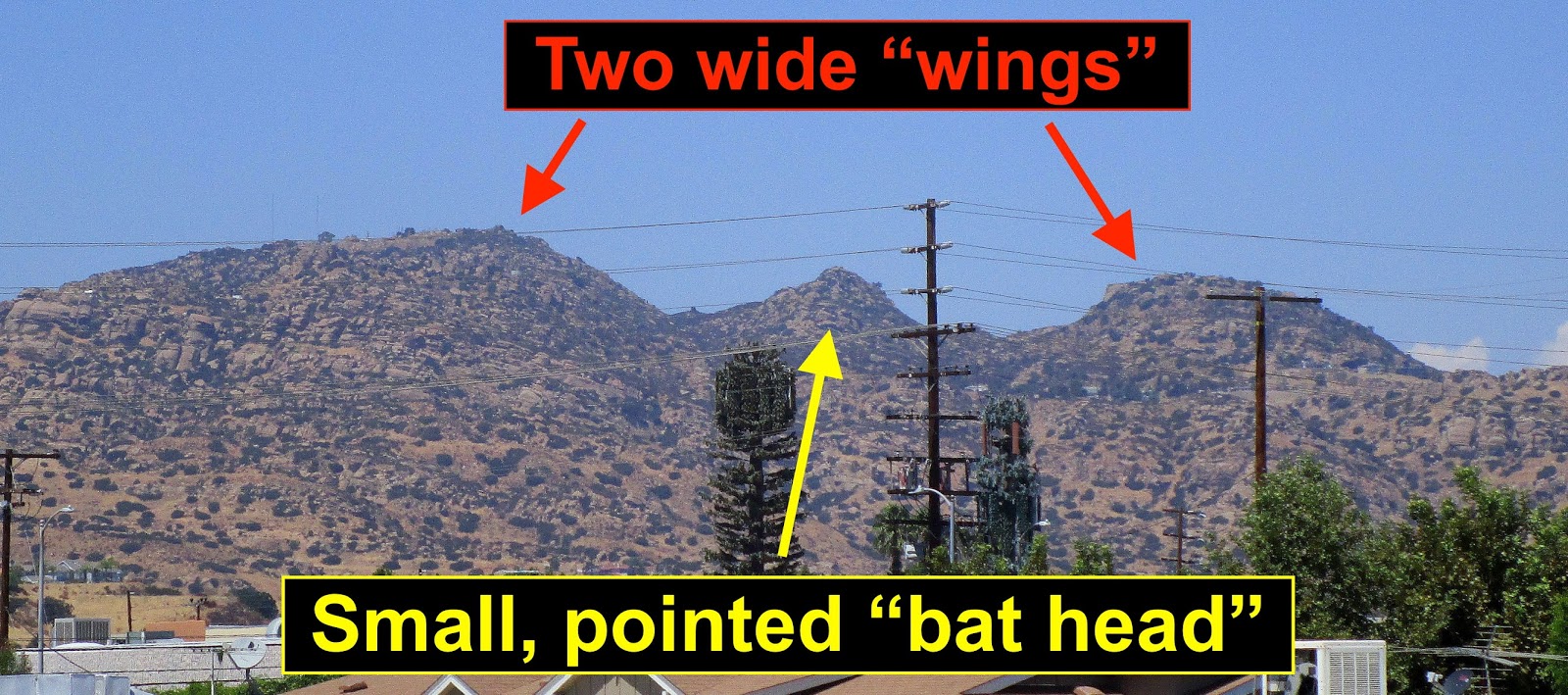
In this recent shot of the formation, which I previously referred to in my own research as the "Bat Signal," the "mummy-faced" rock appears at the right of the frame.

The real Bat Signal

My old research name "Bat Signal" came from the formation's similarity to the actual Bat Signal from the "Batman" TV show — not that "actual" or "real" are the right words to use when describing the Bat Signal.

As usual with rock names, "Bat Signal" was not a perfect fit. But the formation's wide "wings" combined with the small peak in the center evoked the Bat Signal for me, and that's what I called it for years — until I learned something about the formation's history and realized that it had several more legitimate names.

An actual kestrel

The name "Kestrel" is an English translation from the Native Americans who were here for thousands of years. I'd say they got it right. Even though I came up with my own silly 21st century variation in the "Bat Signal," I feel a certain kinship with the region's early residents who also saw the rock formation's "head" and "wings."

The Kestrel in 1949

The Kestrel is visible across a wide swath of the northern San Fernando Valley. Here's a shot of it that someone posted online that was taken following a rare San Fernando Valley snowstorm on Jan. 11, 1949.

The photo is taken looking west along Plummer Street in Chatsworth. In my experience, once you see the Kestrel, it's impossible to "unsee" it. I apologize to those of you who might find this unsettling.

Promo still for "Three Word Brand," 1921 (Jerry England collection)

The Kestrel can occasionally be spotted in productions. Here's a promo shot for the silent William S. Hart Western "Three Word Brand," taken at the Chatsworth Reservoir, in which the Kestrel can be seen at the right.

The formation looks a little less "kestrel-like" from this angle — and even less "bat-like" — with the photo taken from farther south than the Lillian Gish promo still. But the profile of the formation remains recognizable.

"Bat Masterson" episode "Garrison Finish" (premiered Dec. 10, 1959)

In this screen shot from, appropriately, the TV show "Bat Masterson," a partial version of the Kestrel appears at top left, helping to pinpoint the filming location as the Marwyck Ranch in Northridge.

Marwyck was a thoroughbred farm founded by Barbara Stanwyck and Zeppo Marx, who owned neighboring ranches near Devonshire and Reseda. Stanwyck's home remains intact and is now known as the Oakridge Estate.

Extending north from the Kestrel are the same Santa Susana Mountains frequently seen in the backgrounds of productions filmed on the Iverson Ranch, although the unusual angle here makes them harder to recognize.

The Oakridge Estate — former home of Barbara Stanwyck

The Friends of Oakridge have been working for years to help preserve Stanwyck's Northridge home. I recommend a visit to the website (click here) to learn more about the estate and its preservation.

Google aerial photo of northwest Chatsworth, including the Kestrel

It can be challenging to translate hill profiles to an aerial map, but here's a rough diagram. The tops of the Kestrel formation rise above Lilac Lane and Mesa Drive, east of Box Canyon Road.

You can barely see it here, but this is where Mummy Face can be found. Along with the bulk of the Kestrel, Mummy Face sits on land that today is part of the Santa Susana Pass State Historic Park.

Here's a zoomed-in version, just to give you an idea of what Mummy Face looks like in the aerial photo. I'm tempted to call it Max Headroom from this angle, but I will resist that temptation.

Other important features in the area include the Oakwood Memorial Park and the former Iverson Movie Ranch.

Once I determined the general location where the Lillian Gish photo was shot, I set my sights on finding the clump of rocks that stood behind Gish during the shoot.

"Search area" for the Lillian Gish rocks

With all the development that has taken place in the area since the 1910s, I felt it was likely that the rocks did not survive. And even if they had, there was still the pesky problem of finding them.

Ground Zero for the search

Thanks to getting a pretty good matching angle on the "Mummy Face" rock in the background, I was able to establish that Ground Zero for the search was somewhere near the Lassen-Andora intersection.

It's an interesting section of Chatsworth — not only a point where four roads meet, but also a frontier between the developed areas to the south, east and north and the undeveloped parkland to the west.

A number of landmarks can be found near this key intersection — including the Andora trailhead into the park, which is right where Roy Rogers and Dale Evans used to have their driveway.

Survivors: the same rocks seen in the Lillian Gish photo

Now we can add another landmark to the list: The Lillian Gish Rocks. They survived development, and can be found along the west side of Baden Avenue, just below Lassen and the cemetery entrance.

The rocks seen behind Lillian Gish are part of a larger cluster of rocks, most of which do not appear in the old promo shot. As you can see, today the rocks are behind a chain-link fence.

The "Lillian Gish Rocks" in 2020 (photo by Jerry Condit)

If you're able to resolve the logistics of the fence you can get a much better look at the rocks — something my buddy Jerry Condit succeeded in doing in early 2020.

While the rocks are on Baden Avenue, they're in the backyard of a house on Andora. The location of the rocks turned out to be pretty much at Ground Zero.

Once I found the Lillian Gish rocks I got a little cocky, setting my sights on the seemingly unrealistic goal of finding other features hidden deep within the promo shot.

Zoomed-in shot of the background features

Specifically, I wondered whether the old house seen in the circa 1915 photo might, by some miracle, still be standing. And assuming the house was long gone, I could still search for that interesting clump of rocks.

Undated photo of the Miranda Adobe in modern times

To my amazement, I found out the house is in fact still standing. Known today as the Miranda Adobe, the building was once the home of Francisco Miranda, an early Chatsworth homesteader.

A map of the old homesteads in the area shows that Miranda owned much of the property that became the Oakwood Memorial Park, along with a strip of land to the west that is now public parkland.

When the Oakwood Memorial Park was established at the west end of Lassen back in the early 1920s, Miranda's former home became a part of the cemetery.

The Miranda Adobe in 2017 — as Joan's Flowers

In recent years, the Miranda Adobe, now located behind the Oakwood offices and chapel, became a flower shop.

The building has been renovated and reinforced, but still retains much of its original appearance.

Out behind the flower shop, Mummy Face continues to overlook the setting.

The Miranda Adobe, circa 1915-1917, as seen in the Lillian Gish photo

Photos of the Miranda Adobe as far back as the 1910s are extremely rare. The Lillian Gish photo provides an important view of the building in its early setting.

But what about that great clump of rocks out behind the house?

The rocks out behind the Miranda Adobe

Sure enough, the rocks have survived too. They can still be found on a rise just north of the house.

Off the Beaten Path is a series of posts that stray from the usual subject matter of this blog, which is the Iverson Movie Ranch. Past subjects have included Franklin Canyon, Bell Ranch, Pioneertown, Corriganville, Oak Park and other old filming locations. You can go directly to the Off the Beaten Path posts by looking up the term "Off the Beaten Path" in the long index of labels at the right of the page, or by clicking here.