Why we love old movie locations — especially the Iverson Movie Ranch

For an introduction to this blog and to the growing interest in historic filming locations such as the Iverson Movie Ranch — the most widely filmed outdoor location in movie and TV history — please read the site's introductory post, found here.
• Your feedback is appreciated — please leave comments on any of the posts.
• To find specific rock features or look up movie titles, TV shows, actors and production people, see the "LABELS" section — the long alphabetical listing on the right side of the page, below.
• To join the MAILING LIST, send me an email at iversonfilmranch@aol.com and let me know you'd like to sign up.
• I've also begun a YouTube channel for Iverson Movie Ranch clips and other movie location videos, which you can get to by clicking here.
• Readers can email the webmaster at iversonfilmranch@aol.com
.

Showing posts with label Saddle. Show all posts

Tuesday, February 18, 2014

The Toucan makes an appearance in "The Cisco Kid" — and brings along its pal Freddie Frog

"The Cisco Kid" TV show episode "Montezuma's Treasure," which first aired Feb. 24, 1955;
I. Stanford Jolley appears as crooked Professor Danforth.

Here's a screen shot from the "Cisco Kid" TV series showing the juxtaposition of a bunch of great old movie rocks. The shot is set in the northern reaches of Garden of the Gods, in an area I call the North Cluster.

Iverson Movie Ranch aficionados may recognize the rock noted here, known as the Saddle or Saddle Rock. It's worth noting that, for the most part, the rocks in this shot have survived — although many of them have seen better days.

Above perennial B-Western bad guy I. Stanford Jolley's head, is a rock I call the Toucan — not that it looks like a toucan here, but it did in "The Lone Ranger," where I first saw it. I've blogged about it before, and you can click here to read a post that reveals how the mystery of the Toucan was solved.

"The Lone Ranger" TV series — shot in 1949

This is the shot that gave the Toucan its name — my first sighting of the rock, in an early episode of the "Lone Ranger" TV series. The same shot can be found in the movie "The Lone Ranger," released in 1952, which is an edited version of the first three episodes of the TV show. (The movie is also sometimes called "The Legend of the Lone Ranger" or "Enter the Lone Ranger.")
 
As it appears here, the rock reminds me of a toucan's beak, even though the effect turns out to be an optical illusion. It may be hard to tell that the rock in this shot and the one in the blue rectangle in the "Cisco Kid" shot above are the same rock, but they are.

For comparison, here's an actual toucan. I know — the beak is curved, and the rock really doesn't look much like the bird. Still, that's what came to me at the time, and I've been stuck with it ever since.

Here's the Toucan — the rock — as it appears today. It's hard to get a decent shot of it because these days it's hidden under a tree. It even has a coating of moss on it from being in the shade all the time.

Back to "The Cisco Kid," the blue rectangle here highlights a rock I call Freddie Frog. Freddie doesn't look at all like a frog here, but I think it does in the next shot — kind of a cartoonish frog.

"Range Beyond the Blue" (1947)

That's the same rock, Freddie Frog, at the bottom center of the frame, showing a little more personality than in the "Cisco Kid" shot. You may also notice the Toucan again making an appearance, in the center of the shot, directly above Freddie Frog.

"Freddie the Frog" — the plush toy

Here's an example of a "Freddie Frog" in the real world, if toys are the real world. It's a plush toy called "Freddie the Frog" that you can buy anywhere as part of the NoJo Jungle Babies line. I get that not everyone will see the resemblance, but I have to say it works for me.

"The Living Bible" (1952)

Freddie Frog pops up again in the 1952 production "The Living Bible," which was marketed under a variety of titles including "Jesus, the Christ" and "The Life of Christ." That's Freddie at the left in the above shot, and once again, the Toucan shares the screen with him. The Toucan is harder to make out here, but that's it just above the two guys at the right.

A "meaningless" pile of rocks containing clues to movie history

It took me a few years to figure out what happened to Freddie Frog — the rock — but I finally unlocked the mystery on a visit to Iverson earlier this month. The Freddie story turned out to be a bit more convoluted — and definitely more interesting — than I ever suspected. The secret of Freddie's fate was contained in the pile of rocks seen here.

First, to put that pile of rocks in its place in the universe, here's a slightly wider view of the spot. The pile of rocks appears at the right, but pay attention to the larger rock at the left of the shot. That same rock, which is unnamed, can also be seen in the "Cisco Kid" shot, as noted below.

In the "Cisco Kid" shot, I've highlighted the "unnamed larger rock" as it appeared in the TV show. I've also highlighted Freddie Frog again to point out how close these two rocks were to each other.

Now let's take a closer look at that pile of rocks ...

These two large rocks have splotches of cement and concrete all over them, revealing that they were used to hold another rock in place during the filming era. That other rock, of course, was Freddie Frog, and these rocks formed its base. The large crack between the two rocks can be seen in the "Cisco Kid" shot, highlighted below.

The crack is one of the key identifiers revealing that the two rocks at the site today — seen in the photo above this one — formed the original base for Freddie.

Here's a closer look at some of the cement that once held Freddie's head in place. This is the same patch that's near the top of the frame in the "traces of cement and concrete" photo a couple of shots up, and it apparently secured the "north leg" of Freddie's head, if that makes any sense. It looks just like sand in person — as cement tends to do — but it's hard as a rock.

And the mystery is solved: These two unrecognizable rocks are the former Freddie Frog, having been toppled off his carefully cemented perch for unknown reasons and apparently splitting in half in the process. The two rocks that were once Freddie's head now fill the spot where the bad guy stood in the "Cisco Kid" shot. It remains unclear whether Freddie got his block knocked off by vandals, an earthquake — maybe even as part of preservation efforts. Regardless, Freddie Frog has survived, in a way — even if he's not quite ready for his closeup anymore.


You may want to take a look at the "Cisco Kid" TV show DVD sets being sold on Amazon — highly recommended if you're into the Iverson Movie Ranch, location research in general or just old TV Westerns. The picture quality is generally really good — I'm not sure how well it comes across in the screen shots you see here, but this is by far the best "Cisco Kid" TV show stuff I've seen. Click on the links above to order the same sets I'm using for these posts. One minor note of caution: I don't think Collection 1 has as much Iverson content as Collections 2, 3 and 4.

Friday, March 23, 2012

Some cool Iverson Movie Ranch videos

Film historian Bill Sasser has been doing research for years on Western movie locations and has put up some terrific video clips on YouTube. Many of them feature the Iverson Movie Ranch, but Bill's prolific research encompasses a wide range of locations — from the other major filming sites, such as Lone Pine and Corriganville, to some of the less widely known ones, such as Beale's Cut and Walker Ranch.

I wanted to share some of Bill's videos and make sure my readers know about the work he has been doing. I'll start off with a few brief videos about Iverson ...


The above clip shows a corner of Iverson Village and spotlights a couple of the nearby rocks. (Click here for more posts about Iverson Village.) I don't know which movie this clip is from, but it includes some good stuff. The distinctive rock at the beginning of the clip, which appears right next to the wooden walkway in front of a building, is an interesting feature that is also seen during periods when the town didn't exist, often in the middle of a pond as the area flooded during the rainy season. I call it Pond Rock, but it is also commonly called Stacked Rocks. Sadly, Pond Rock was destroyed to make way for the Indian Hills Mobile Home Village — and presumably they cleared up that flooding problem before they moved the trailers in.

Also in the clip, starting around the 39-second mark, is Center Rock, which can be seen in the background, sticking out from under a big tree. I have an earlier blog post here that includes some background on Center Rock. Center Rock can still be seen today in the mobile home park. The tree is still there too, but it has been trimmed back considerably.


Here's a clip that compiles still shots of Iverson Village, aka the Western street, when it was flooded. I think most or all of these shots come from the episode of "The Roy Rogers Show" called "Ghost Town Gold," which first aired on May 25, 1952. It's one of only a couple of instances I know of where the town appeared in a production when it was flooded. The town was in hundreds of movies and TV episodes, even though it only existed for a relatively short time — from 1945 until about 1957.


This next clip features the Saddlehorn area on the Lower Iverson — and the video begs for ample use of the pause button. If you're quick you can catch the Sphinx in the background in the first three seconds. Right after Sphinx, still in the first three seconds, a stacked rock, presumably manmade, makes a brief appearance. Saddlehorn Rock surfaces at the 6-second mark, followed by a mysterious saddle-shaped rock at 10 seconds. (It's not the same rock as the Saddle, although that rock is located nearby.) The Saddlehorn Relay Station makes an appearance near the end, about 19 seconds in.

The relay station is long gone — none of the buildings from Iverson's filming era survived. As for the rocks seen in this video, the Sphinx and Saddlehorn Rock can still be seen today on a visit to the former Iverson Ranch. The Sphinx is in Garden of the Gods, which has been preserved as a park, and Saddlehorn Rock is just off a walkway through the condominium complex. The mysterious saddle-shaped rock, however, didn't survive, nor did the stacked rock.


Finally, here's a video of the opening sequence from the movie "Callaway Went Thataway" (1951), which features a romp through various parts of Iverson Ranch. The clip, which depicts a movie within the movie, flashes past too many famous movie rocks to try to name them, but it offers a good overview of the ranch. The sequence includes shots of Iverson horizontally flipped as well as properly oriented, and it blends Upper Iverson with Lower Iverson.

You can go directly to Bill's YouTube channel by clicking here. I plan to post more videos from Bill in future entries.

Wednesday, November 2, 2011

Scratch off another mystery: The Toucan has been found

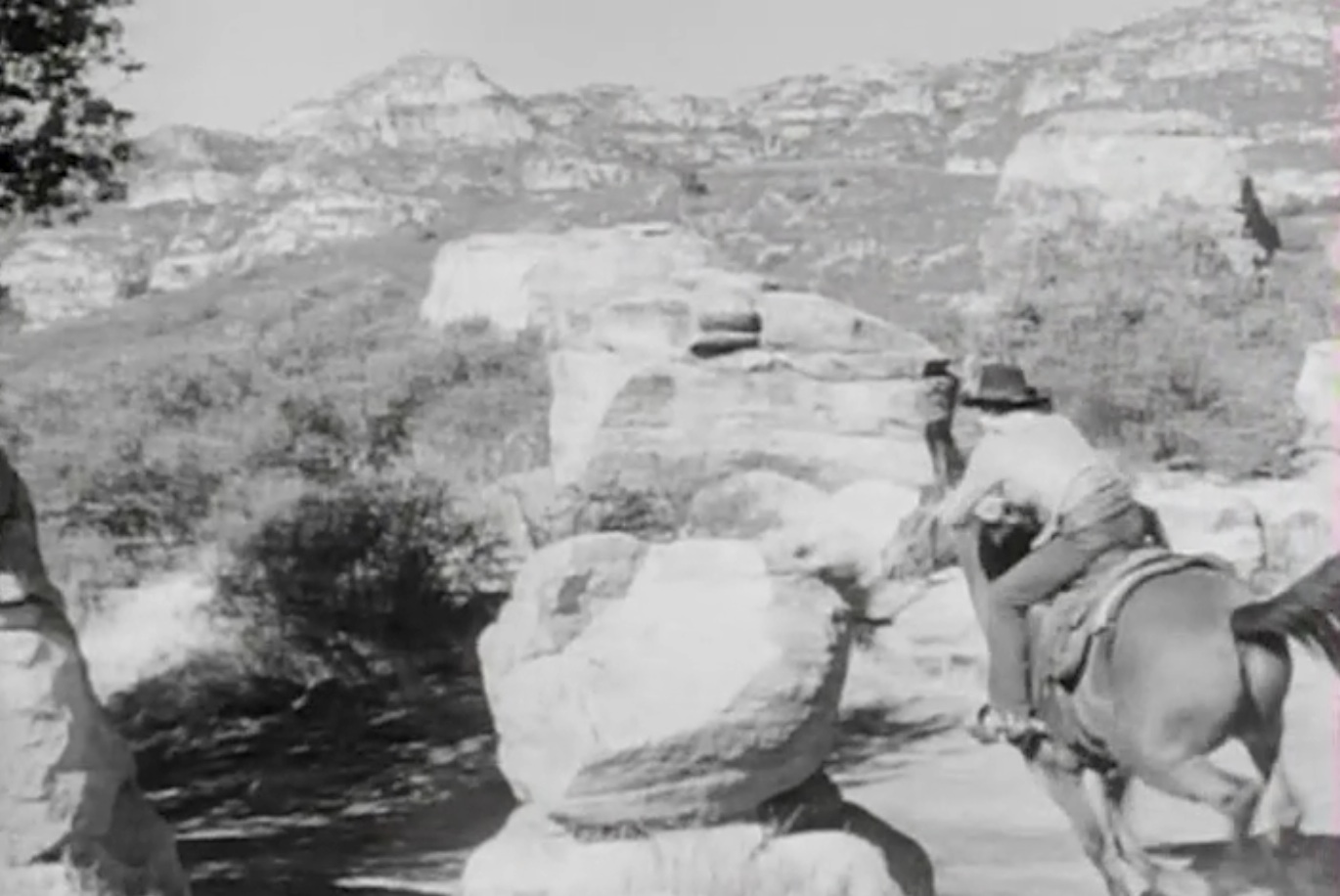
One mystery that captured my imagination in the early days of my research into the Iverson Movie Ranch (before I even considered it "research") was this unusual rock seen in the background of the "Lone Ranger" movie:

"The Lone Ranger" (filmed in 1949)

To me it looked like a large beak, and I started calling it Toucan. I always suspected the appearance might be an optical illusion, and it turns out that it is.


Maybe you can see the resemblance to a real toucan.


Of course, this is the toucan that's familiar to most Americans.

"Range Beyond the Blue" (1947)

The Toucan eventually began turning up in a few other places, and each time I got clues that helped pinpoint its location. The above shot from the Eddie Dean B-Western "Range Beyond the Blue" helped establish it as Lower Iverson, with a distinctive peak in the background that I call Pyramid Peak, which is in the Rocky Peak area. (Everyone always talks about Rocky Peak, and kind of nods in that general direction, but no one has ever said with any conviction whether that particular rocky peak is the real Rocky Peak.) Toucan is in the center of the shot, and doesn't look as "Toucan-y" as it did in the Lone Ranger movie.

This version of the "Range Beyond the Blue" photo pinpoints the Toucan, along with the quirky rock in the foreground, Freddie Frog. Freddie has an interesting history of its own, which you can read about — along with more about the Toucan — by clicking here.

"Rocky Mountain Rangers" (1940)

Another angle, this time from the Three Mesquiteers movie "Rocky Mountain Rangers." That's Toucan at the right of the photo. With each new angle it looks less like a toucan. The hills in the background are west of Chatsworth Park.

The Toucan as it appears today

Today, more than three years after first spotting it in "The Lone Ranger," I finally found Toucan. It was hiding under a tree. It was a lot smaller than I expected, and covered with green moss (or something), presumably from getting too much shade. It's located in a portion of the former Iverson that has been preserved as a park, in the area just north of Garden of the Gods, which I call the North Cluster. The above shot shows what it looks like today, from close to the same angle seen in the "Rocky Mountain Rangers" shot above.


This is the most "toucan-y" shot I can get of it today, which isn't very toucan-y. It's hard to get a good look at the rock because of the tree that surrounds it.

The Saddle, or Saddle Rock

The Toucan is right next to Saddle Rock, a feature that is on the radar of most Iverson researchers. The Toucan and the Saddle are kind of hidden under the same tree. I used to call this one the Bongos before I encountered other researchers and found out that some of these rocks, including this one, already had perfectly good names — in most cases more Western-sounding than mine, which is a good thing when naming rocks that may have appeared in hundreds of Westerns.

The Toucan — mostly covered — at left, and Saddle Rock, right

Here's a shot I took today showing the Saddle, on the right, which is a little bit hard to see because of the tree, and the Toucan, on the left, which is almost impossible to see under the tree. This shot shows their proximity to each other.