Why we love old movie locations — especially the Iverson Movie Ranch

For an introduction to this blog and to the growing interest in historic filming locations such as the Iverson Movie Ranch — the most widely filmed outdoor location in movie and TV history — please read the site's introductory post, found here.
• Your feedback is appreciated — please leave comments on any of the posts.
• To find specific rock features or look up movie titles, TV shows, actors and production people, see the "LABELS" section — the long alphabetical listing on the right side of the page, below.
• To join the MAILING LIST, send me an email at iversonfilmranch@aol.com and let me know you'd like to sign up.
• I've also begun a YouTube channel for Iverson Movie Ranch clips and other movie location videos, which you can get to by clicking here.
• Readers can email the webmaster at iversonfilmranch@aol.com
.

Showing posts with label Allan "Rocky" Lane. Show all posts

Saturday, June 14, 2014

"I am Mister Ed" — No, not me ... movie cowboy Rocky Lane; he really WAS Mister Ed, and a new book promises to tell all about it

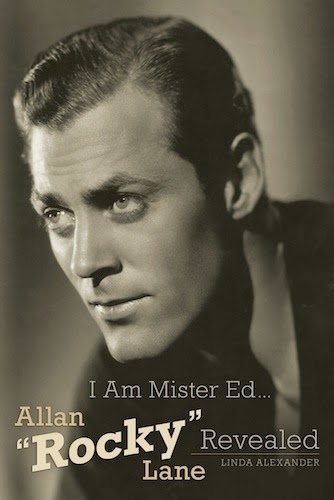
One of my favorite movie cowboys is Allan "Rocky" Lane, so I'm pretty excited that a new book is coming out about Rocky, and it looks like it'll be a good one: "I Am Mister Ed ... Allan 'Rocky' Lane Revealed," by Linda Alexander. That's the cover above, and you can go to the publisher's website by clicking here. The official release date is July 4, 2014.

Rocky Lane had a strong run in Republic B-Westerns in the 1940s and 1950s, including starring opposite child actor Bobby Blake — you probably know him as grown-up Robert Blake, aka "Baretta" — in a number of Red Ryder movies.

"Code of the Silver Sage" (1950) — Allan "Rocky" Lane on the roof 
of the Grove Relay Station at the Iverson Movie Ranch

Included in Lane's filmography is an impressive list of movies I consider Iverson masterpieces, all of them from Republic: "Sheriff of Sundown" (1944), "Stagecoach to Monterey" (1944), "Corpus Christi Bandits" (1945), "The Topeka Terror" (1945), "Santa Fe Uprising" (1946), "Rustlers of Devil's Canyon" (1947), "Marshal of Cripple Creek" (1947), "Bandits of Dark Canyon" (1947), "The Bold Frontiersman" (1948), "Carson City Raiders" (1948), "The Denver Kid" (1948), "Marshal of Amarillo" (1948), "Oklahoma Badlands" (1948), "Renegades of Sonora" (1948), "Sundown in Santa Fe" (1948), "Sheriff of Wichita" (1949), "The Wyoming Bandit" (1949), "Code of the Silver Sage" (1950), "Fort Dodge Stampede" (1951), "Frisco Tornado" (1950), "Gunmen of Abilene" (1950), "Night Riders of Montana" (1951), "Black Hills Ambush" (1952), "Desperadoes' Outpost" (1952), "Thundering Caravans" (1952), "Marshal of Cedar Rock" (1953), "Savage Frontier" (1953).

Just to be clear, when I say "Iverson masterpiece," I'm talking more about the rocks and other background features than I am about plot, character development, dialogue, acting, direction and the other traditional attributes that define a good movie. But with Rocky Lane's B-Westerns, the general rule is they're a cut above the rest in those attributes as well. Republic had the hang of it by the time Rocky mounted up, and the company seemed to put a little more effort into its Rocky Lane movies than it did the series headlined by some of its other stars. When it came to B-Westerns, Rocky was on Republic's "A-team."

"Night Riders of Montana" (1951) — Rocky Lane in action

It's an almost unbelievable body of work at one notoriously demanding filming location, the Iverson Movie Ranch, where it was always way too hot in the summer and way too cold and miserable in the winter. But the effort paid off: You almost can't go wrong with a Rocky Lane movie if you're looking for interesting Iverson location shots — not to mention good B-movie cowboy action.

Mister Ed — played by Bamboo Harvester

Of course, the thing that ended up being Rocky Lane's claim to fame, even though he toiled anonymously while the show was on TV, was his voice work on "Mister Ed." Rocky was the only person who could truly say — and DID say — "I am Mr. Ed." Never one to yakkity-yak a streak and waste your time of day, Allan "Rocky" Lane nevertheless had something to say as the famous Mr. Ed for six seasons, providing the horse's voice throughout the sitcom's run from 1961-1966, first in syndication and then for five seasons on CBS.

Allan "Rocky" Lane and Black Jack

In my opinion Allan Lane belongs in the top tier of the B-movie cowboy heroes. He had a natural ease on camera and an imposing physical presence that helped make his heroics believable, and his movies rank among the best of the B-Western genre.
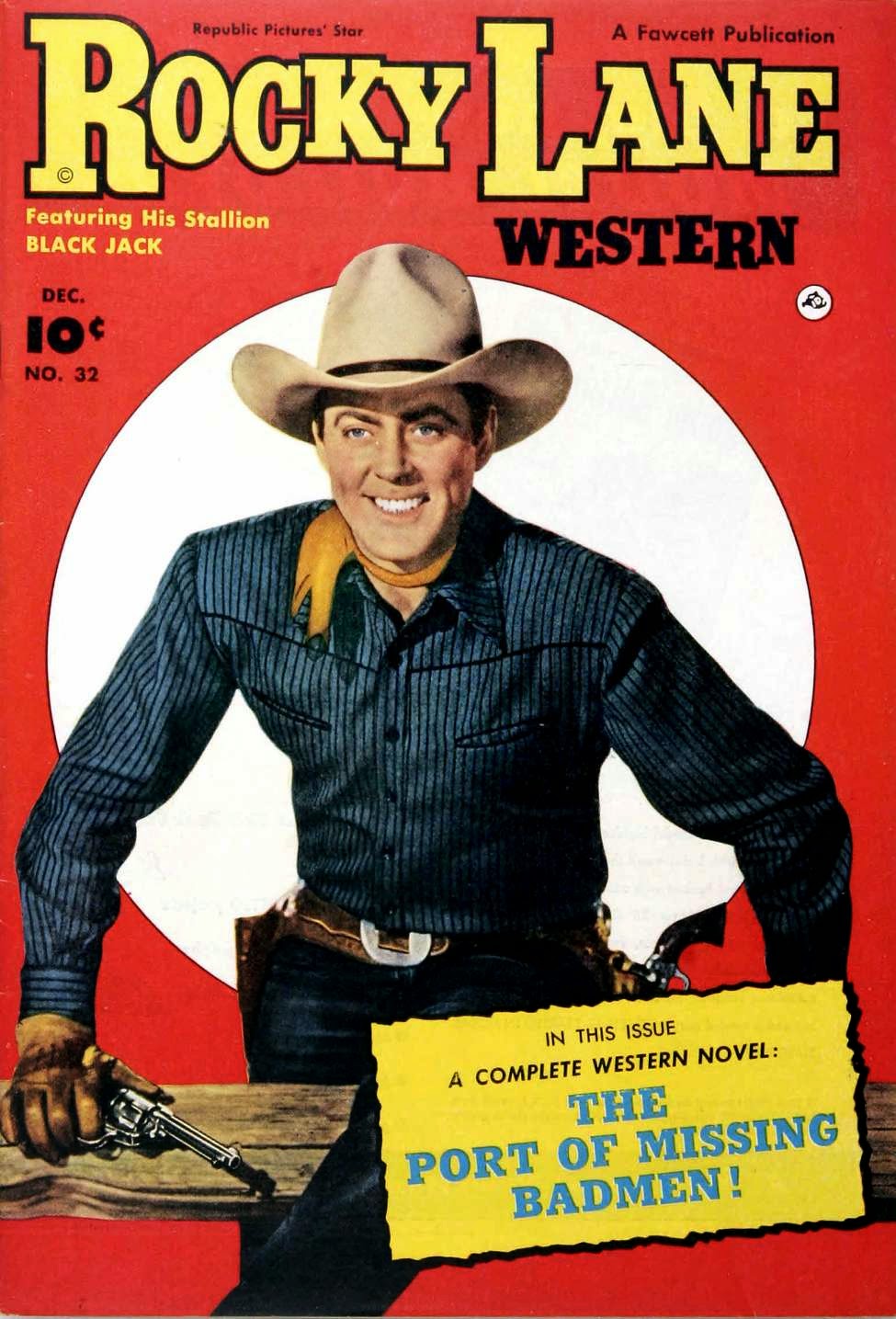
Rocky Lane comic book

The following blurb about Rocky Lane and the new book comes from the website of the publisher, BearManor Media:

Allan Lane has been a mystery almost as long as he's been seen on a movie screen. His audiences have been varied over many, many years. Some know him as the never officially recognized voice of TV's famous talking horse, Mister Ed. There are others who better remember him as Red Ryder, the comic book Western hero-come-to-life at the Saturday afternoon matinee. And even more people remember him as Rocky Lane, yet another Western good guy, and a name which became synonymous with his own. Scores of youngsters over the years in the 1940s and 1950s went to the picture show to while away a happy Saturday afternoon, watching in adolescent excitement as Red Ryder or Rocky Lane fought off all the bad guys on the Western range, always winning the day just in the nick of time. Children were Allan Lane's main audience.


Not nearly as many people are aware that Allan Lane also had an earlier movie career, before he became a fast-riding cowboy. He began in films in 1929 as a handsome, suave "drawing room" romantic type, over the years working with such leading ladies as Barbara Stanwyck, Loretta Young, and Joan Fontaine, among others. He went through many character iterations in those early days, almost to the point of having his own revolving door in and out of Hollywood with nearly as many studio contracts. And before that, even prior to his screen careers, Allan started his love/hate relationship with acting at the age of sixteen on the traveling stage, going from city to city to ultimately make his way to Broadway. Playing various sports filled in the blanks, and his pocketbook, in those days.


Allan "Rocky" Lane with Gerry Ganzer in "Powder River Rustlers" (1949)

Then there was Allan Lane, or as often Alan Lane, the businessman. He began working to help support himself and his family at the tender age of six. He became something of a vagabond, moving from place to place, family member to family member, and even sometimes living on his own in a boarding house. This is how he got his education, took care of his own needs and the needs of his family, and ultimately made his way in the world. Allan Lane owned his own successful photography advertising agency when he was only twenty-four. Years later, when his Hollywood career was fading, he went back to what he knew best ... his business background.


The man was an enigma — arguably misunderstood, but without question so much more than history has yet to show. Until now. "I Am Mister Ed ... Allan 'Rocky' Lane Revealed" finally exposes the full scope of the complicated life of Allan "Rocky" Lane.

Sunday, March 25, 2012

Allan "Rocky" Lane — a terrific cowboy actor and an Iverson Movie Ranch mainstay


A new blog post by Jerry England — longtime Iverson researcher and an expert on all things cowboy — spotlights one my favorite B-movie cowboy stars, Allan "Rocky" Lane, seen above with Black Jack.

Check out Jerry's tribute to Rocky here — Jerry has posted a bunch of great movie stills showing the actor in his element at Iverson. Also check out any Rocky Lane movies you might happen to find — he was easily one of the most natural and believable of the cowboy heroes. It helped that Rocky was a big guy, so when he beat people up, it seemed real. It was an advantage that Roy Rogers and Gene Autry never had — although that didn't keep them from beating up everyone too.


Rocky Lane spent the bulk of his movie career shooting at Iverson. I guess that sucks for him — I've always heard that everyone hated to shoot there, due to the intense heat in the summer and the cold, windy conditions in winter. But for better or worse, Rocky, who died in 1973, left behind a legacy of strong Iverson movies. The crew assembled by Republic Pictures for the Lane series raised the studio's game in just about every facet, with strong scripts, solid acting and terrific action.

Late in his career, Rocky Lane had a long-running role that made him a familiar presence while keeping him anonymous at the same time — as the voice of Mr. Ed in the TV show about everyone's favorite talking horse. Oh Wilbur!


Click here to check out Linda Alexander's great book on Rocky Lane, "I Am Mister Ed ... Allan 'Rocky' Lane Revealed," and see the comments below for some discussion of the book.

Saturday, July 3, 2010

The great Iverson cinematographers: William Bradford

born September 1905, Vermont
died May 1959, Los Angeles (age 53)

William Bradford’s career as a movie cinematographer essentially spanned 1942-1954, followed by a healthy plunge into TV. He shot B-Westerns for Republic for six years before hitching his wagon to Gene Autry when the Republic star went independent in the late 1940s. 

"Secret Service in Darkest Africa" (1943)

Early in his career, Bradford "apprenticed" at Republic, learning the ropes from legendary Iverson cinematographer Ernest Miller and graduating to director of photography on a series of labor-intensive serials such as "Secret Service in Darkest Africa."

"Annie Oakley" TV show (1954)

Bradford later became the primary DP for Gene Autry Productions, shooting the company’s entire film output over the next five years before leading the camera work on the various Autry TV productions.

The Aztec, center, and Notch Hill, filmed by William Bradford in Carson City Raiders (1948)

He distinguished himself at Republic with some standout work with cowboy stars Roy Rogers, Allan “Rocky” Lane and Wild Bill Elliott. 

All of these features remain in place today

Prime examples of Bradford's Iverson cinematography from this period include the Rocky Lane features Carson City Raiders (1948) and Stagecoach to Monterey (1944), the Roy Rogers classic Heldorado (1946), the Wild Bill Elliott Western Old Los Angeles (1948) and a pair of 1947 Red Ryder movies starring Rocky Lane, Rustlers of Devil’s Canyon and Marshal of Cripple Creek.

"The Hills of Utah" (1951) — Upper Iverson

A highlight of Bradford's film work with Gene Autry Productions is The Hills of Utah (1951). He would continue to work at Iverson on TV shows such as Range Rider, Death Valley Days, Buffalo Bill Jr., The Gene Autry Show, The Adventures of Champion, Annie Oakley and eventually Sky King.

William Bradford — Plymouth Colony governor (not the same guy)

William Bradford filmography on IMDb

Bradford — the cinematographer, not the Plymouth Colony governor — kept working his whole life, but died at the age of 53. It may be that the DPs of the era were overworked, because I've found that many of them died young.