Why we love old movie locations — especially the Iverson Movie Ranch

For an introduction to this blog and to the growing interest in historic filming locations such as the Iverson Movie Ranch — the most widely filmed outdoor location in movie and TV history — please read the site's introductory post, found here.
• Your feedback is appreciated — please leave comments on any of the posts.
• To find specific rock features or look up movie titles, TV shows, actors and production people, see the "LABELS" section — the long alphabetical listing on the right side of the page, below.
• To join the MAILING LIST, send me an email at iversonfilmranch@aol.com and let me know you'd like to sign up.
• I've also begun a YouTube channel for Iverson Movie Ranch clips and other movie location videos, which you can get to by clicking here.
• Readers can email the webmaster at iversonfilmranch@aol.com
.

Showing posts with label Tower Rock. Show all posts

Saturday, August 29, 2015

Garden of the Gods: Now featuring more naked rocks!

Tower Rock, left, and Sphinx (2015)

A welcome trend in recent months has been the move toward a more open, one might even say more "naked," Iverson Movie Ranch. The recent photo above shows the "new look" version of the Garden of the Gods fixtures Tower Rock — also known as the Pinnacle — and Sphinx.

Tower Rock and Sphinx a few years ago

Up until recently, this was the view we had of Tower Rock and Sphinx. The main difference, other than the fact that I have a better camera now than I did then, is that the tree was recently removed that was blocking the view of Tower Rock. The view of Sphinx, on the right, remains pretty much the same.

Eraserhead, before the removal of the ivy

I don't know that it's part of a conscious effort to "free the rocks," but the removal of that tree follows a couple of other similar developments, including the trimming of ivy that was covering much of "Eraserhead." In this shot from 2011, Eraserhead — one of the main boulders forming Rock Island — is barely visible behind all that ivy.

Eraserhead, minus the ivy

Eraserhead today is big, bald and proud — and free of not only the ivy, but also the grass that was encroaching on its space. Now if only it could bust out of "Rock Island Prison."

RI-2: It's here, it's clear, get used to it

Some of the other Rock Island mainstays — notably RI-2, positioned to the left of Eraserhead in these shots — are also waving their freak flags a little higher these days. Not that long ago, RI-2 was all but impossible to see.

"Overland Stage Raiders" (1938): Rock Island by the numbers

I did an in-depth blog post about Rock Island back in May, and encourage you to click here to check out that post if you're interested in learning more about this fascinating cluster of famous movie rocks.

Mushroom Rock in recent years: It's in there somewhere

Another beneficiary of the trend toward leaner, cleaner foliage around the ranch has been Mushroom Rock. Movie fans have been deprived of the sight of its defining crown for decades, with much of the rock hidden behind foliage (not to mention garbage bins and other junk).

Mushroom Rock in 2015

For the first time in decades, the crown that defined Mushroom Rock in the movies again saw the light of day this year. Unfortunately, the garbage bins and piles of crappola remain in place. I talked more about the emergence of Mushroom Rock in a blog item back in April, which you can read by clicking here.

One benefit of the new, more visible, Garden of the Gods is that it has "liberated" a piece of the Iverson Movie Ranch legacy: the "Garden" sign. In the past it was difficult to get a good look at the inscription because it was concealed beneath the tree. This recent shot of the sign was taken by film historian Jerry Condit.

Not much is known about the sign, but this shot pinpoints where it is located. It is generally assumed that there's also an "of the Gods" piece of the stone engraving somewhere, but no such piece has ever turned up.

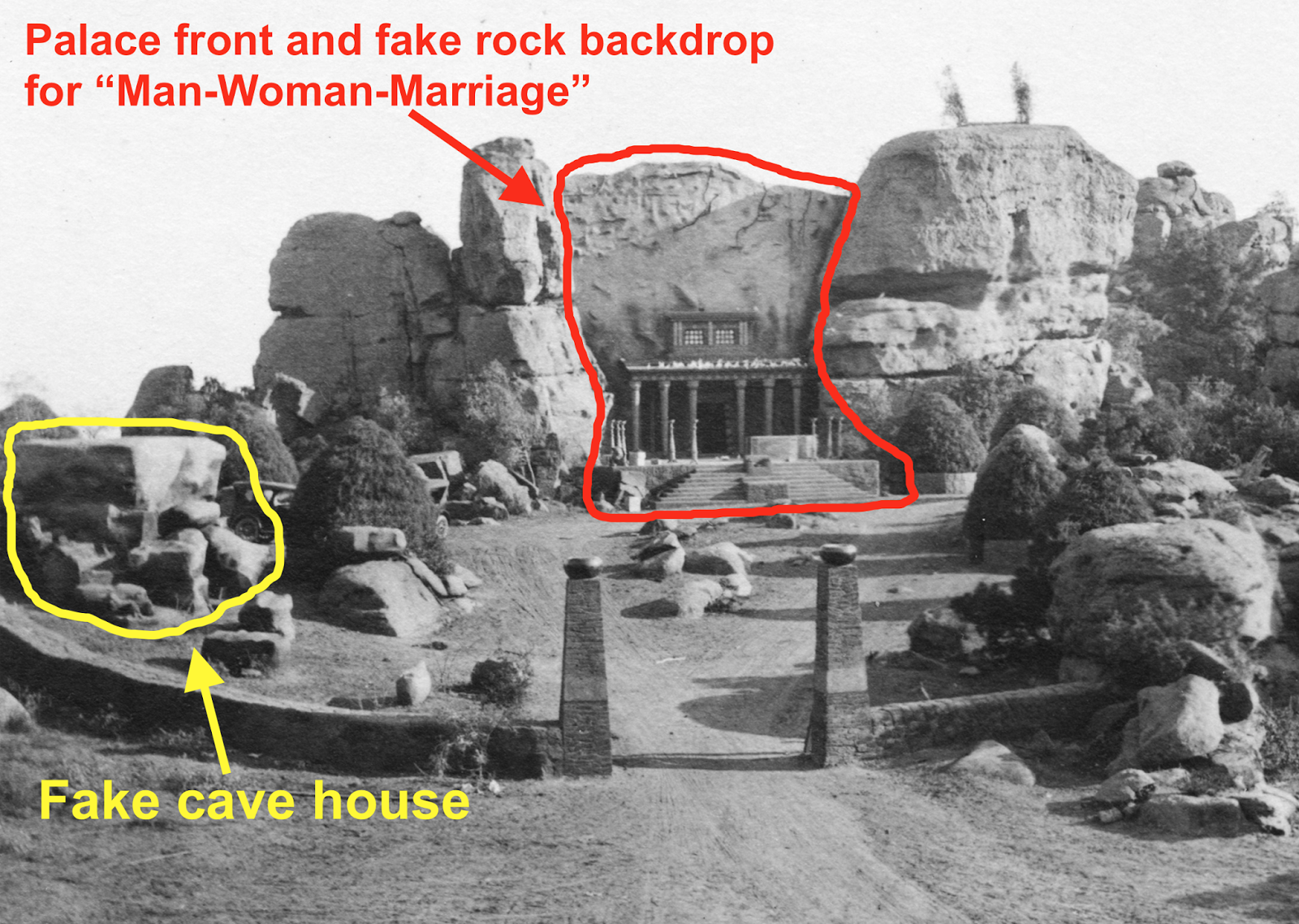
Behind-the-scenes shot from production on "Man-Woman-Marriage" in 1920

I believe it's possible to make out the same rock 95 years ago in this production shot from the 1920 filming of the silent movie "Man-Woman-Marriage," released in early 1921. It is unlikely that the inscription was already in place that long ago, although even with an unusually sharp photo such as this, there's no way to tell from this distance.

This slightly zoomed-in version of the "Man-Woman-Marriage" production shot highlights what I believe to be the same rock that now displays the "Garden" inscription. It appears to me that the small rocks just to the right of the "Garden" rock were covered up by the palace set. To see additional photos from the filming of the battle scene for "Man-Woman-Marriage," please click here.

I first published versions of the "Man-Woman-Marriage" photo as part of a recent post about the fake cave house, which is seen in this version of the shot. For the rundown on the cave house, which is featured in the Buster Keaton movie "Three Ages," please click here.

June 2015: The tree below Tower Rock, weeks before being cut down

Of course, there's a downside to the tree removal, and it's kind of obvious: the loss of the tree. As luck would have it, I happened to take pictures of that same tree on a visit to Garden of the Gods back in June. It seems obvious now that the tree was not healthy, which explains why it had to go.

Was it a famous movie tree? It does appear that the tree was around when filming was taking place in the area, but I have yet to find an example of an identifiable sighting of the tree in any movie or TV show.

Here's a shot of the same tree that I took back in February, when the tree was already looking pretty unhealthy. I took this shot to capture the group of rocks in the foreground, situated just east of where the tree was.

"Wanted: Dead or Alive" (1958): The "Easy Chair"

I gave the group of rocks the nickname the "Easy Chair" because of this shot from the TV show "Wanted: Dead or Alive" in which a sentry relaxes in the crack between two of the rocks while on duty.

"Richard the Lion-Hearted" (1923)

These same rocks — the "Easy Chair," if you will — came up in a recent post about the silent movie "Richard the Lion-Hearted," where I pointed out that the group of rocks could be seen both in recent shots and in shots of the movie's castle set from 1923. Please click here if you would like to read that post in its entirety.

Saturday, August 22, 2015

"Richard the Lion-Hearted": A silent movie-era Medieval castle in Garden of the Gods

"Richard the Lion-Hearted" (1923)

A number of early filmmakers were inspired to build fake castles and palaces in exactly the same spot — spanning the two most prominent sandstone behemoths in the Iverson Movie Ranch's Garden of the Gods. The above example is a production shot for "Richard the Lion-Hearted," a rarely seen silent picture starring Wallace Beery.

Most of the castle in the photo consists of a painting on glass, superimposed over a partial version of a castle that was built on the site, in the space between Tower Rock on the left and Sphinx on the right. The wandering yellow line in this version of the photo traces the approximate division between the two parts of the composite photo.

Fake castle front, built for "Richard the Lion-Hearted"

This production shot depicts only the portion of the castle that was built in Garden of the Gods, along with a full view of the sandstone boulders framing the construction. You may also notice a few crew members working on a camera tower in front of the castle gate.

The two main rock features are highlighted here. Tower Rock has had multiple names, with "the Pinnacle" being an early reference apparently used by the Iverson family, while "Tower Rock" is a name the family used in the movie ranch's latter days. Both rocks have also been called "Indian Head" in various circumstances, and the Sphinx has also been referred to as "Eagle Beak."

"Dallas" (Warner Bros., 1950)

These giant boulders have been featured in countless movies and TV shows spanning roughly the past 100 years. The above photo is a nice color example of the rocks as they appear in the Gary Cooper Western "Dallas," filmed from approximately the same angle seen in the "Richard the Lion-Hearted" photo.

"The Lone Ranger" TV series (1949)

Here's another example, from the TV series "The Lone Ranger," with the two main rocks shot from a different angle. From this angle I think we get a pretty good idea of why the giant boulder on the right — which is closer to the center in this shot — is called "The Sphinx."

Garden of the Gods, on a visit to the site in 2015

Here's a shot of the same area seen in the "Richard the Lion-Hearted" photo, taken on a recent visit to the site. While Tower Rock and Sphinx are instantly recognizable, even some of the smaller rocks, seemingly strewn about on the ground, can be matched up with the movie shots.

Notice the distinctive group of small rocks highlighted here, on the ground below Tower Rock.

This is that same group of rocks more than 90 years earlier, in the "Richard the Lion-Hearted" photo.

A number of the other rocks in the two photos also match. Here I've highlighted a couple of rocks in the "Richard the Lion-Hearted" production shot from 1923.

Here are those same rocks as they appear today, although they're much closer here and seen from a slightly different angle.

Taking another look at the "Richard the Lion-Hearted" composite photo, you may notice that the two elements of the castle — the glass painting and the location shot — are not perfectly aligned. That's because the photo is taken by a still photographer while the glass is being held in place for filming. It's not exactly the same view seen by the movie camera, where the two parts would be lined up more accurately.

This version of the "Richard the Lion-Hearted" shot reveals some interesting context. We can see part of the frame on the glass shot as it is being held in place to be filmed against the backdrop of the actual location. This photo comes from the book "The Invisible Art: The Legends of Movie Matte Painting" by Mark Cotta Vaz and Craig Barron, possibly the only authoritative work done to date — and easily the best — on matte shots in the movies.

Readers who have been following recent posts about the Buster Keaton movie "Three Ages" and the fake cave house may have already spotted this, but the cave house appears again in this shot for "Richard the Lion-Hearted" — not really a surprise, as the two movies were produced the same year, 1923, and filmed in the same area.

"Three Ages" (1923): Fake cave house

This shot from "Three Ages" shows the cave house in use by a cave family. The "stone" staircase seen at the left here is visible toward the front of the shot in the castle photo above this one. The cave house is known to have stood near Garden of the Gods at least from 1920-1926, and may date as far back as the 1910s. You can read more about this fake cave house by clicking here.

Set for battle scene in "Man-Woman-Marriage" — filmed in 1920, released in 1921

We've recently explored another example of silent movie-era construction in the same spot where the castle was built for "Richard the Lion-Hearted." For "Man-Woman-Marriage," filmed three years earlier, a palace front was built, along with a fake rock backdrop spanning the gap between Tower Rock (aka the Pinnacle) and the Sphinx. Please click here to read the recent post about the 1920 shoot for "Man-Woman-Marriage."


This blog post is part of a series of posts exploring silent movies filmed on the Iverson Movie Ranch. We have previously reported on a number of the Iverson silent films, and you can read those posts by clicking on the links below:

• Please click here to read a recent post about a fake cave house that stood near Garden of the Gods for several years in the 1920s — and possibly as far back as the 1910s — which had a prominent role in the 1923 Buster Keaton silent feature "Three Ages."

• Here's a post about a battle sequence filmed near Garden of the Gods for the 1921 release "Man-Woman-Marriage" — a scene that was billed at the time as "so stupendous that it amazed even the film colony of Los Angeles."

This blog post talks a little bit about the iconic scene used in the label above, in which Noah's Ark is "beached" on top of the sandstone giants of Garden of the Gods. The shot comes from the 1928 silent feature "Noah's Ark," directed by Michael Curtiz, who later directed "Casablanca" and who brought crews to the Iverson Movie Ranch on a number of occasions. 

• Buster Keaton's 1923 comedy feature "Three Ages" may be the best-known of the silent-era Iverson shoots, and this post from August 2014 explores a rarely discussed set for the movie: an "armory" controlled by Buster's caveman character, built high atop Rock Island in the Iverson Gorge.

Click here to see some terrific behind-the-scenes photos from the 1925 silent feature "Ben-Hur: A Tale of the Christ," provided by Jill Bergstrom, the granddaughter of the great Iverson cinematographer George B. Meehan Jr., who was part of the camera crew on "Ben-Hur." (Note that most of the material in this post is non-Iverson, even though parts of "Ben-Hur" were filmed on the location ranch.)

Saturday, May 31, 2014

The Sentries — Guardians of the Gods


"You Can't Fight City Hall," an episode of "The Life and Legend of Wyatt Earp"

Much of the action in the "Wyatt Earp" episode "You Can't Fight City Hall," which premiered Oct. 20, 1959, takes place on and around the trail leading up into the Garden of the Gods. The shot seen above includes a portion of the trail, in the foreground, along with a number of significant rocks, which I'll highlight below.

This is the same shot from the "Wyatt Earp" episode, with some of the rock features noted.

If you're an Iverson aficionado, you may have already spotted Tower Rock, sometimes called Indian Head, as one of the Three Kings — the one on the right in these shots. The King on the left also has its own identity, as the Pharaoh. I'll discuss the Pharaoh more in an upcoming post.

Virtually all of the rocks seen above, along with the Garden of the Gods Trail itself, remain in place today, thanks to the preservation efforts of a number of organizations that worked together to get Garden of the Gods preserved as a park. The plaque seen above was placed on Hawk Rock just in the past few years to commemorate the filming location, and can be seen as you hike up toward Garden of the Gods.

Garden of the Gods Trail as it appears in recent years, 
including Hawk Rock and the Sentries

The above shot was taken on one of my first visits to the Iverson Movie Ranch, back in 2008, and shows the same trail rising up into Garden of the Gods that's seen in the Wyatt Earp episode. At the left is Hawk Rock, with this shot taken before the plaque was in place. Also in the shot are the Sentries, which keep a vigil on both sides of the trail. I'll highlight them in the next shot.

This shot should help you pinpoint the Sentries, and match them up with their appearance above in the "Wyatt Earp" episode. Hawk Rock was featured regularly in the old movies and early TV shows filmed at Iverson, but the Sentries hardly got any screen time. Even so, they stand tall as guardians of the trail in modern times, and everyone who hikes up into Garden of the Gods from that direction passes between them. I presume the main reason the Sentries and the trail area didn't get filmed much was logistical: The trail is on an incline and doesn't provide a lot of room for movie equipment.

Here's a more recent shot of Hawk Rock showing where the plaque can be found. It's just inside the gate to Garden of the Gods, off Redmesa Road.

Monday, March 12, 2012

Roger Corman's Iverson Movies, Part 2:
The Saga of the Viking Women and Their Voyage
to the Waters of the Great Sea Serpent

I posted recently about Roger Corman's first movie as a director, "Five Guns West," which included an extensive shoot on the Iverson Movie Ranch. You can see that post here.

Roger Corman

Corman has returned a number of times to the Iverson Ranch since that first effort. He directed four Westerns early in his career, all released in 1955 and 1956 — with "Apache Woman" and "The Oklahoma Woman" also filmed on the ranch. Corman soon transitioned to the more campy fare that has remained his calling card, but even when he's not shooting Westerns, he finds interesting ways to use Iverson's rocky terrain.

"The Saga of the Viking Women and Their Voyage to the Waters of the Great Sea Serpent" (1957)

Corman filmed extensively at Iverson for one of his earliest cult films, "The Saga of the Viking Women and Their Voyage to the Waters of the Great Sea Serpent." That's the complete title, but it's also known by shorter variations, including "Viking Women and the Sea Serpent," "The Saga of the Viking" and "Undersea Monster."

If you're eager to get a good look at a sea serpent, don't hold your breath — there's not much here in the way of budget-busting special effects. But the Viking women content is good — and the Iverson content is outstanding.

Overall, the movie is good, campy fun. In the above shot, filmed in the Iverson Gorge, one of Iverson's most familiar landmarks, Nyoka Cliff, can be seen in the background as the Viking women and their boyfriends do a little exploring. Also visible in the background is a glimpse of the western San Fernando Valley.

As he always seems to do when he shoots at Iverson, Corman again comes up with some unusual shots of the movie ranch. Here's a double "burning at the stake" scene shot in Garden of the Gods.

This shot from a few moments earlier gives a better idea of the location, which is behind (or south of) Sphinx, another of Iverson's famous landmarks. The large rock that takes up most of the frame is Sphinx, and Tower Rock, also called Indian Head, appears in the top right corner.

The gang looks on during the stake burning from some of the nearby rocks in Garden of the Gods. For an update on the site where this shot takes place, please see this later blog entry.

In another fiery sequence, a crowd gathers on the summit of Nyoka Cliff, where the "sink" at the top of the cliff serves as a firepit for a cremation ceremony.

"The Fighting Seabees" (1944): John Wayne & Co. on the Nyoka Summit

John Wayne and his men took shelter in the same pit in "The Fighting Seabees."

"Viking Women and the Sea Serpent": The Upper Gorge Plateau

Here's an interesting shot from a location standpoint, because it features the rocky slope below Iverson's elusive Bulldog Bluff. Bulldog Bluff was displaced years ago by the Cal West Townhomes condo community, making it a challenge to pinpoint its location — and shots like this tend to help.

Bulldog Bluff was seen frequently in the many B-Westerns shot at Iverson, but it was usually filmed from higher up. This shot shows a rocky slope that helped hide Bulldog Bluff from below. The bluff itself was above and to the right of this slope, and was either sandy or grassy, depending on the season, making it a good spot for the "bulldog" move — the takedown that would end a chase, typically involving a rider jumping from his horse at full gallop and "bulldogging," or tackling, the other rider, launching him off his horse and bringing them both crashing to the ground. Then they would typically have a fistfight in the grass or sand near the base of Bulldog Bluff — with the good guy always winning, naturally.

Composite shot from "Belle Starr" (1941): Bulldog Bluff

This composite shot from the 1941 Gene Tierney movie "Belle Starr" adds some context, and helps place the location of Bulldog Bluff, because it shows another angle on the rocky slope along with a section of the bluff, identifiable as a grassy area above the slope.

Juxtaposition of Bulldog Bluff and the rocky slope

The best we can do based on this shot is approximate the position of Bulldog Bluff, which is only partially visible. The bluff does not exist in the contemporary landscape — condominiums have replaced many of the features seen here, and the grading that was done during construction of those condos dramatically altered the terrain.


Movie location historian Jerry England — the "drifting cowboy" — has a blog entry about Bulldog Bluff, which you can find by clicking here.

Stepping away momentarily from Iverson, "Viking Women" includes a few shots at Bronson Canyon in the Hollywood Hills, including this one showing the entrance to Bronson Cave. The cave later became famous as the Bat Cave in the "Batman" TV series of the 1960s.

"Viking Women" shot extensively in Iverson's Upper Gorge and Garden of the Gods. This shot in the Gorge is set against the background of The Wall — a key rock feature of the Gorge during the filming era, and one that, sadly, was later destroyed to make way for condos.

Corman's "Viking Women" movie became something of a cultural phenomenon — even getting the "Mystery Science Theater 3000" treatment. I have a feeling Corman approves!

"Viking Women and the Sea Serpent" was even made into a swimsuit — Yowsah!

Roger Corman's "Teenage Caveman" (1958): Upper Iverson

Corman was back at Iverson the following year, filming "Teenage Caveman" — another movie that has achieved cult status. In the scene above, the title "teenager" — future "Man From U.N.C.L.E." Robert Vaughn, who was about 24 at the time — appears on the Upper Iverson's South Rim along with Darah Marshall.

Lobby card for "Teenage Caveman" featuring Darah Marshall as "the Blond Maiden"

"Teenage Caveman" provides a rare look at the lovely Darah — misidentified as "Darrah" on promotional material for the movie — who followed up her "Teenage Caveman" role with an all-too-brief career in TV. The movie also offers something that appeals to the intellect: It plays out as a literal adaptation of Plato's Allegory of the Cave, one of the essentials of ancient literature.

"Viking Women" and "Teenage Caveman" complement each other nicely, offering a summary of Corman's late 1950s Iverson Movie Ranch expeditions. Conveniently, someone else thought to link the two movies too, as they've been combined into a DVD set. Below you'll find a link to the budget-priced DVD set on Amazon.