Why we love old movie locations — especially the Iverson Movie Ranch

For an introduction to this blog and to the growing interest in historic filming locations such as the Iverson Movie Ranch — the most widely filmed outdoor location in movie and TV history — please read the site's introductory post, found here.
• Your feedback is appreciated — please leave comments on any of the posts.
• To find specific rock features or look up movie titles, TV shows, actors and production people, see the "LABELS" section — the long alphabetical listing on the right side of the page, below.
• To join the MAILING LIST, send me an email at iversonfilmranch@aol.com and let me know you'd like to sign up.
• I've also begun a YouTube channel for Iverson Movie Ranch clips and other movie location videos, which you can get to by clicking here.
• Readers can email the webmaster at iversonfilmranch@aol.com
.

Showing posts with label Come On Cowboys. Show all posts

Friday, October 24, 2014

It's Now or Never: Time to find out whether Elvis Presley ever worked the Iverson Movie Ranch

The King of Rock 'n' Roll — in costume for "Harum Scarum" (1965)

I've been trying for some time now to nail down a definitive answer to the question of whether Elvis Presley ever appeared in movie footage shot at the Iverson Movie Ranch. That answer was surprisingly elusive, but I believe I finally have it — and the answer is ... Yes!

It happened in the 1965 MGM musical "Harum Scarum." It's widely known that a number of the outdoor scenes for the movie were shot at Iverson, but I had to put together a few separate pieces of evidence to determine whether Elvis himself took part in filming at the movie ranch. Finally, I can confirm that Elvis not only showed up at Iverson, but also ran around among its famous rocks.

"Harum Scarum" — Is that Elvis running around in the North Cluster?

This shot features Elvis' character, at the center of the frame, running near an Iverson rock that can be recognized from its appearances in other movies, as noted below. The shot does not provide a clear look at Elvis, but it's about as good as it gets as far as actually seeing the King at Iverson in the movie. (You may want to click on the photo to see a larger version.)

The rock seen just to the right of Elvis in the shot is one that appears frequently in old Westerns, which I call E.T. I've been aware of this shot for a few years, but I didn't consider it proof that Elvis was at Iverson because it could be that a stand-in was used in the shot. In those days big stars were routinely spared from having to do actual location work for long shots, especially in a harsh locale such as the Iverson Ranch. Until recently I remained skeptical about the actual presence of Elvis — Then I saw the promo still.

Promo still for "Harum Scarum" (1965) — shot on the Lower Iverson 

The promotional still, from the collection of film historian Jerry England, makes it clear that Elvis was indeed at Iverson. Whether the action here was a special setup for the photo or was a part of the actual filming doesn't matter. Clearly, the actors are all in costume for the movie, positioned in their same spots from the movie, and they're running through the same sequence that appears in the movie. Add it all up, and it means that's indeed Elvis in the scene in the movie.

The action in both the promo still and the movie scene takes place in a section of the former location ranch just north of Garden of the Gods known as the North Cluster. In this version of the shot I've identified the rock I call E.T.

"Come On, Cowboys" (1937)

This shot from the Three Mesquiteers movie "Come On, Cowboys" might help explain the origin of the name "E.T." The rock appears from a different angle here than in the Elvis movie, but is once again at the right of the frame.

This shot pinpoints E.T., as I want to make sure readers are certain which rock I'm talking about.

"E.T. the Extra-Terrestrial" (1982)

I find the shape of the rock to be strongly reminiscent of the title character in the Steven Spielberg movie. This shot also features a young Drew Barrymore.

"Stagecoach" (1939) — the stage arrives at Apache Wells

E.T. — the rock — appears in a minor role during an iconic sequence in one of the most high-profile movies filmed at Iverson, John Ford's Great American Western, "Stagecoach." The sequence in which the stagecoach arrives at the Apache Wells outpost, with the Garden of the Gods rock behemoths in the background, also includes the much smaller E.T. — although it would be easy to miss.

This version of the "Stagecoach" shot points out E.T. As I mentioned, it would be easy to miss the rock in this shot if you didn't know exactly where to look.

Here's a more widely recognized shot from the sequence, in which the giant Garden of the Gods towers are prominently featured in the background. From this angle, E.T. is blocked out by the wall and cannot be seen.

The best shot of E.T. in "Stagecoach" is probably this one, which appears as the stage pulls out of Apache Wells.

Pointing out E.T. one final time. In these shots we can begin to see that the rock was sort of out by itself, in a flat area where it was distanced from the other rocks. Its solitude and distance ultimately proved fatal, as E.T. was removed when the flat area was prepped for condo development in the 1980s.

"Harum Scarum": Is that Elvis, or a stand-in?

Getting back to "Harum Scarum," I wanted to point out a couple of other shots. The above scene is filmed at Iverson, with Cactus Hill in the background. But as with some of the other shots, it's unclear whether it's Elvis in the scene. His character is riding the second horse in the group, but here again, it could be a stand-in — and in this sequence, where only distant shots are included, my hunch is that this is not Elvis.

The situation is similar with this sequence of shots taken in the Iverson Gorge. Elvis is again supposedly a part of the group of riders, but it's impossible to be sure in the long shots. This shot includes the rock feature Bald Knob, directly above the riders. I talked about this shoot in a post about Bald Knob a couple of months back, which you can see by clicking here.


Below are some links to DVD versions of "Harum Scarum" and "Stagecoach," along with a link to a streaming version of "Come On, Cowboys," for those who are interested in seeing more of the Iverson Movie Ranch in these movies — or maybe just seeing the movies themselves.


Thursday, September 30, 2010

The great Iverson cinematographers: Ernest Miller


Ernest Miller: born March 1885, Pasadena, Calif.
— died April 1957, Los Angeles (age 72)

"Little Big Horn" (Lippert, 1951) — Ernest Miller, director of photography

Oscar-nominated cinematographer Ernest Miller, probably the most prolific DP in the history of the Iverson Movie Ranch, showed a love for the location ranch’s dramatic rocks during a career that included stays at Mascot, Republic, PRC, Western Adventure and eventually Monogram and some of its smaller production house partners.

"Made in Heaven" (silent film, 1921) — Ernest Miller, DP (not an Iverson production)

Miller hailed from Pasadena in the Los Angeles area, and got an early start in the movie business — going all the way back to "Made in Heaven" in 1921, his first credit as cinematographer. He was in his mid-40s by the end of the silent film era and had already amassed a lengthy resume as a DP. 

He hit the ground running in the 1930s, working steadily at Mascot Pictures during the first half of the decade before joining Republic in 1935 as part of the newly formed company’s acquisition of Mascot. He would remain at Republic for the next ten years before jumping to PRC soon after World War II.

Early examples of Miller’s career-long love affair with the Iverson Movie Ranch include the Mascot serials "Fighting With Kit Carson" (1933), "The Law of the Wild" (1934, starring Rin Tin Tin Jr.) and Gene Autry’s breakthrough production "The Phantom Empire" (1935). While at Mascot, where dual DP credits were the norm, he shared cinematography duties on a long list of projects with either Jack Marta or William Nobles, both of whom would make the migration to Republic along with Miller and would continue to shoot extensively at Iverson. 

During his first year at Republic, Miller was often again paired with Marta. Presumably one of the two DPs handled the studio work while the other was sent on location — but which one did which? Sadly, little is known about the working arrangements in those days, but my suspicion is that Miller, who was the veteran DP, would have received the more desirable studio assignments at that point in his career, while Marta — Miller's understudy, in a sense — would have had to suffer the hardships of Iverson, with its weather extremes and general notoriety as a harsh environs for film crews.


Miller was not yet a B-Western specialist when he arrived at Republic in 1935, although he did work on projects starring up-and-coming singing cowboy Gene Autry a few times early on. It was Mascot stablemate William Nobles, who had been shooting B-Westerns steadily since the silent era, who first established himself as the new company’s go-to B-Western shooter, landing the bulk of the prestigious shoots with Autry and John Wayne in those first few years at Republic. Miller typically handled more indoor-oriented fare at that point, and only later proved himself to be a powerhouse in B-Westerns, in outdoor adventure shoots ... and in particular, at Iverson.

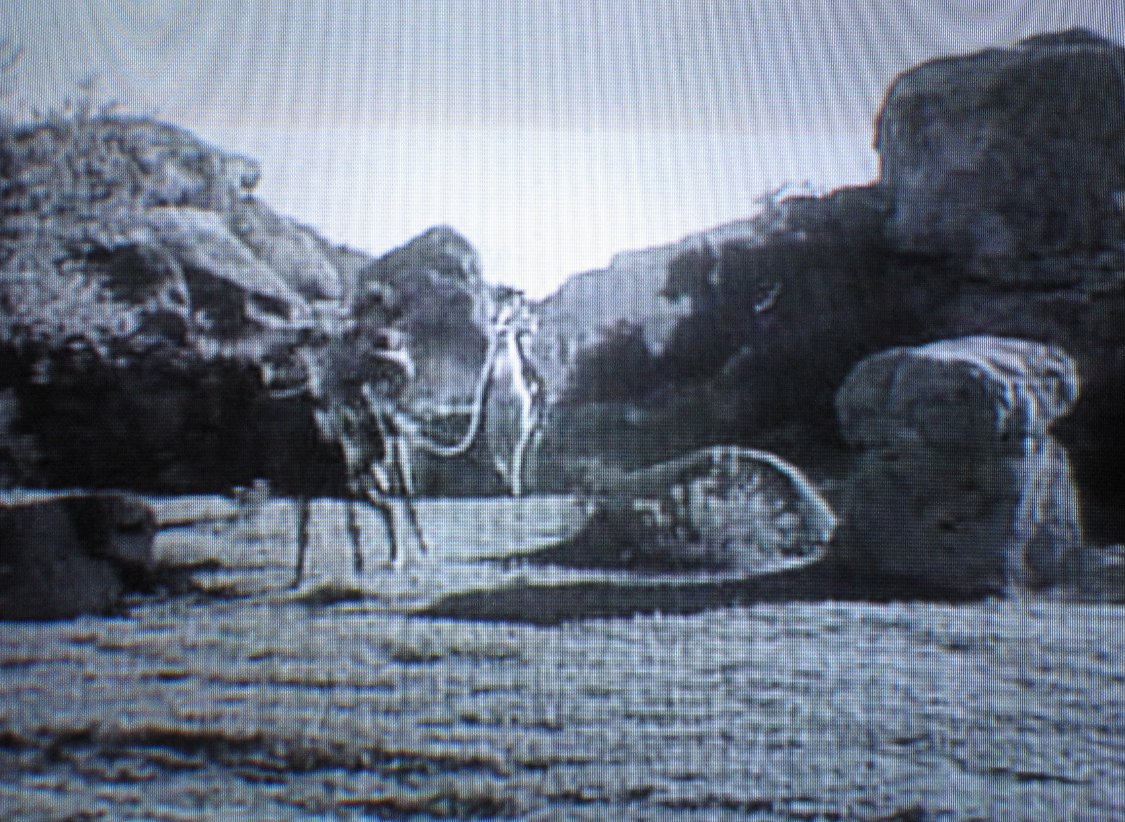
"Come On, Cowboys" (1937) — Grumpy Candelabra?

He had a breakthrough in 1937, shooting an Iverson rock spectacle in "Come On, Cowboys," a Three Mesquiteers feature. In the above screen shot from the movie, Bill Rock, a relatively common feature in productions shot at Iverson, is partially visible at top left. Far less common is the rock at center-right, which looks like a grumpy candelabra that might be at home in Beauty and the Beast.


"Army Girl" (1938) — the adobe fort at the western end of Iverson's Sheep Flats

The following year, 1938, Miller shot Republic's "Army Girl" largely at Iverson, along with co-director of photography Harry J. Wild. The two men shared an Academy Award nomination for their work on the film.


"Army Girl" was followed by a period in which Miller's workload at Republic steadily increased, and by the early 1940s he was working regularly with most of the company’s cowboy stars, including Roy Rogers, Gene Autry, Sunset Carson, Don “Red” Barry and Bob Steele. 

"Bells of Rosarita" (Roy Rogers, 1945) — Iverson's Eucalyptus Grove

Miller's cinematography on Republic's "Bells of Rosarita" produced a series of memorable views of the movie ranch, with the Roy Rogers B-Western winding up as one of the strongest entries in Miller's Iverson portfolio. Meanwhile, Miller also continued to shoot much of Republic’s long-running Three Mesquiteers series.

Miller's special flair for showcasing Iverson can be seen as well in a few Allan “Rocky” Lane features from the late 1940s — "The Bold Frontiersman," released in 1948, being a prime example.

"The Hawk of Powder River" (1948) — the rock is Chili Pepper

Miller began working in the mid-1940s with Producers Releasing Corp., with the period from 1947-1951 yielding a wealth of Iverson-rich spectacles in his work with first PRC and then PRC spinoff Western Adventure. Both companies specialized in cheap B-Westerns shot in about a week, and both took advantage of Miller’s eye for Iverson. During this period he filmed a steady string of Eddie Dean and Lash LaRue pictures — "Dead Man’s Gold" (Lash LaRue, Western Adventure, 1948), "The Hawk of Powder River" (Eddie Dean, PRC, 1948), "Check Your Guns" (Eddie Dean, PRC, 1948) and "Outlaw Country" (Lash LaRue, Western Adventure, 1949) being just a few of the many highlights from a location standpoint.

"The Daltons' Women" (Western Adventure Productions, 1950)

During the short lifespan of Western Adventure from 1948-1952, Miller shot 11 of the company’s 12 movies — all of them at Iverson. At the same time he kept up a busy work schedule at Lippert Pictures, Monogram, Republic and others.


"Little Big Horn" (1951)

Miller went on to work with tiny outfit Lippert Pictures for a couple of years, from 1949-1951, shooting Don “Red” Barry Westerns — something he had also done earlier in his career at Republic — and filming a batch of Jimmy Ellison Westerns, which again involved plenty of work at Iverson. It was at Lippert that he shot what might be considered the crowning achievement of his Iverson work, the Lloyd Bridges-John Ireland retelling of Custer's Last Stand, "Little Big Horn" (1951) — adding an impressive coda to a film career filled with Iverson gems.

Whip Wilson's last starring role (1952)

Miller continued to kick around a few minor production houses in the early ‘50s, mainly companies with distribution and production partnerships with Monogram, such as Silvermine Productions, where among other things he shot the last of the Whip Wilson B-Westerns in 1951 and 1952, and Westwood Productions, where he was part of the last gasp of the B-Western as a viable theatrical format, shooting several Wild Bill Elliott features — again reunited with one of his occasional Republic subjects — in 1953 and 1954.

"Gunsmoke" — 11 episodes shot by Ernest Miller, from 1955-1956

Miller eventually made a mark in the early television Westerns, notably shooting episodes of "Hopalong Cassidy" and "Gunsmoke" before calling it a career in 1956. He died the following year in Los Angeles at age 72.

Ernest Miller left his mark on Iverson, on B-Westerns and on film as a whole. Among other things, he left behind one of the longest filmographies I’ve seen for a cinematographer, with 348 movie and TV series credits as DP. But beyond the numbers, his camera work, his appreciation of the rocks, his eye for interesting angles and his intuitive sense of the drama inherent in the Iverson landscape have never been equaled.