Why we love old movie locations — especially the Iverson Movie Ranch

For an introduction to this blog and to the growing interest in historic filming locations such as the Iverson Movie Ranch — the most widely filmed outdoor location in movie and TV history — please read the site's introductory post, found here.
• Your feedback is appreciated — please leave comments on any of the posts.
• To find specific rock features or look up movie titles, TV shows, actors and production people, see the "LABELS" section — the long alphabetical listing on the right side of the page, below.
• To join the MAILING LIST, send me an email at iversonfilmranch@aol.com and let me know you'd like to sign up.
• I've also begun a YouTube channel for Iverson Movie Ranch clips and other movie location videos, which you can get to by clicking here.
• Readers can email the webmaster at iversonfilmranch@aol.com
.

Tuesday, January 10, 2012

"Platypus Shack" and "Platypus Farm" — an oddity of the old Upper Iverson

This is a screen shot from the 1949 Paramount Western "El Paso," starring John Payne, Sterling Hayden, Gail Russell and Gabby Hayes, directed by Lewis R. Foster with cinematography by frequent Iverson shooter Ellis W. Carter. It shows a farm set I call "Platypus Farm," after the rock near the left of the shot, Platypus. (I call the rock in the center of the shot "Fish Head.") The farm set was probably built specifically for "El Paso," as the full set has not been spotted anywhere else. It has been suggested that the main house, on the right, may have been a false front or a mobile structure. Either way, by the end of the movie, it's gone.


The main building may have been destroyed in the production, as the house burns to the ground later in the movie. The above shot has the survivors burying two poor souls killed in an attack on the farm, and the charred remains of the house can be seen in the background, behind the rider on the right. It seems unlikely that they would have gone to the lengths of actually destroying a building to get the shot, but who knows? This shot seems to support the theory that the house was just a front and was perhaps designed to ultimately be destroyed on camera. Either way, at least part of the set — the shack, partially visible at the left of both of the above shots — survived and went on to appear in a number of productions, including episodes of the "Lone Ranger" TV show.


Here's "Platypus Shack" again, along with the rock Platypus, in the "Lone Ranger" episode "Barnaby Boggs, Esquire," which premiered Feb. 2, 1950, during the TV show's first season. The shot ran properly oriented in this episode, but in a different episode, the exact same footage was used — but flipped horizontally, as seen below:

This is how the shot ran in the "Man of the House" episode, which aired one week earlier, on Jan. 26, 1950. It may seem like shoddy production to run back-to-back episodes containing such an obvious shortcut — presumably just a way to save money by using the same footage twice. But that sort of thing was common in B-Westerns and carried over into early TV, where the producers were convinced, and probably rightly so, that no one was looking at this stuff very closely. Thankfully, we have DVDs and other digital media now and can really tear it down. (Click here for some additional posts about flipping shots.)


One more "Lone Ranger" shot, back to the "Barnaby Boggs, Esquire" episode, where Platypus Shack ran in its correct orientation. This shot offers a better look at the shack, with the Lone Ranger, played by Clayton Moore, circling around back. The shack stood from about 1949-1952 and appeared in a number of movies, including the Whip Wilson B-Westerns "Gunslingers" and "Silver Raiders" for Monogram (both 1950) and the Rocky Lane B-Western "Marshal of Cedar Rock" for Republic (released in early 1953 but filmed in 1952).

"Gun Belt" (1953) — "fancy" version of Platypus Shack

A fancier version of the shack, located a bit closer to the rock Platypus, can be seen in the 1953 movie "Gun Belt," which is discussed in a blog post here.


Here's another look at Platypus — the rock, minus the shack — in the slightly upscale Columbia B-Western "The Gun That Won the West" (1955).

And here's a real Platypus. Maybe you can see the resemblance in the bill, which gives the rock its name. I'll take the blame for it.

The 1957 George Montgomery Western "Gun Duel in Durango" provided this unusual shot of Fish Head, Platypus' neighbor to the east, with a couple of sentries on it — including one sitting on the rock's fish lips. As a footnote about Platypus and Fish Head, I believe both of these distinctive and heavily filmed rocks have survived, although I've never seen them in person. If they do still exist, they're "living" in someone's back yard on the former Upper Iverson Movie Ranch.

Sunday, January 8, 2012

Spahn Movie Ranch, as seen from the Iverson Movie Ranch


This little cluster of buildings in the background caught my eye during a scan of a "Have Gun Will Travel" episode, and after some detective work I figured out that it was part of the Spahn Movie Ranch. The episode is "Show of Force," which first aired Nov. 9, 1957, and the shot is taken from the Iverson Movie Ranch, shooting toward the west, probably along the western edge of Garden of the Gods.

The buildings seen just to the left of center in the photo were located in the northeast corner of the Spahn Ranch property, on the south side of Santa Susana Pass Road, which can't be seen in the photo. These buildings and the rest of the structures at Spahn were destroyed in the same fire in September 1970 that destroyed most of the remaining sets at Iverson — along with Corriganville to the west, in Simi Valley. The fire ravaged a huge area from Newhall to Malibu.

In the shot above, the flat area on the right, above the head of the guy in the black hat, is now the site of the Rocky Peak Church, west of Iverson. Toward the left, the winding mountain road directly above the Spahn buildings is a dirt road that I think is referred to as West Santa Susana Pass Road, which still exists today and is probably a hiking area.

Saturday, January 7, 2012

Cowboys and Aliens? Something's going on in the skies above a beloved TV Western


I love a good anachronism — who doesn't? Here's one in an early episode of the TV Western "Have Gun Will Travel." The episode, "Show of Force," originally aired Nov. 9, 1957, and the show was set in the Wild West days (obviously). But you can't miss the jet contrails in the sky — especially given that they did a nice wide pan shot.

It's a little bit surprising that the producers of the show didn't think it mattered — or just didn't notice, which is a good possibility. Contrails were so common at the time (not that they're uncommon now) that they could easily be overlooked. These were almost certainly military, as they were formed by two jets flying in formation. It was the Cold War era, and the military had a big Nike missile installation at Oat Mountain (the lighter-colored hill that appears at the right of the shot), which probably had nothing to do with the jets flying over, but who knows? Parts of the missile base were also regularly creeping into the backgrounds of productions shot around this time — you can see an example here (from "Panic in Year Zero," appropriately enough — a nuclear war movie).

The above photo is a two-part composite taken from a pan — a nice shot even without the contrails as it provides context for the bunkhouse, which was part of the Middle Iverson Ranch Set. I posted a detailed entry not too long ago about the set, which you can see here. I know these photos start out pretty small — especially in a wide format like the one above — so you may want to click on the picture to enlarge it for a better look.

Thursday, January 5, 2012

Killer shot of Lipless Diplodocus

I recently ran across this nice rock closeup in a 1957 episode of "Have Gun Will Travel," titled "Strange Vendetta." This is easily the best view I've seen of the rock I've been calling Diplodocus from the period after its top "lip" disappeared. I did a detailed post not too long ago about Diplodocus with and without its lip — including the opposite side of the rock, Grumpy. (I named them before I knew they were the same rock, which is a pretty common occurrence.) Check out that earlier post here for more details about Diplodocus and Grumpy. As I mentioned in the earlier post, the top "lip" of Diplodocus probably went away around 1952. The rock was located on the South Rim of the Upper Iverson, and I've never been able to determine whether it still exists — which is usually an indication that it's gone. But you never know, and I'm still searching for it.

Monday, January 2, 2012

Roger Corman's Iverson Movie Ranch movies, Part 1:
Five Guns West

Roger Corman


One of the most interesting filmmakers to embrace the Iverson Movie Ranch as a shooting location over the years is Roger Corman, whose Iverson work goes all the way back to his first movie as a director.

A traditional Western in many respects, the 1955 film "Five Guns West" — Corman's directorial debut, which he also produced — boasts better production values, a better script and better acting than the B-Westerns that inspired it, serving notice that the career of an important filmmaker was being launched.

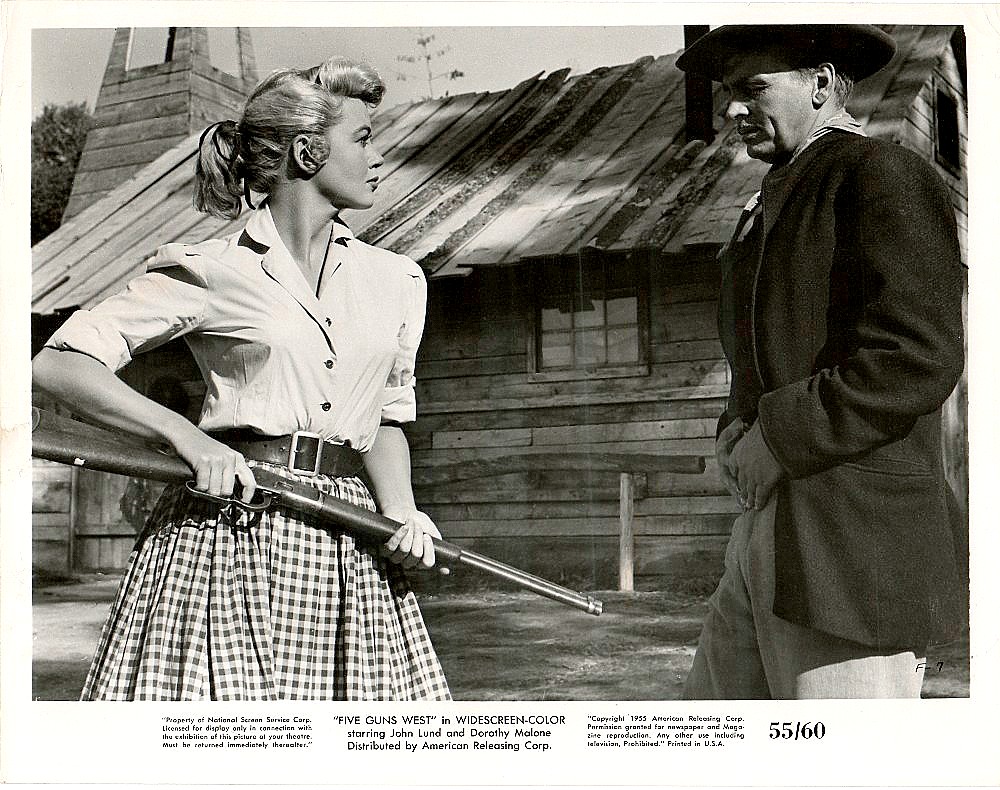
Dorothy Malone and John Lund on the Ingram Ranch in "Five Guns West"

John Lund, best known for Billy Wilder's "A Foreign Affair" (1948), plays the male lead in "Five Guns West," opposite the potent screen presence of Dorothy Malone.

Promo still for "Five Guns West" featuring Dorothy Malone and Jonathan Haze

Malone is put to great use in the movie, tantalizing a series of outlaws with her raw sexuality.

"Five Guns West": Mike "Touch" Connors, center

The cast also includes Mike Connors — long before he became famous as TV's Mannix, back when he was still known as "Touch" Connors.

Ambush sequence using Wrench Rock, on the Upper Iverson Movie Ranch

Corman's ability to economize on production costs was already evident, with "Five Guns West" shot almost in its entirety at two locations: The first half-hour takes place at the Iverson Movie Ranch, with the rest of the movie set a few miles south of there at the Jack Ingram Ranch. (Jack Ingram, who was a B-Western regular for years before opening his location ranch, also has a role in the movie.) The above shot features the widely filmed Wrench Rock, sometimes called Indian Head. Even though the rock is a familiar feature in Iverson movies, it's unusual to see it used in this manner — as a perch for an ambush.

"Five Guns West": The view from Cactus Hill looking south

This shot offers a long-distance view of the movie ranch's most famous section, the Garden of the Gods (to the left of the riders), along with the western San Fernando Valley, at top left, and a familiar rocky hill at top center.

Sunset Peak, or Elders Peak, was (and remains) situated south of the Iverson Ranch, across Santa Susana Pass Road. The western San Fernando Valley was still rural at the time, and Chatsworth Reservoir still had water in it.


Corman's Iverson shoot for "Five Guns West" is an unusual one, taking place mostly on Cactus Hill — probably the most prominent single feature at Iverson, but one that was typically seen only in the background and was rarely used as a shooting location in its own right. Corman used that fact to his advantage, shooting heavily on Cactus Hill and getting unusual shots in the process. The above shot, looking north from Cactus Hill, provides a rare glimpse of a rock I call Gorilla, seen at the right of the photo, just above the halfway point.


Here's another view of Gorilla from a recent site visit, again looking north. You can also see Oat Mountain in the distance, along with some of the estates that now fill the former Upper Iverson. For the Iverson aficionados, that's the back end of Turtle Rock directly to the left of Gorilla.

Cactus Hill has traditionally been referred to anonymously by film location researchers (for example: "a large hill separating the Upper and Lower Iverson"), but it came to my attention recently that the Iverson family called it Cactus Hill, and it works for me. True to its name, Cactus Hill is loaded with impressive cactus. Above is an example from a recent visit. The hill also features a treasure trove of beautiful and underutilized movie rocks, if you're into that sort of thing (which I am).

Another shot from "Five Guns West" — looking toward the west this time — features another unusual Iverson rock located atop Cactus Hill. Between the trailing rider and the two leading riders is a spherical rock I call the Head, because when you first come upon it along the trail, it looks a lot like a human head.

"The Head" in modern times

Here's a shot of the Head that I snapped on a recent visit to the site. One intriguing thing about the Head is that it's manmade — the smaller rock on top of the formation was cemented onto the larger rock that forms the base.

Closeup of the Head — note the cement base

This closeup shows some of the cement work. Whenever I find a rock at Iverson that has been cemented, and there are a number of them, I find it significant because it had to be done specifically for the movies — the place was a working movie ranch, after all. I always want to know the answers to questions such as: What movie was this done for, and why? And where else does it appear?

"Apache Woman," 1955, directed by Roger Corman

In the case of the Head, I'm sure it wasn't done specifically for the Corman movie. It's not the kind of thing he would budget for, and besides, it was probably done a few years earlier. The bulk of the cement work at Iverson appears to have taken place around 1950-1951, indicating that the practice may have been associated with the transition from B-movies to early TV shows. It may be that the Iversons felt they had to "spruce up" the place to get it in shape for what would turn out to be extensive TV work in the 1950s. Oddly, most of the "stacked rocks" created during the "cement scare" of the early 1950s never ended up being used much — with a few noteworthy exceptions, which I will cover in a future post.

Jack Ingram Ranch, as seen in "Five Guns West"

For now, suffice to say that whatever the motivation was to create "the Head," the rock almost never turned up in any productions. I have my fingers crossed that it will eventually show up somewhere else, but at this time Corman's "Five Guns West" is the only movie I've found that features it.

"Viking Women and the Sea Serpent," 
1957, directed by Roger Corman

Roger Corman returned to Iverson a number of times, especially early in his career, and whenever he shot there — often with "Five Guns West" cinematographer Floyd Crosby — he typically found inventive ways to shoot it. The pair collaborated again on another Iverson Western, "Apache Woman," later in 1955, and Corman continued to shoot at Iverson even after moving on from Westerns to cult films — including "Viking Women and the Sea Serpent" (whose full title is much longer) in 1957 and "Teenage Caveman" in 1958. I'll feature more of Corman's Iverson work in Part 2.