Why we love old movie locations — especially the Iverson Movie Ranch

For an introduction to this blog and to the growing interest in historic filming locations such as the Iverson Movie Ranch — the most widely filmed outdoor location in movie and TV history — please read the site's introductory post, found here.
• Your feedback is appreciated — please leave comments on any of the posts.
• To find specific rock features or look up movie titles, TV shows, actors and production people, see the "LABELS" section — the long alphabetical listing on the right side of the page, below.
• To join the MAILING LIST, send me an email at iversonfilmranch@aol.com and let me know you'd like to sign up.
• I've also begun a YouTube channel for Iverson Movie Ranch clips and other movie location videos, which you can get to by clicking here.
• Readers can email the webmaster at iversonfilmranch@aol.com
.

Saturday, February 20, 2016

Batman Corner, where Johnny Mack Brown rode the "Silver Range" — and where you can park next to historic movie rocks

"Silver Range" (1946) — Batman Corner and Rock Island

This screen shot from the Johnny Mack Brown B-Western "Silver Range" looks toward the west across a portion of the Upper Gorge on the old Iverson Movie Ranch, including an area I call Batman Corner.

Marked in yellow on this recent bird's-eye view, Batman Corner is named after the large, heavily filmed Batman Rock. The "Batman Corner" cluster of rocks is situated today at the corner where Redmesa Road meets Horizon Place, one of the driveways into the Cal West Townhomes in Chatsworth, Calif.

"Stagecoach" (1939)

Batman Rock had a long career in movies and television, including this appearance in John Ford's epic Western "Stagecoach." This is the rock's western face, its most familiar and most distinctive side.

Batman Rock in 2016

Batman Rock today is relegated to a role as part of the landscape of the Cal West condo community. "Batman Corner," which is hidden behind the rock and cannot be seen here, refers to the rock's "back side," or eastern side.

"Batman and Robin" (Columbia serial, 1949)

Batman Rock gets its name from Columbia's Batman serials of the 1940s. To learn more about Batman Rock and see additional shots of Batman Corner, please click here to read a post from May 2015, which also discusses nearby Rock Island and a visit by Elvis Presley in 1965.

With the camera aimed west in the "Silver Range" sequence, Batman Rock is unrecognizable from this angle — but we get an unusually detailed view of Batman Corner.

Here's a breakdown of the three major rock areas seen in the screen shot. Moving from the foreground to the background, and right to left, we see Devil's Wall (part of the Devil's Doorway Cluster), Rock Island (with two of the five main rocks visible — RI-1 on the left and RI-2 on the right), and Batman Corner to the west.

The rock on the left is a bit of a mystery, but it's safe to say it doesn't belong there. I'm reasonably sure the rock is fake, as what would normally be seen here is a gap between Devil's Wall and Crown Rock. The fake may have been associated with an adobe village that stood in the area in the late 1940s.

A close examination of the background reveals a couple of large, but largely overlooked, rocks that define the lower portion of Batman Corner — labeled "A" and "B" here.

Both rocks, "A" and "B," survived development and can still be seen, adjacent to Redmesa Road. These days the view of the rocks is typically blocked by parked cars, but the shot illustrates how the terrain was built up after the filming days. Note that much of Rock B in particular is now buried.

Compare the position of Rock B in the recent shot with its position back in 1946, when it loomed well above the level of the old dirt road. I've zoomed in on the screen shot here.

Approximately this much of Rock B remains above ground. This is consistent with the level to which nearby Rock Island was buried, as I've discussed previously. During development of the Cal West project in the late 1980s, truckloads of dirt were brought in to support construction of Redmesa Road and the condos.

"Three Ages" (1923) — Batman Corner and Rock Island

The rocks at the base of Batman Corner have appeared in films going back to the silent era, including the Buster Keaton comedy "Three Ages."

From this angle Rock A blends into the background, but Rock B can be readily identified.

Another shot from the "Three Ages" sequence prominently features Rock B.

Also visible in "Three Ages" is a group of smaller rocks that includes a pointed rock abutting Rock A.

The pointed rock can be seen today, immediately adjacent to the much larger Rock A.

Johnny Mack Brown on Rebel in "Silver Range" (1946)

"Silver Range" is relatively off-the-radar, as Johnny Mack Brown's Monogram movies go, but it's a good one for Iverson Movie Ranch sightings. In this shot, Johnny and Rebel appear in front of the late, lamented Gorge Arch.

"Silver Range"

Johnny has his backup with him during a sequence filmed in what's now the Indian Hills Mobile Home Village. The overhanging rock to the right of Johnny's hat is Saucer, and part of Mushroom Rock can be seen at the right edge of the frame. That's popular silent movie actor and B-Western sidekick Raymond Hatton on the left.

"The Lone Ranger" TV show (1949)

Saucer and Mushroom Rock starred in their own blog item last spring, after it was discovered that Mushroom Rock has had some foliage removed and its "cap" is now visible again. Check it out here.

"Silver Range" — Johnny Mack Brown and Raymond Hatton near Batman Corner

Batman Corner can be seen in the background on the left in this screen shot, with Rock Island's distinctive "Eraserhead," or RI-1, looming at top right.

Lane Bradford at Champion's Barn in "Silver Range"

Perennial B-Western bad guy Lane Bradford is in the movie, catching rays on his formidable chin. I waxed poetic about Lane's chin last fall in a post you can read by clicking here. In this shot Lane appears outside Champion's Barn on the Monogram Ranch in Newhall.


"Silver Range" is included in Volume 8 of the outstanding DVD series "Monogram Cowboy Collection," which features 12 nicely remastered B-Westerns and a lot of cool rocks. The "Silver Range" screen shots in this post come from this DVD set. You can find the set on Amazon by clicking on the above link.

Sunday, February 7, 2016

"Little Big Horn": Tracking down the infamous grassy knoll where Sheb Wooley met his demise in the 1951 Lloyd Bridges-John Ireland movie

"Little Big Horn" (1951): A grisly end for Sheb Wooley's character on the grassy knoll

Film historians have struggled over the years to find the location for the haunting scene in the 1951 Western "Little Big Horn" in which the brutalized body of Sheb Wooley's character, "Quince," is found propped up on a stick. But I'm excited to report that the grassy knoll where the scene was filmed has now been found.

"Little Big Horn" — closeup of Quince's body

The closeup of Quince provides clues to the location, with the landmark Elders Peak, south of the Iverson Movie Ranch, seen in the background. "Elders Peak" is my research term for this frequently filmed hill, which has also been known by a number of other names including Sunset, Retz Peak and Rockridge.

Note the alignment of background features in the red circle

Veteran movie location hunter Eddie Henn was the driving force behind the discovery. Eddie noticed the alignment between Elders Peak and a distinctive notch in the ridgeline atop the Santa Monica Mountains, which form the southern boundary of the San Fernando Valley.

The same features as they line up today — from the grassy knoll

Eddie and I got together in January for an expedition onto the former Upper Iverson to see whether we could locate the sweet spot where the background hills would line up. As we approached our "target zone" at the west end of Cactus Hill, suddenly there it was: the grassy knoll.

Wider shot of the grassy knoll

At the top of the knoll it quickly became obvious that it was the filming location for "Little Big Horn," as everything matched up. The above shot provides a wider view of the grassy knoll with its contemporary background.

"Little Big Horn"

I don't know of any other movies in which the grassy knoll has been used for filming, but it's such a nondescript setting that it would be easy to miss. While the Iverson Ranch as a whole is defined by its rock features, the grassy knoll is virtually rock-free.

Looking south from the Grassy Knoll (photo by Jerry Condit)

On a return visit to the site within days of the discovery, we brought along another intrepid location hunter, Jerry Condit, who took a black-and-white photo that nicely matches the closeup of Quince from the movie.

Quince on the Grassy Knoll — "Little Big Horn"

Here's another look at the haunting Quince closeup to facilitate comparison with Jerry's photo above this one. The detail in Jerry's shot reveals that much of the background remains virtually untouched, even 65 years later.

The view from behind Sheb Wooley, which also appears in the movie, provides more insights. With the camera looking north toward a portion of the former Upper Iverson, some of the rocks at the west end of Cactus Hill come into view near the right of the frame.

This is what the view looks like today. A few of the estate homes that now occupy the former Upper Iverson can be seen here, along with Oat Mountain filling the top of the frame.

Note the two rocks identified here as "A" and "B."

The same rocks can be seen in the recent photo, although the trees surrounding Rock "A" have grown considerably in the intervening years, and now conceal much of the rock.

Both the 1951 screen shot and the 2016 photo also feature two distinctive foothills situated just to the north of the Upper Iverson. My nickname for these hills is the Tetons.

The Tetons as they appear today are identified in this shot.

The approximate location of the grassy knoll is noted on this Google aerial. The location remains on private property today, and access is restricted.

Friday, January 29, 2016

How Roy Rogers solved the mystery of the Japanese sniper in John Wayne's "Fighting Seabees"

"The Fighting Seabees" (1944)

One photo I didn't put up when I blogged last summer about the John Wayne World War II movie "The Fighting Seabees" was this shot of a Japanese soldier using a diagonal crack in a rock as a sniper's perch.

"The Roy Rogers Show" (1952)

I didn't post the shot because I couldn't figure out where it was taken. But with some help from Roy Rogers, the mystery is now solved. Roy peers through the same crack in an early episode of "The Roy Rogers Show" called "The Train Robbery," filmed in 1951 and first aired Feb. 3, 1952.

Sniper's crack, on a recent visit to the Lower Iverson

Thanks to the context in the "Roy Rogers" episode, I was able to determine that the crack is part of a heavily filmed movie rock that I call Hangdog. The tricky thing about both the "Fighting Seabees" shot and the "Roy Rogers" shot above is that they feature the rarely seen "back side" of the rock.

"The Train Robbery" ("The Roy Rogers Show")

This is what the sniper's crack area looks like from the much more heavily filmed "front side" of the rock — its west side. In the "Roy Rogers" episode, Roy climbs on top of Hangdog to get a drop on the bad guys.

A portion of the crack is visible near the legs of the two bad guys. The section of Hangdog shown in this shot is just a fraction of the massive rock feature.

The rock, including the sniper's crack, remains intact today on the Lower Iverson Ranch. This recent photo of Hangdog shows the same section of the rock seen in the "Roy Rogers" shot.

The sniper's crack area is located at the north end of the rock.

This is what the rest of Hangdog looks like in modern times. The photo shows the west-facing side of the rock.

Hangdog today is on private property, and access is difficult. The rock is positioned near the southeast corner of the Cal West Townhomes, separated from the condo community by a brick wall.

Friday, January 22, 2016

Movie rock "survivors" found in the Iverson Gorge — thanks to "Atom Man vs. Superman"

"Atom Man vs. Superman" (1950): Bald Knob, center, and its neighbors

I recently came across this shot of the gravity-defying Bald Knob and some of its neighboring rocks in "Atom Man vs. Superman," the second of Columbia's two Superman serials. Some readers may recall previous posts talking about whether Bald Knob was real or fake.

We may never know for sure, because Bald Knob disappeared when development came to the Iverson Gorge in the late 1980s. The space once occupied by this fascinating movie rock is now filled by dirt embankments supporting Redmesa Road and the Cal West Townhomes.

The sighting inspired me to do a little exploring in the Gorge. It occurred to me that it would be interesting to find out whether any of those nearby rocks might have survived. To my surprise, I was able to pretty easily find some of the rocks seen in the "Atom Man vs. Superman" shot.

This shot from my recent expedition into the Gorge features a small clump of rocks that has survived from the "Atom Man vs. Superman" shoot. The terrain has been dramatically altered in the intervening years, and only the rocks near the top of the formation seen in the serial remain above ground.

This shot from "Atom Man vs. Superman" points out the surviving rocks. You may be able to see the similarities between these rocks and those in the recent photos — especially a sort of duckbilled rock on the left and a mushroom-like "crown" at the top of the formation.

Here's another view of the surviving rocks. From this angle it can be seen that the ground level is now much higher than it was back in 1950.

A wider shot from the same recent Gorge expedition shows the setting where the surviving rocks can be found today, with Nyoka Cliff in the background. The "Atom Man" rocks can be seen near the bottom of the photo.

Iverson Gorge (Bing bird's-eye view)

This bird's-eye view pinpoints how to find the rocks. Make your way to Redmesa Road in Chatsworth, Calif., just north of Santa Susana Pass Road, and park below the first condos. The rocks are on the east side of the road.

The discovery of the "Atom Man" rocks helps narrow down the area where Bald Knob once stood — and where it may still be located beneath the Redmesa dirt embankment. The above bird's-eye view also notes its proximity to the landmark Lone Ranger Rock.

Friday, January 15, 2016

"Border Feud," starring Lash LaRue: The day in 1947 when the Iverson family left the barn door open

The "Old Barn," as seen in "Border Feud" (1947)

The Iverson family's residential and farm buildings were generally kept out of movies filmed on the Iverson Movie Ranch, but there were a few exceptions. One big exception was the day in 1947 when the so-called "Old Barn" on Aaron Iverson's ranch became a key set for the Lash LaRue Western "Border Feud."

"Border Feud" was part of a string of ultra-cheapo B-Westerns from Producers Releasing Corp. filmed on the ranch. PRC was a consistent presence at Iverson from 1940-1947, and LaRue, one of the Poverty Row studio's biggest stars, filmed virtually all of his PRC movies at the Chatsworth shooting location.

Al "Fuzzy" St. John at the Old Barn in "Border Feud"

Like many of PRC's productions, "Border Feud" also featured perennial Western sidekick Al "Fuzzy" St. John, a screen veteran with a resume going back to about 1914. Like LaRue, Fuzzy was a fixture at Iverson, providing comic relief opposite LaRue, Buster Crabbe, George Houston, Bob Steele and other cowboy heroes.

Just a few of PRC's Lash LaRue movies filmed at Iverson in 1947

PRC filmed at least a dozen B-Westerns at Iverson in 1947 alone. It may be that by the time "Border Feud" was filming, the Iversons had become friendly enough with LaRue, Fuzzy and the PRC crew to relax the rules. "Border Feud" is one of the rare occasions when they allowed the barn to be used as a movie set.

"Border Feud" — the Old Barn

Western movie historian Tinsley E. Yarbrough first identified the "Border Feud" building as an Iverson family barn in an article published in 1998. In the years since then, the barn has been mildly controversial, with some researchers — including yours truly — remaining skeptical that the barn seen in the movie was located at Iverson.

Aaron Iverson in front of his barn (Edwin Iverson collection)

But any controversy was put to rest in a recent exchange I had with Tinsley, who pointed me to the "smoking gun" that proves the identity of the building. The undated photo above, circulated by Aaron Iverson's son Edwin, shows Aaron in front of his barn — which can be readily identified as the same barn seen in "Border Feud."

A number of the same markers seen in the "cow photo" can also be identified in screen shots from "Border Feud," as noted above. These markers leave no doubt that it's the same building in both shots.

Closeup of the Old Barn in "Border Feud"

Other screen shots from the movie provide detailed views of various sections of the barn. The dilapidated building was a holdover from an earlier period when farming was still an important part of life on the Iverson Ranch — before the movie location operation evolved into the ranch's predominant business activity.

Here's a shot of the movie's star, Lash LaRue, in front of the Old Barn.

This shot of Fuzzy near the corner of the barn includes a rare glimpse of a second structure, apparently another farm building, at the right of the frame. "Border Feud" stands alone as a film document of these buildings.

In addition to detailing farm features such as fences and windmills, the movie shots reveal the view looking out from the barn area. This shot looks southwest toward the rugged hills south of Santa Susana Pass Road.

"The Virginian" (1963)

Although the Old Barn figured prominently in the action in "Border Feud," it was essentially never seen up close in a movie again. However, it does pop up from time to time in backgrounds, with the above shot from the TV Western "The Virginian" being one of the best examples.

The shot comes from the episode "Strangers at Sundown," which premiered April 3, 1963.

"Tell It to the Marines" (1926)

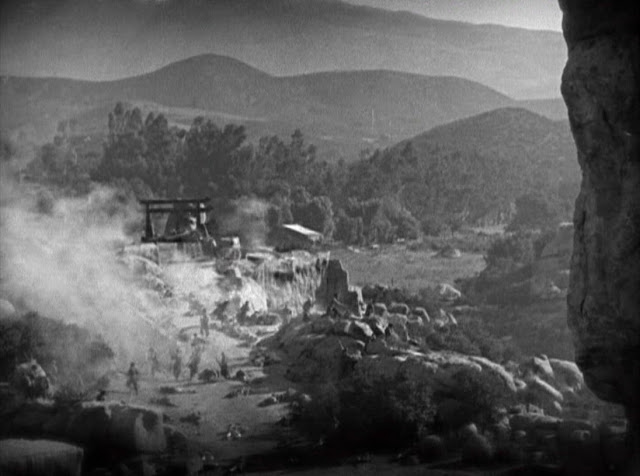
A screen shot from the silent movie "Tell It to the Marines" reveals that the barn was already in place as early as 1926. The building, identifiable by its angled white roof, can be seen near the center of the frame.

The barn is highlighted here. The shot is taken from Garden of the Gods, and includes a Chinese bridge, to the left of the barn, that was the subject of a detailed post in September 2015.