Why we love old movie locations — especially the Iverson Movie Ranch
For an introduction to this blog and to the growing interest in historic filming locations such as the Iverson Movie Ranch — the most widely filmed outdoor location in movie and TV history — please read the site's introductory post, found here.
• Your feedback is appreciated — please leave comments on any of the posts. • To find specific rock features or look up movie titles, TV shows, actors and production people, see the "LABELS" section — the long alphabetical listing on the right side of the page, below. • To join the MAILING LIST, send me an email at iversonfilmranch@aol.com and let me know you'd like to sign up. • I've also begun a YouTube channel for Iverson Movie Ranch clips and other movie location videos, which you can get to by clicking here. • Readers can email the webmaster at iversonfilmranch@aol.com.
The Lone Pine Film Festival just wrapped up its 32nd year
We had a great time earlier this month at the Lone Pine Film Festival, which is still going strong in its 32nd year. Not only is Lone Pine one of the best film festivals in the U.S., I believe it also stands alone in that it's more focused on actual filming locations — and a lot of them — than any other festival in the world.
Dawn breaks in the Alabama Hills (Oct. 9, 2022)
The centerpiece of the festival — and of movie history in the Lone Pine area — is the Alabama Hills, a unique geological formation that first caught the attention of Hollywood more than a century ago.
Alabama Hills — a vast rocky landscape
"Alabama Hills" is the name
given to a sprawling rocky area west of the town of Lone Pine in California's Owens Valley, where hundreds of movies and TV shows have been filmed over the past 100-plus years.
Painting of Confederate warship CSS Alabama, which gave the Alabama Hills their name
The
area has nothing to do with the state of Alabama, but the name is a
Civil War reference. The Alabama Hills are named after the CSS Alabama, which was sunk by the Union ship Kearsarge in 1864.
A typical Alabama Hills rock formation
California's Alabama Hills are known for their unusual rock formations, spread out across mile after mile of dramatic landscape. This area has stood in for the American West of the frontier days in countless Western movies, and remains an active filming location today.
Lone Pine Peak and Mount Whitney, west of the Alabama Hills
The Alabama Hills are bordered on the west by the Eastern Sierra, including Lone Pine Peak and Mount
Whitney, which lend additional scenic splendor to
the location.
Mount Whitney keeps a low profile here
Almost everyone mixes up Lone Pine Peak and Mount Whitney at first — I know I did. Even though Mount Whitney is the tallest peak in the Lower 48 States, the proximity of Lone Pine Peak makes it appear higher.
Lone Pine rock detective and tour guide Don Kelsen examines an Alabama Hills formation
The Alabama Hills aren't the only thing that sets the Lone Pine Film Festival apart from run-of-the-mill movie festivals. A key to the annual event's enduring popularity is that Lone Pine is a gathering of not just movie fans, but movie location fans — including some who really know their stuff when it comes to Lone Pine.
"The Last Posse" (1953): One of hundreds of filming locations documented by Don Kelsen
A case in point is master Lone Pine rock finder Don Kelsen, who has been involved with the movie festival — and with uncovering historic Alabama Hills filming locations — for something like three decades.
The "Last Posse" location in modern times, photographed by Don Kelsen
"Gunga Din" — 1939 epic filmed in the Alabama Hills
High-profile Lone Pine movies such as "Gunga Din" and "Bad Day at Black Rock" are well-documented, so on my recent visit I made a point of seeking out locations for productions that don't normally get as much attention.
Jeep commercial featuring Lone Pine Peak and the Alabama Hills, 2018
One thing I've been seeing a lot of lately is car commercials shot in the Alabama Hills. Ads for Jeep, Acura, Chevy trucks and other makes have been capturing breathtaking Lone Pine scenery in recent years.
The same location in October 2022 — not quite the same angle, but in the neighborhood
I took this photo approximating the location of the Jeep commercial from my campsite in the Alabama Hills on Sunday morning, Oct. 9.
Click on the video above to watch the Jeep spot
Here's the 30-second Jeep commercial that features the beautiful Alabama Hills shot, which appears at 0:19 in the ad. Click on the image above, then click on YouTube in the bottom right corner for the best look at the video.
Rabbit Dry Lake in the same Jeep commercial
Other parts of the Jeep commercial are shot at Rabbit Dry Lake in Southern California's Mojave Desert. We explored this location back in 2019, in a post you can see by clicking here.
Randolph Scott arrives in the Alabama Hills in the opening to the 1957 Western "The Tall T"
Unique movie tours of the Alabama Hills, such as the Del Gaudio
brothers' "Tall T" tour, have long been among the biggest attractions at the Lone Pine
Film Festival.
The same location in 2022, one of the many highlights on the Del Gaudios' "Tall T" tour
These fascinating tours give the general public a chance to experience the
excitement of seeing stunning filming locations up close, and to benefit
from the knowledge and legwork of veteran Lone Pine explorers.
Mike Del Gaudio breaks down a filming site for "The Tall T"
When you spend time in the Alabama Hills with location hunters like the Del Gaudios, you're bound to learn a thing or two — but more important, you're likely to get caught up in their passion for movie locations.
John Del Gaudio stands in for Richard Boone, illustrating a key shot in "The Tall T"
The Del Gaudio brothers, who travel from the East Coast each year to conduct tours, flip burgers and whatever else the festival needs, have perfected a tandem approach to revealing the finer points of the Alabama Hills.
Richard Boone's character, Usher, rides through the same pass in the movie
A movie like "The Tall T," filmed almost entirely in the Alabama Hills, offers countless shots that can be matched up against the current landscape — and it's a landscape that remains largely unchanged since the peak filming years.
Tour participants follow along with their "Tall T" photo brochures
Visitors participating in the movie tours receive photo brochures containing screen shots from the movie so they can see exactly where everything was filmed and line up their own matching photos.
Randolph Scott on the Anchor Ranch in Lone Pine — note the horse stable behind him
A scene early in "The Tall T" finds Randolph Scott on the Anchor Ranch, a cluster of old buildings in downtown Lone Pine that was historically used for filming.
The same stable building in 2022
To my surprise, much of the old ranch remains intact today — if "intact" is the right word. The old stable isn't in the best shape these days, but it's still recognizable as the same building seen behind Randolph Scott in the movie.
"Conquering Comes Standard" Jeep commercial, circa 2018
One of my favorite locations I visited during this year's festival was from another Jeep commercial. When I showed this shot to Don Kelsen, he knew right away where it was.
The Jeep location in October 2022
Here's
a matching shot I took at the Jeep location — probably my best match from the latest Lone Pine expedition.
Promo still for the 1938 serial "The Lone Ranger": Chief Thundercloud and Lynne Roberts
Another highlight for me from this year's festival has a connection to the Iverson Movie Ranch. I spent a long time searching for the location of this photo after someone suggested years ago that it was taken on the Iverson Ranch. It turns out it wasn't shot there after all.
The same rock in 2022, in the Alabama Hills
Thanks
to Greg Parker — another extremely accomplished Lone Pine rock hunter and tour guide — the elusive rock was found earlier this year in the Alabama Hills. I took part in an expedition to the site on Oct. 9.
"The Lone Ranger" (1938): The movies' original Tonto in the Alabama Hills
A second promo still from the same photo session also turned up some time ago, with Chief Thundercloud standing on top of the rock and Lynne Roberts, the serial's leading lady, on the right.
The mystery rock — a mystery no more
The serial "The Lone Ranger" was filmed both on the Iverson Movie Ranch and in the Lone Pine area, among other locations. But the promo stills with the distinctive rock were definitely taken in the Alabama Hills.
John Del Gaudio basks in the presence of Chief Thundercloud's rock
A number of veteran Lone Pine researchers, including the Del Gaudio brothers, took part in the pilgrimage to the rock, with Don Kelsen leading the expedition.
"Thundercloud Rock" in its natural setting (Oct. 9, 2022)
After wondering for years where this rock might be, I have to admit it was pretty exciting to finally see it in person.
Lone Pine, one of the best-kept secrets of the Eastern Sierra
If you missed this year's Lone Pine Film Festival, you might want to start making your plans early for next year. The motels in town fill up fast, but there's also camping available in the historic Alabama Hills.
The Lone Pine Museum of Western Film History
Meanwhile,
Lone Pine's Museum of Western Film History is open year-round, and is a must-see. You
can pick up a brochure there for $2 that'll show you the way to
many of the most important filming locations.
Where to go, how to get there and what to do once you're there
If you do plan to go to Lone Pine 2023 — and for that matter, if you're headed to just about any historic filming locations in the SoCal area — shoot me an email ahead of time and maybe we can arrange to meet up.
I 💗 Lone Pine
As for me, I'll be going back for sure — and sooner than later. Seems I left my heart-shaped rock arch in the Alabama Hills.
"Hot Rods to Hell" (1967): Plenty of hot rods, and sufficient hell
Is it a mid-20th century metaphor for the settling of the Wild West? Who knows! But this much is clear: "Hot Rods to Hell" is one of the classics of the much-loved juvenile delinquent genre.
Jeanne Crain gets hysterical while Dana Andrews responds to an emergency by "resting his eyes"
If a Juvenile Delinquent Movie Hall of Fame existed, they'd need a whole wing for "Hot Rods to Hell." But your own mileage may depend on your level of tolerance for ... um, I almost said "bad acting," but let's just call it "camp."
"Blackboard Jungle" (1955): Fanning the flames of juvenile delinquent paranoia
"Hot Rods to Hell" is what "Blackboard Jungle" might've been if they moved it to the weekend.
"West Side Story" (1961): A seminal juvenile delinquent movie and a fun musical rolled into one
It's what "West Side Story" would have been if they took out all the singing and dancing, the choreographed knife fights, the racially motivated gang warfare, Natalie Wood, and replaced it all with hot rods.
"Rebel Without a Cause" (1955): What is it with Natalie Wood and her bad boys?
"Hot Rods to Hell" is what "Rebel Without a Cause" could have been if they took out all the great writing, directing and acting, moved it to the desert ... and they'd have to take out Natalie Wood again.
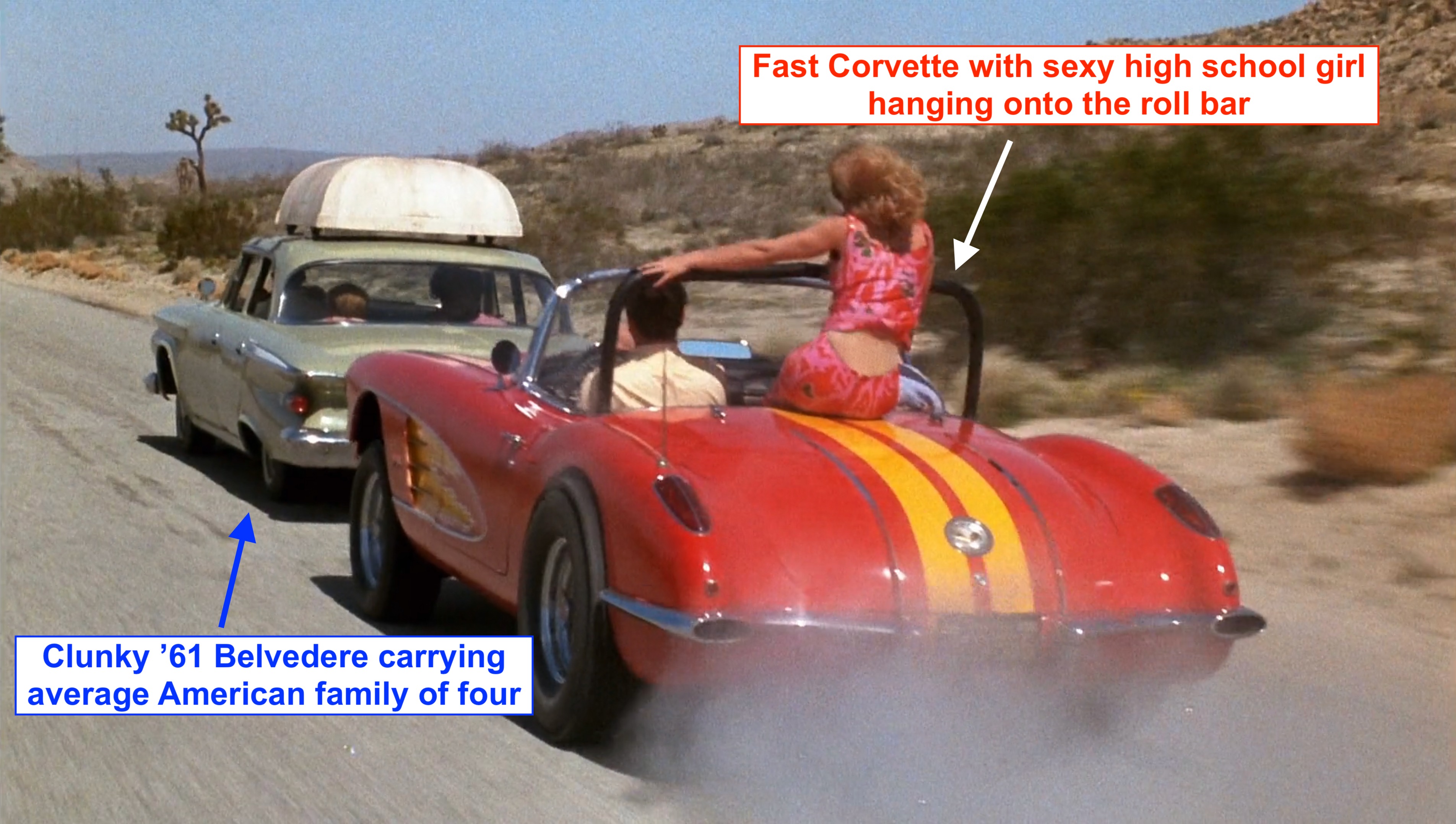
A souped-up '58 Corvette tears up the Mojave Desert in "Hot Rods to Hell"
On one level it's just the saga of a typical American family headed West, where they get hassled by a gang of teenage misfits in fast cars. But the movie's "classic" status is cemented by footage of hot rods kicking up dust all over Southern California's Mojave Desert.
Those hot rods wouldn't seem so hot if it weren't for one not-so-hot rod that lunks along throughout the movie. It's a green Plymouth Belvedere hauling around a family strictly from Squaresville, and in this movie all the kids love saying things like "Squaresville."
"Hot Rods to Hell": A beginner's guide to torturing out-of-towners
The movie is essentially a how-to manual for aspiring troublemakers, with step-by-step instructions on how to bug the heck out of anyone driving a slower car or bringing an ugly luggage carrier into the desert. We can only hope these lessons were never taken to heart by any real-world teenagers with actual driver's licenses.
The Typical American Family adds a blown tire to its list of problems
As
if they didn't already have enough to freak out about, the Phillips
family suffers a hair-raising blowout, requiring most of them to overact. This becomes a recurring theme throughout their desert adventure.
The beleaguered Belvedere limps into Charlie's Gas & Oil
Thank goodness they were fairly close to a service station, even if it's the same place the hot rod punks hang out. Pay
attention, kids, because this is what we used to call a "service
station."
The Feed Store in Wilsona Gardens, 2022 (formerly "Charlie's Gas & Oil")
The old gas station from "Hot Rods to Hell" is still there, but it's not a gas
station anymore, and the whole place has been remodeled at least a few times over the past half-century — including the addition of a roof.
Still a Wilsona Gardens landmark
These days Charlie's Gas & Oil is a feed store, but a few telephone poles, a big butte out back and some of the station's original dirt confirm that we're in the right place.
Oddly enough, it's the windows that give it away
About the only thing that's still the same on the building itself is the windows — even though they now have metal security bars. Meanwhile, the old "slider" soda machine has been replaced by a broken-down Snapple unit that looks as though it probably had a cardboard "free" sign on it that blew away years ago.
Another "upgrade" gone wrong
I know I'm not the only one around here who still pines for the good ol' days. What would you give to slide a Coke through the metal maze on one of those vintage soft drink machines again?
Soon after arriving at Charlie's, everyone tries to calm down from the overacting incident
For some reason Mrs. Phillips seems determined to soothe her young son Jamie, the only member of the family who didn't lose his mind when the tire blew.
Trouble awaits at Charlie's gas station — for the legal department
The movie's crew apparently scoured the location ahead of time for any unsponsored branding that might give the legal team a headache back at the studio. Unfortunately, they tried to cover everything up with black electrical tape, and they made a hot mess of it.
First attempt at a tape-over job
You may think I'm being harsh by calling it a "hot mess" — especially if you're from England and would have preferred the British slang term "dog's dinner." But follow the timeline and draw your own conclusion.
They botched it!
Zooming in on the screen shot, we can spot problems right away with the crew's low-budget, low-effort masking procedures. The electrical tape handiwork is OK, up to a point, but they could have used another strip or two. Meanwhile, covering up the Phillips 66 badge may have been too much to expect from a black Marks-A-Lot.
Second attempt: A squared-off logo tape-over job
At some point during the shoot, someone with a smidgeon of authority apparently noticed the screw-up, and some poor crew flunky had to redo it — probably after getting yelled at. Of course, they weren't about to reshoot anything they already had in the can.
Third time's almost the charm (but when you have a Marks-A-Lot, I suppose you're gonna use it)
That lower management person was apparently a real stickler, because they made the poor crew do it a third time — and I have to think additional yelling was involved. This time they finally finished covering up those letters, but they also made the Phillips logo look more like a badge again, wasting more ink in the process.
After all that hard work, the branding gets into the movie anyway
I think the desert heat must've been getting to them, because they still managed to screw it up. Nobody bothered to turn the oil rack around for the Belvedere's grille closeup, so all the original signage — including an un-Marks-A-Lotted Phillips 66 badge and an untaped Trop-Artic oil logo — is right there on full display in the movie.
Was Charlie's really a Gulf station?
Other examples of the crew's "that's good enough" set-decoration policy can be found elsewhere at Charlie's Gas & Oil. The generic "gas" sign looks like a movie prop, but it wouldn't be a total surprise to find out there's a Gulf sign under that temporary banner.
Then there's the Texaco theory
Didn't we already figure out Charlie's is really a Phillips 66 station? Well this gas pump sure looks like it wears the Texaco star. The station's fixtures are such a hodge-podge, either it's all fake movie stuff or this gas station has a long-standing policy of breaking up with its corporate partners and keeping their equipment.
Awkward moment for the Phillips family?
It might look as though family patriarch Tom Phillips, on the right, is leaning forward to check out his 16-year-old daughter's impressive derriere — and getting busted by his wife to boot! But that's not what's happening here.
Nothing to see here!
I don't suppose it helps matters any that Tom has to haul his daughter and her rear end all over a desert full of testosterone-fueled hot rod boys. But Tom's just bent over in pain from a back injury, which plagues the poor guy throughout the movie.
Ernie takes a good long gander at Tina Phillips as she sways by
Besides, if there's any leering or ogling to be done at this gas station, Ernie will see to it that it gets done.
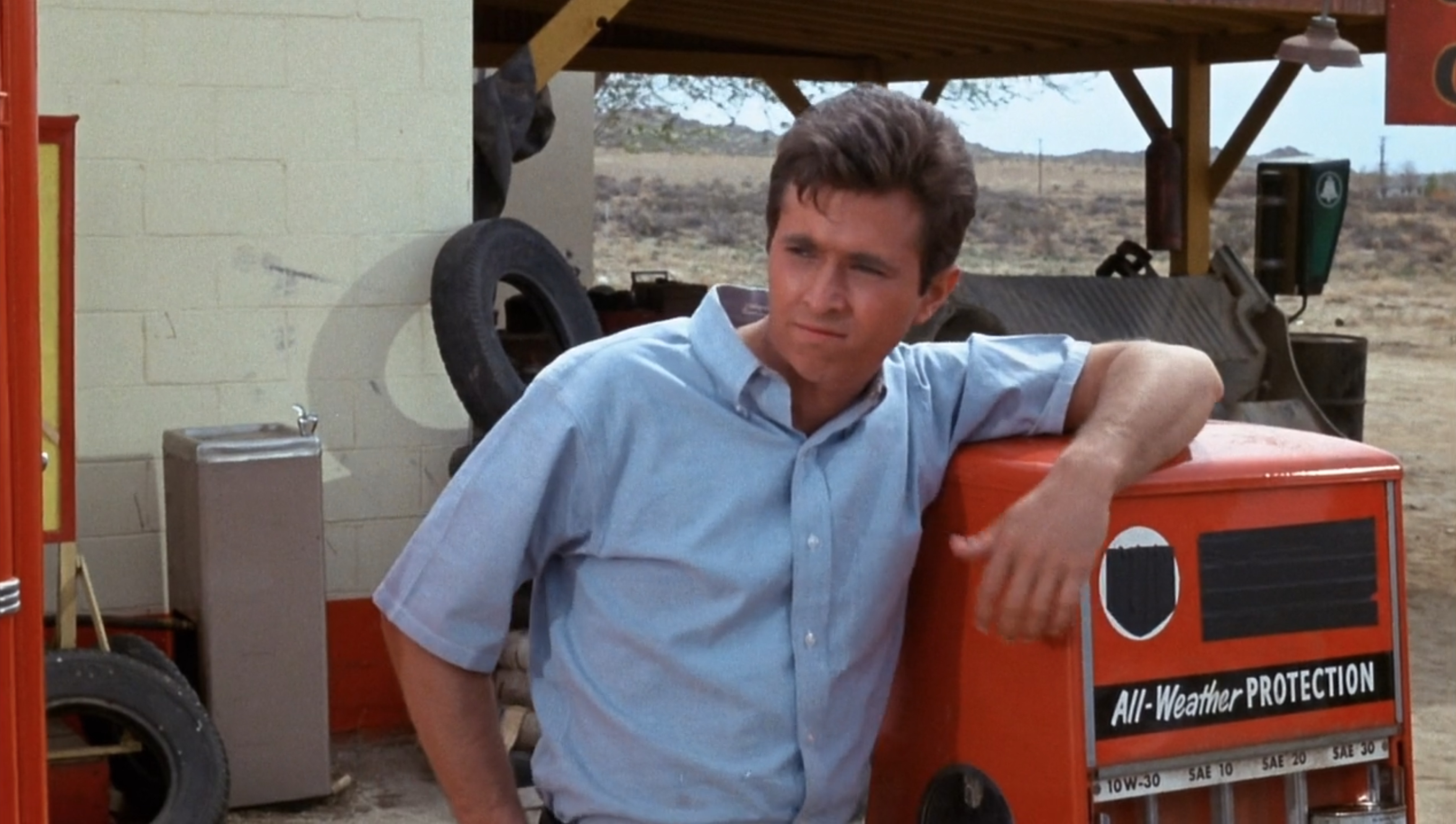
Beneath Ernie's button-down shirt beats the heart of a punk
A word of warning about high school hot rodder Ernie, played by Gene Kirkwood:
Don't let his good grooming and schoolboy face fool you — he's mean!
This may be true, technically, but is it really that big a deal?
One
of the more perplexing signs the movie crew put up at the gas station is this one making sure everyone knows that Charlie's Gas & Oil is the "last chance until Hanesburg." So,
where are we again, exactly?
Stuck inside East Hanesburg with the Hanesburg blues again
OK, so we're not exactly in the middle of nowhere, we're just in East Hanesburg. But still, it must be at least a
couple of miles from regular Hanesburg. Better top off the tank before
you roll outta there, Tom.
Charles P. Thompson as Charlie in "Hot Rods to Hell"
You may have spotted this old geezer wandering around the gas station. That's Charlie, who runs the station, and he's played by an actual Charlie and actual geezer, veteran actor Charles Thompson.
Charles Thompson with Steve McQueen in "Wanted: Dead or Alive" (1960)
Thompson never quite rose to the status of "geezer icon" — you know, the Clem Bevans, Cyril Delevanti, Burt Mustin level. But Charlie had his moments.
Charles Thompson as Asa Breeney, with Jim Nabors and Andy Griffith (1962)
Charlie may have found the inspiration for his mechanic's outfit in Gomer Pyle's wardrobe when Thompson played Asa Breeney in "The Bank Job," one of his seven guest appearances on "The Andy Griffith Show."
Charlie uses a wrench to make a point, prompting Ernie to strike an Elvis-like pose
Thompson's Charlie character in "Hot Rods to Hell" is a beaten man. He's fed up with the local hot rodders, but even though he wields a big wrench, he knows he's helpless to do anything about them.
The ghastly trio regroups at Charlie's
We have to give Charlie credit for trying, though. When Duke and Gloria show up in Duke's 'Vette to pick up their henchman Ernie, Charlie ambles over with a tire iron so he can lecture the bratty high-schoolers.
Gloria's need for speed has been satisfied — momentarily
Gloria, who's prone to alarming mood swings, is exhilarated for the time being, presumably from racing around the desert in a hot rod, which all the local kids apparently spend every waking moment doing.
Gloria (Mimsy Farmer) and Duke (Paul Bertoya) soak up Charlie's sage advice
Duke, who's way too old to be in high school — actor Paul Bertoya was 28 at the time — listens attentively to Charlie's words of wisdom as Gloria braces for another mood swing.
Charlie's advice falls on deaf ears
The well-dressed and impeccably coiffed hooligans react to Charlie's lecture the same way they react to almost everything: They laugh it off. These kids laugh so much I'm starting to think they might actually be having fun.
"Ah, you're old, Charlie. How would you know?"
Then Gloria, ever the philosopher, delivers one of the movie's most memorable lines, which pretty much sums up the code by which all the young desert rats live.
The San Gabriel Mountains loom to the south as the 'Vette makes a dramatic exit
And on that meaningful note, they go roaring off into the desert to raise more hell. That's a reference to the movie's title, in case I was too subtle about it.
The view from Charlie's looking southwest across 170th Street
Next thing we know, we're getting the 50-cent tour of Wilsona Gardens attractions. First up is Piute Butte, across the street from Charlie's.
Piute Butte in 2022, viewed from the former Charlie's location
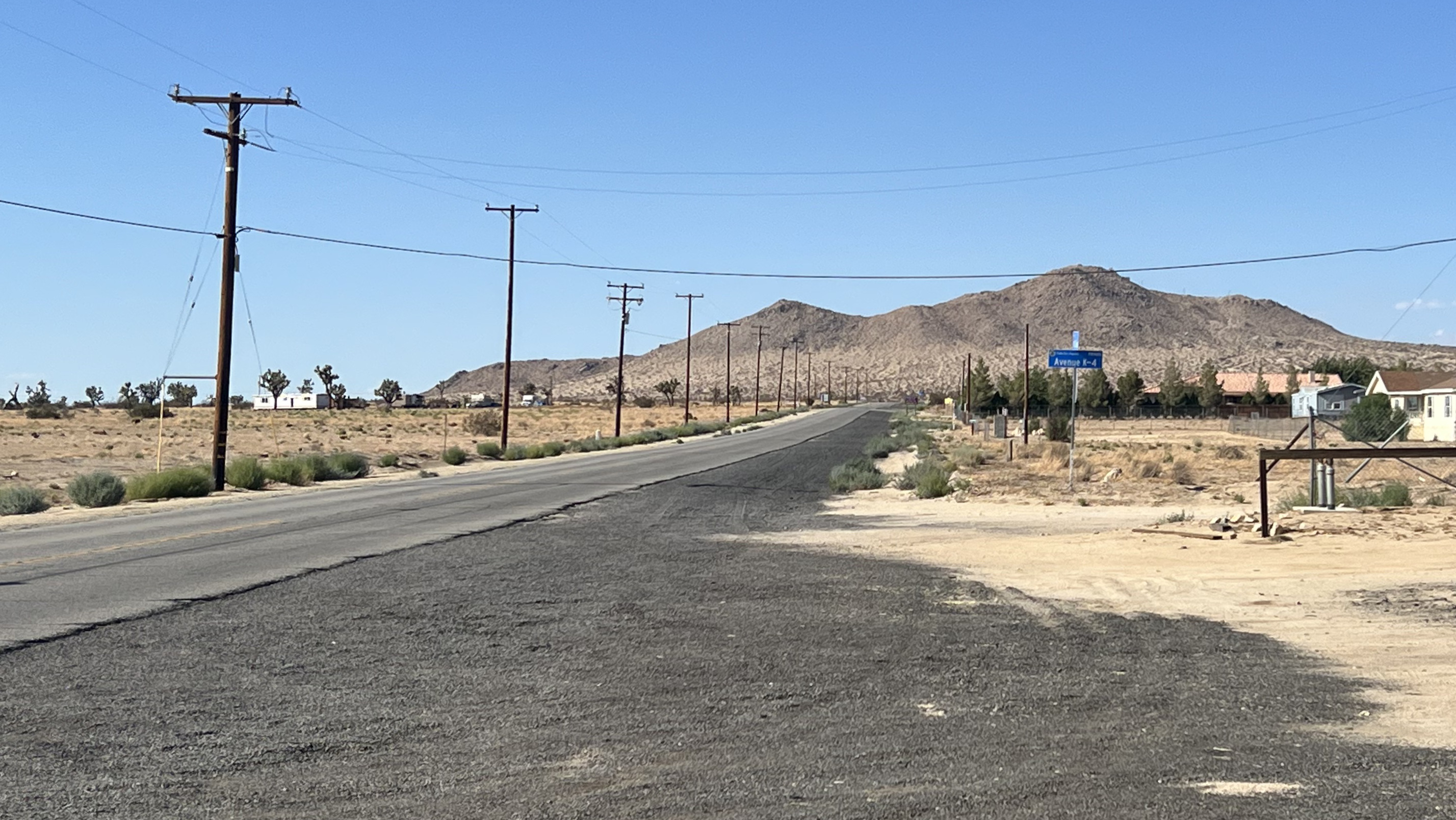
Needless to say, all of these landmarks are still there — where else would they be? This is the eastern slope of Piute Butte seen from 170th and Avenue K-4 — the same corner where Charlie had his gas station.
"Extradition, Part 2" ("Gunsmoke" episode, 1963): Piute Butte's southern profile
Piute Butte is one of the most important movie landmarks in the western Mojave Desert, and it pops up all the time in Westerns and other productions. We've featured it before — click here to see more of Piute Butte.
The Phillips family Belvedere hits 170th Street headed north
Around the same time the hot rodders roll out from Charlie's, the Average American Family of Four also gets back on the road — unfortunately for them. As they pull out we see a distinctive butte to the north.
The same location in 2022
I tracked much of the Phillips family's desert outing on my own recent visit to Wilsona Gardens, and found most of the buttes and other rock features, including this one at the north end of 170th Street, still intact. I was only mildly disappointed that I did not encounter any sociopathic hot rodders.
"Wagon Train" episode "The Duke Le May Story" (1959)
The small butte at the north end of 170th Street turns up from time to time in Westerns too. Here's an appearance by the butte in the TV series "Wagon Train."
Looking north from Lake Los Angeles
The butte is located due north of the town of Lake Los Angeles, about five miles up 170th Street.
The 170th Street butte, seen from Saddleback Butte State Park (William Sharpe photo)
The 170th Street butte is adjacent to Saddleback Butte State Park, and while it's formidable in its own right, it's dwarfed by other formations in the
area — including Saddleback Butte itself.
Drag racing up 170th Street outside Lake Los Angeles
In "Hot Rods to Hell," the west end of Saddleback Butte, positioned to the southeast of the 170th Street butte, sneaks into the frame at times when the camera shoots north up 170th Street. This shot includes just a small section of Saddleback Butte.
That can't be good!
Duke's Corvette constantly looks as though its engine is about to explode. The hot rod continues to be driven hard throughout the movie, but it keeps spewing ominous blue smoke the whole time.
Here comes Joe with his '56!
We get a better look at Saddleback Butte when Joe, another ranking member of the local hot rod delinquents club, arrives in his '56 Chevy to help terrorize the Phillips family.
The same location in 2022: 170th Street East and Avenue K
Today the spot where Joe joins the 170th Street terrorization party runs along the fence setting off Saddleback Butte State Park, near the campground area. That's the western slope of Saddleback Butte in the background.
Saddleback Butte is in a lot of productions, most often seen from the south and the Lake Los Angeles area, as in this shot from "Wagon Train." Click here for more about Saddleback Butte.
"Wagon Train": Saddleback, right, and the 170th Street butte
Another shot from the same "Wagon Train" episode, with only about half of Saddleback Butte visible, gives some idea of the size disparity between Saddleback and the smaller butte at the north end of 170th Street.
Zooming in on the background, because who doesn't enjoy the occasional blooper?
Taking a closer look at the "Wagon Train" shot, we can see something that looks like a modern farm vehicle in the background. OK, so it's a production error, but we've all seen worse.
Tiny movie towns on the outskirts of Lake Los Angeles
Wilsona Gardens, where much of "Hot Rods to Hell" was filmed
Zooming in on Wilsona Gardens, we can pinpoint the former location of Charlie's Gas & Oil. The satellite shot also gives a sense of some of the buttes and other features surrounding the town.
"Hot Rods to Hell" locations in and around Wilsona Gardens
The map quickly becomes too "busy" if we try to point out all the "Hot Rods to Hell" locations, but here we can see where Joe enters the picture in his '56 Chevy, along with some of the key buttes and roads.
Tom gets the Belvedere a little squirrelly as the hot rod punks keep him boxed in
The addition of Joe's '56 Chevy to the festivities ratchets up the unpleasantness level for the Phillips family. Here Tom struggles to maintain control of the Belvedere as Joe and Duke work together to box him in.
Advanced driver's training: Proper use of the wrong side of the road
These shots from the "boxing in" sequence are taken looking north up 170th Street, where the smaller butte at the north end of the street continues to be showcased.
What's that white thing?
In some of these shots we can just make out a white object, possibly a building, way in the distance.
It appears to be an arch
Here we get about as good a look at the distant object as we can find in the movie, and it's good enough to tell that it is indeed a manmade structure, apparently an arch.
The arch as it appeared in 2014 (Philip Sustachek photo)
It turns out this arch is a local landmark, part of a set of stone ruins situated north of Avenue J. This shot from 2014, looking south, shows that the arch remained more or less intact at that time, but was showing signs of wear.
The remains of the arch in 2022 — defying gravity even as the old building falls apart
One side of the arch has since fallen off, as I discovered on my recent visit to the location. The San Gabriel Mountains to the south can be seen in both of the above two photos.
South face of the stone ruins (2022)
I took this shot from the front of the ruins looking north. The missing piece of arch puts a crimp in the property's aesthetic groove, but we can still see that the old stone building once had a prime location below that butte.
"Hot Rods to Hell": The kids race west on Avenue K-8, with Saddleback Butte behind them
The hot rodders appear to race each other all over the desert, but in reality they stick mainly to one particular route. Part of that route involves tearing down Avenue K-8 west of Wilsona Gardens.
Avenue K-8 and Saddleback Butte in 2022
The road looks about the same today, albeit with enough cracks and patches that it may no longer be suitable for hot rod racing. Saddleback Butte, meanwhile, hasn't changed a bit since "Hot Rods to Hell" filmed here in 1966.
The road hangs a right as they approach the turnaround
This route includes a bend in the road that also marks one of the hot rodders' main turnaround points, where Avenue K-8 takes a turn to the north and becomes 160th Street.
Duke whips into the turnaround area as we look north up 160th Street
The hot rodders typically make a big display of kicking up dust — and in the case of Duke's Corvette, spewing more blue smoke — whenever they hit the turnaround at the end of each lap.
The turnaround point in 2022: Still plenty of room to kick up dust
This turnaround area is still there, and various tire tracks suggest that it may still be getting some use as a turnaround.
Location of one of the main racing routes
This action takes place along Avenue K-8 near 160th Street, just west of Wilsona Gardens and not far from Charlie's Gas & Oil. If you're following on Google Maps, note that Google misidentifies 160th Street as 152nd.
Location of the turnaround
The turnaround spot where Duke kicks up dirt can still be found at the bend in the road.
Street sign at the bend in the road: 160th Street East and Avenue K-8
A street sign at the turnaround lets everyone know this is 160th Street at Avenue K-8, despite what Google Maps might want people to think.
Drag racing up 150th Street
Another favorite stretch of road is 150th Street south of Avenue M. In this shot we see Duke's Corvette — with Gloria attached to the roll bar, as usual — racing a couple of the kids' greaser pals in an old roadster.
Looking south to Lovejoy Buttes
The feature that dominates the background is the northern slope of Lovejoy Buttes, one of the area's most prominent butte formations.
150th Street and Lovejoy Buttes in 2022
Lovejoy Buttes continues to provide a backdrop to the south if you're traveling on this stretch of 150th Street.
The two hot rods race north up 150th Street, running the Phillips family off the road
One problem the hot rodders have with the family in the Belvedere is that they keep getting in the way of the most important thing in the kids' lives: hot rod racing. In this sequence a race between two hot rods suddenly becomes a game of "chicken" with Mrs. Phillips, forcing the Belvedere off the road.
The same location in 2022: 150th Street, south of Avenue M
We can easily pinpoint the location where the encounter takes place because the same big clump of rocks is still there by the side of 150th Street.
The Belvedere kicks up some dust of its own after being run off the road
The car comes to a stop near the big roadside clump, prompting a spontaneous family meeting.
Family meeting in the Belvedere
After talking things over, Team Belvedere decides that as long as they're parked anyway, sort
of, this would be a great time to take a break from all the driving and
the getting hassled by juvenile delinquents.
Note the rock in the rear window
This meeting is filmed at the actual location, and underscoring that point is a rock that appears in the rear window of the Belvedere. We will see it again in just a moment.
Time to toss the football around
The kids get out of the car right there to play some catch, at young Jamie's insistence. Mom and Dad, meanwhile, commiserate about what a bummer this trip is turning out to be.
Another major butte surfaces
While this action is taking place, we get a look at yet another of the region's major rocky buttes. In fact, this one goes by the name "Rocky Buttes."
Rocky Buttes, immediately to the west (2022)
As you may have already guessed, Rocky Buttes is another rock formation that remains right where it's always been, as I was able to confirm on my recent visit to the site.
An idyllic desert setting for a game of catch — just don't back up, Tina!
Tom eventually joins the kids in the flinging of the pigskin, delighting Jamie while earning a typically teenage "who gives a flyin' half-a-crap" response from Tina.
Tina, played by Laurie Mock, has some thinking to do
Tina's not exactly the football type — plus she's dealing with a crisis of conscience. She's secretly drawn to the hot rod life herself, although the last thing she wants to do is admit it to her traumatized parents.
A lumpy rock formation peeks in over Tina's shoulder
But while she's thinking things through, at least they put her in front of an interesting rock — the same rock we saw a moment ago through the rear window of the Belvedere.
The same rock formation in 2022
And like just about all of the rocks in the area, this one is still there too.
Tina's rock, just off 150th Street
Tina's "thinkin' rock" is tucked in behind the main roadside clump.
Tom can do this with his eyes closed!
Daddy Tom was something of a football hero in high school, but he's not exactly feelin' it these days.
Looking northeast from the football tossing area
The shot of Tom is taken with the camera shooting northeast, and captures two buttes that may be starting to become familiar sights: Piute and Saddleback.
The same buttes in 2022, from about the same angle
Here again we were able to duplicate the shot on our recent visit to the location, and we can see that, once again, not much has changed.
Location of the football sequence
The football tossing scenes take place alongside 150th Street on the western edge of Lake Los Angeles, a short distance south of Avenue M.
Buttes of the western Lake Los Angeles area
A number of key buttes can also be found in this area, including Rocky Buttes, adjacent to the football tossing location, and a smaller formation I call "Longview Butte," south of Avenue O.
More hot rods join the feeding frenzy
Longview Butte gets some screen time during a sequence in which the number of menacing hot rods multiplies. That's Longview Butte on the right, as the hot rodders speed west on Avenue O.
Making good use of the road's wide shoulders
I believe the filmmakers chose this particular stretch of road because it features smooth dirt shoulders on both sides of the road, enabling them to line up as many as four hot rods side by side.
Looking east down the same stretch of Avenue O in 2022
"Longview
Butte" is my name for this small butte west of Lake Los Angeles. The
butte is located near Longview Road, which is an alternative name for
135th Street East.
The hot rodders raise the intensity level of their terror tactics
The hot rods quickly catch up to the Phillips family in their overmatched Belvedere. It doesn't take long, because first of all, it's a '61 Belvedere, but on top of that it's running on one of Charlie's spare tires.
The same location in modern times, with modern traffic (Google Maps)
The terror continues to play out on Avenue O, a little west of the previous location, near 110th Street. This is about as far west as "Hot Rods to Hell's" Mojave Desert shoot would go.
Two familiar buttes in the background
Even though this stretch of road doesn't have much in the way of landmarks, we can spot enough of them to figure out where it is — including partial views of Longview Butte and Lovejoy Buttes.
A lesser-known Mojave Desert landmark
The same movie shot also provides a glimpse of the area where Big Rock Wash crosses Avenue O and the road dips a little before going up a slight rise as it continues east.
The hot rodders show off their precision driving skills
Now the movie presents the hot rod club at full strength, with no less than six hot rods weaving back and forth around a terrified Phillips family with the precision of an Olympic synchronized swimming team. Who's teaching that driver's training class, Joie Chitwood?
Poster for the Joie Chitwood Thrill Show (circa 1956)
I realize almost nobody will get that Joie Chitwood reference, and some readers may even be tempted to look it up. But I'm so old that I'm convinced I know what I'm talking about.
Chitwood's '58 'Vette catches some air
The Joie Chitwood Thrill Show even had its own 1958 Corvette, just like "Hot Rods to Hell." The Chitwood operation didn't see a need for a roll bar, but then, they didn't have Gloria to haul around.
The troublesome Corvette arrives at Makeout Rock
"Hot Rods to Hell" found its way on a few occasions into what today is midtown Lake Los Angeles — especially when the randy teenagers would visit what I like to call "Makeout Rock."
Does this mean we'll finally see some real action?
If there's one thing wild desert teenagers like to do almost as much as racing hot rods, it's making out, and being anywhere near Makeout Rock seems to instantly awaken those urges.
Gloria starts getting friendly with Duke while the youths are parked next to Makeout Rock
Even the moody Gloria hears the call of the wild whenever she finds herself in close proximity to the rock.
Ernie looks on in disgust as things heat up
But three's a crowd when the love mojo's about to boil over, and unfortunately for Ernie, he's the odd man out.
Ernie braces for his marching orders
Ernie knows what's about to happen as soon as Duke and Gloria crawl out of the 'Vette — he's about to be told to take a hike.
Duke and Gloria go at it while Ernie awaits the command to beat it
The tender moment when Duke is about to tell Ernie to get lost is captured in a promo still for "Hot Rods to Hell," with Makeout Rock prominently featured in the background.
Makeout Rock in "Wagon Train" (1963)
"Hot
Rods to Hell" isn't the only production to showcase Makeout Rock,
although it may be the only one to show people actually making out
there. Most of the other ones are Westerns.
"The Blane Wessels Story"
Back in 1963, "Wagon Train" viewers watched settlers fight to the death
with the Cheyenne at the same rock in the episode "The Blane Wessels
Story."
"The Virginian" (1965): Makeout Rock on the right, with Water Tower Rockpile
An episode of "The Virginian" captured Makeout Rock in the same shot as another nearby Lake Los Angeles rock feature, Water Tower Rockpile.
"Beyond the Border" ("The Virginian," season four)
This is as close as "Hot Rods to Hell" comes to showing on-screen sex
In
contrast to just about every movie made in the past 40 or 50 years —
especially ones about wild teenagers — there's no on-screen sex in "Hot
Rods to Hell." This shot of Duke with his
shirt off makes it clear what's been going on, but it might as well be radio because the audience has to use its imagination.
As Gloria's moods go, this one's about to be epic!
But it doesn't take much imagination to figure out that the couple's rendezvous behind the rock didn't go well — at least not for Gloria. She's suddenly mad as a wet hen, and feels some more philosophizing coming on.
Duke puts his shirt on while Gloria contemplates the nature of existence
As we learned elsewhere in the movie, Gloria's mood swings tend to be
accompanied by deep philosophical revelations, and this one is no
exception.
Here it comes ...
After weighing the pros and cons of her latest unsatisfying escapade at Makeout Rock, Gloria realizes that this is the perfect moment to bring up Every Teenager's Complaint About His or Her Home Town.
Gloria morphs into the spokesperson for teen angst
Duke, who's satisfied with a life of hot rodding and taking Gloria to Makeout Rock, pretends to listen while Gloria announces her Big Revelation: There's nothing to do around here!
The Mojave Desert: A harsh land
I've been spending time in that same area lately, and I have to admit, Gloria has a point. If I had to live in the middle of the Mojave Desert, I might be driven to antisocial behavior too.
Probably not the first lovers' spat at Makeout Rock
Gloria begs Duke to take her somewhere exciting, like
Las Vegas. This provokes an argument between the young lovers, because Duke knows the 'Vette would never make it to Vegas without that ring job he's been putting off.
Let's go find that Belvedere!
Duke eventually talks Gloria out of her Vegas fantasy and, after yet another mood swing, Gloria gets excited about picking up Ernie and getting back to torturing the Phillips family.
Midtown Lake Los Angeles in modern times (Google Maps)
Some readers may be starting to wonder where Makeout Rock is in today's landscape, and I'm afraid I have some bad news: Makeout Rock didn't make it. (Pause to appreciate the irony.)
Here lie the bleached bones of Makeout Rock
This bleached-out and mostly demolished pile of rocks near a residential area in midtown Lake Los Angeles appears to be what's left of Makeout Rock. The shot looks northeast with Phantom Hill in the background.
Composite shot from "Hot Rods to Hell": Makeout Rock, left, along with other formations
Back in the peak filming years, Makeout Rock was part of an undeveloped landscape filled with striking rock formations. Most of the other nearby rockpiles have fared better than Makeout Rock.
Rock formations around 170th Street in midtown Lake Los Angeles
One of Makeout Rock's neighbors is a formation I refer to in my research as "Rock 15." It can be a challenge to keep coming up with names for every key rock, so sometimes I get lazy and just hand out numbers.
"Hot Rods to Hell": Rock 15 on the right
If you ask me, it kind of looks like a "Rock 15." Regardless, Rock 15 is another formation that hasn't exactly had an easy time of it since they started building houses in this area in the 1970s.
Rock 15 today: Hiding in some lucky homeowner's backyard
But unlike Makeout Rock, Rock 15 remains recognizable today, part of the current residential landscape of central Lake Los Angeles. Today Rock 15 sits in the backyard of a Lake Los Angeles home.
Rock 15, with Fire Station Butte to the southwest
This shot is taken looking approximately southwest, about 90 degrees off from the angles seen in "Hot Rods to Hell." But despite the variation in the angles, we can discern features on Rock 15 that confirm its identity.
How to make sure it's the right rock
One of the best identifying features is this small rock that forms sort of a "nose" on Rock 15.
The "side view" of Rock 15, if we want to think of it that way
Returning to a view of Rock 15 in "Hot Rods to Hell," about 90 degrees off from the backyard angle, we can easily find the same small "nose" feature.
It's as plain as the nose on Rock 15's face
It may not seem like much, but in combination with the fact that everything else about the rock also matches, the "nose" knows it's on the right rock.
"Gunsmoke" episode "Help Me, Kitty" (1964): Rock 15 with a broken-down set
Rock 15 may be retired now, but it did have a Hollywood career beyond just "Hot Rods to Hell." Here's a shot of the rock in "Gunsmoke," where it had a broken-down wooden set thrown together in front of it.
Another one of the area's many unusual rock features
You may have already spotted this rather elaborate pile of rocks lurking in the background in some of the "Hot Rods to Hell" shots. This rock feature still occupies a prominent roadside position in Lake Los Angeles.
"Glenfall Brain" in "Hot Rods to Hell"
A while back I started using the name "Glenfall Brain" for this formation, for no better reason than it looks kind of like a brain and it's located along Glenfall Avenue.
Glenfall Brain in modern-day Lake Los Angeles
You can't miss Glenfall Brain if you're driving through the heart of Lake Los Angeles. It's just west of 170th Street, the main drag through town, at the spot where Glenfall forms a frontage road to 170th.
The heart of historic movie town Lake Los Angeles
I took this shot in December 2021, looking north, with Piute Butte in the distance. The shot also captures some of the businesses of downtown Lake Los Angeles.
Glenfall Brain, behind the M&G Burgers sign (2022)
It's an impressive rock formation, and one with a respectable Hollywood resume.
"Wagon Train" episode "The Andrew Hale Story" (1959)
"Wagon Train" was among the earliest of the TV Westerns to blaze a trail to Lake Los Angeles and the Western Mojave. Here's a season two shot of wagonmaster Ward Bond with the Glenfall Brain behind him.
"The Clayton Tucker Story" ("Wagon Train," season three, 1960)
"Wagon Train" continued to visit Lake Los Angeles throughout its eight-year run, and continued to feature the Glenfall Brain. This shot captures the "brain" at top left, with Alpine Butte in the distance, to the west.
"Incident at Phantom Hill" (1966)
A similar angle, again showcasing the Glenfall Brain along with Alpine Butte, can be found six years later in the Western feature "Incident at Phantom Hill," from Universal Pictures.
The Belvedere arrives in Hanesburg — still being harassed by those annoying teenagers
In case you're wondering — and I can't imagine that you would be — the Phillips family did finally make it to Hanesburg. This was one of just a handful of locations that required them to leave the Mojave Desert.
The same intersection as it appears today — looking southeast down Motor Avenue
The "Hanesburg" footage was shot in the Palms neighborhood of West Los Angeles, mainly around the intersection of Motor Avenue and Palms Boulevard.
You say you like palm trees? Fuhgeddaboudit!
In contrast to the Mojave Desert locations, this neighborhood has changed a lot since "Hot Rods to Hell" filmed here in 1966. For example, all those palm trees are long gone now — even though the town is still called "Palms."
Wait a minute! Something did survive
But if we look hard enough, we can spot a few clues that pinpoint the location. The best one may be this building.
Palms Elementary School: Everything but the palms
The building is still there, part of Palms Elementary School on Motor Avenue.
This is what happens when you look too closely
This may be the best thing going on in Palms that day — even better than a surviving building. Check out what's happening way down the street. It's super-small, so we'll have to zoom in.
Ha ha — those traffic cops are working the movie shoot!
I'm sure these officers weren't supposed to be seen on camera, since they're
obviously on hand to manage traffic for the movie shoot. But there they are, keeping motorists from driving into the filming
area. Classic!
Promo still for "Hot Rods to Hell": The 'Vette gets sideways — and not in a good way
Inevitably, all good joy rides must come to an end. The studio probably should have put out a spoiler alert in connection with this promo still for "Hot Rods to Hell," but the cat's out of the bag now.
An embarrassing and potentially fatal life lesson for the hot rod punks
Sure enough, at one point the Corvette runs into a little difficulty and winds up in a ditch. Not that it makes up for the Phillips family's suffering, but at least it's a convenient way to put a bow on it.
The butte at top right marks the spot
Needless
to say, the location for this important development is of some
interest, and like most of
the locations seen in the movie, the clues are there to help us pinpoint it.
Looking north up 150th Street in modern times (Google Maps)
A seemingly inconsequential rock mound, which happens to be the westernmost point of Piute Butte, identifies the location: We're on 150th Street, immediately south of Avenue M.
The crash site, looking south down 150th Street
The
Corvette crash is sometimes referred to as the "bridge crash" because
it happens on this narrow bridge along 150th Street. But it's not a real
bridge, just some fake guardrails that were installed temporarily for the movie.
The crash site in 2022
This is what the location looked like when I stood in the middle of the road a few weeks ago trying to get a matching photo. It's reasonably close, considering I had to dodge 18-wheelers to get the shot.
The same roadside rock clump seen in the football tossing shots
One point of interest is this roadside rock formation — the same feature we saw when the Phillips family got out of the car to toss the football around, only this time we're seeing it from the opposite side.
A more shadowy figure, but it's the same rockpile
Here's the roadside clump in the movie shot. If some of these screen shots appear washed out it's because the crash sequence was filmed day-for-night and the shots had to be lightened to be visible here.
And away we go — one Corvette and two stunt punks
Here's a movie shot of the Corvette flipping over the guardrail
— almost the same moment captured in the black-and-white promo still
posted above. I'm sure we're all glad Gloria wasn't in the car at the time.
Tom starts counting the ways to say "Told ya so!"
One good thing about the crash is it gives Tom a chance to finally do the gloating he's been waiting all day to do.
Officer Better-Late-Than Never makes his usual late entrance
A Highway Patrolman who has basically been a useless appendage throughout the movie arrives at the crash site too late to help out — after Tom and the two bloodied and suddenly remorseful hot rod hoodlums have already worked out an arrangement.
Piute Butte in 2022
The officer's arrival, framed as it is by Piute Butte to the northeast, gives us one last opportunity to admire the feature's refusal to change. My photo is taken from slightly farther south, but it's in the ballpark.
The street sign helps pinpoint the crash site
One thing the movie shot captured that I didn't get in my photo is the street sign at the corner of 150th Street and Avenue M. The sign underscores that the crash site is immediately south of Avenue M.
"Hot Rods to Hell" filming locations along 150th Street
Both the crash site and the football tossing site are noted on this map, along with key roads and rock features. The crash site is about one-third of a mile north of the football location.
Car chase video from "Hot Rods to Hell"
Above is a 12-minute video clip posted by the fun YouTube account Car Chase Wonderland 2 showing much of the Mojave Desert action in "Hot Rods to Hell." Drive safely!