Why we love old movie locations — especially the Iverson Movie Ranch

For an introduction to this blog and to the growing interest in historic filming locations such as the Iverson Movie Ranch — the most widely filmed outdoor location in movie and TV history — please read the site's introductory post, found here.
• Your feedback is appreciated — please leave comments on any of the posts.
• To find specific rock features or look up movie titles, TV shows, actors and production people, see the "LABELS" section — the long alphabetical listing on the right side of the page, below.
• To join the MAILING LIST, send me an email at iversonfilmranch@aol.com and let me know you'd like to sign up.
• I've also begun a YouTube channel for Iverson Movie Ranch clips and other movie location videos, which you can get to by clicking here.
• Readers can email the webmaster at iversonfilmranch@aol.com
.

Saturday, February 15, 2014

I'll see you on the Dark Side of The Wall — or Not!

A couple of months after I first published this blog post I realized I had made a mistake in determining that this rock was a part of the legendary Iverson Movie Ranch rock wall known as "The Wall" — and that means the whole "Dark Side of the Wall" business that I had so much fun with at the time was just a wee bit off-target. I have since written a new post revealing the true identity of this rock — and I'm sure this time, as I've seen it in person. You can read that post by clicking here, and find out the real story of the rock seen in the photos below — which is still an Iverson Movie Ranch rock and, as a matter of fact, is still pretty cool.

In the meantime, I'll leave up this post more or less as it appeared originally, not counting this big "mea culpa" at the top — along with a few choice editorial comments added, in red, I suppose to pre-emptively mock myself. The post still contains mostly valid information. Between this one and the update, I hope readers will find something of entertainment value if not historical merit.

"Cowboy Holiday" (1934)

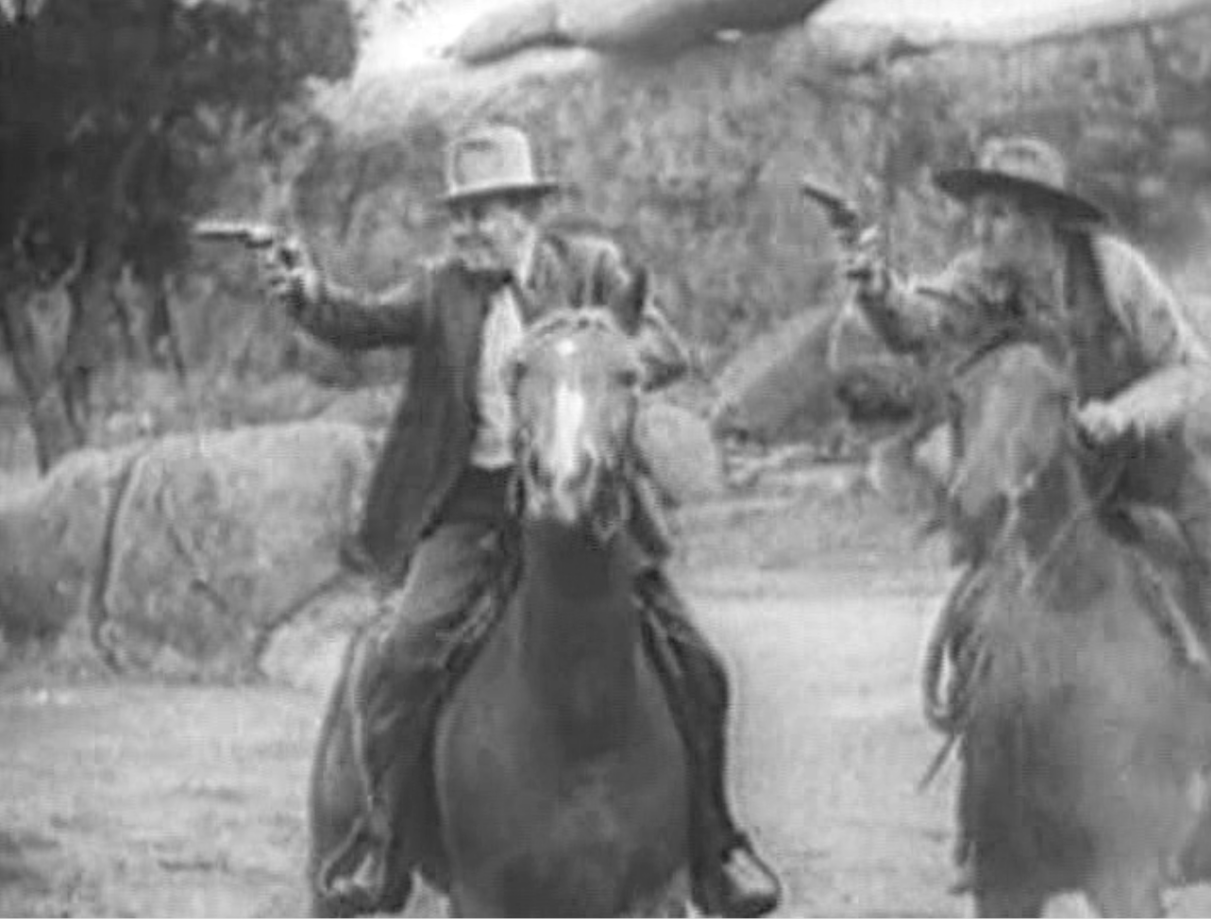
This shot is so unusual — and from a film location research standpoint, so spectacular — that at first I didn't know what I was seeing. But I eventually figured it out — I think — and when I did, I momentarily had a hard time catching my breath. Unless I'm mistaken (and as it turns out, I was), this shot from the 1934 Beacon Productions B-Western "Cowboy Holiday" presents a view of the west side of "The Wall," a legendary rock feature that used to stand on the old Iverson Movie Ranch in Chatsworth, Calif. The large rock "wall" filling the top half of the frame would be just the southern tip of the much larger formation known as The Wall, and this view from the west was virtually never filmed — at least not from close range. Even though the rock appears white in this shot, it's truly the unseen "Dark Side of The Wall." (OK, so, not so much.)

An aerial view of the Cal West Townhomes development on the site of the former Lower Iverson
Movie Ranch in Chatsworth, Calif., shows where The Wall used to stand — approximately
where the magenta bar appears.

The Wall was not an uncommon feature in old movies and TV shows shot on the Iverson Movie Ranch, but it was almost always shot from the east. It was a striking feature, and is among the most lamented of the classic movie rocks that were demolished to make way for development as the old Iverson Ranch was subdivided and built out. Where The Wall once stood, we now have the sprawling condo development known as Cal West Townhomes.

"Lone Rider in Ghost Town" (1941)

This is one of the most familiar views of The Wall, as it appears in the 1941 PRC B-Western "Lone Rider in Ghost Town," showing the rock feature's eastern side. That's The Wall above the horses, filling up much of the right half of the frame. Hanging over the edge on top of the wall, above the horse toward the left, is another well-known feature, Potato Rock. The hazy mountain peak in the background — also a familiar sight in the old Iverson productions — is some distance to the south, located above Chatsworth Park. I call it Elders Peak.

"Tarzan the Ape Man" (1932)

This shot of The Wall is taken from a similar angle to the one seen in "Lone Rider in Ghost Town." The Wall isn't as sharp here, but I wanted to include the shot because it's part of a classic sequence filmed in the Iverson Gorge that appears near the end of the 1932 feature "Tarzan the Ape Man" — the movie that launched the Johnny Weissmuller era of Tarzan. Here again, The Wall is seen at the right, and Potato Rock is easy to spot, above and to the right of the elephant riders. Elders Peak appears again, at top center, and below it are the Elders, in the distance near the center of the shot. I'll highlight all of these features in the photo below.

"Tarzan the Ape Man" — with Iverson Gorge features noted

I want to note again that the Elders and Elders Peak are not on the Iverson Movie Ranch but are across Santa Susana Pass Road, a short distance to the south. They are, however, important features when trying to understand the location work done at Iverson, because they show up frequently in productions filmed on the ranch.

"Jesse James at Bay" (1941)

The above shot from the 1941 Roy Rogers movie "Jesse James at Bay" from Republic offers a wider view of The Wall and its context in the Iverson Gorge, seen again from the east, as usual. The focal point of the shot is Gorge Cabin, in the foreground, but many of the dynamic features of the Gorge can be seen in the background and should be pointed out. I'll highlight them in a series of shots, below.

"Jesse James at Bay" — with Iverson Gorge features highlighted

Gorge Cabin was in place in the Iverson Gorge from approximately 1936-1944, undergoing a series of renovations and expansions and appearing in many movies, among them "The Terror of Tiny Town" (1938), the original "Lone Ranger" serial (1938)  and many of PRC's "Billy the Kid" movies of the early 1940s. It is believed that the cabin was relocated in the mid-1940s to the Upper Iverson, where it continued to appear in productions for some time, usually being referred to during that later period as Hidden Valley Cabin or Stone Cabin.

"Jesse James at Bay" — with additional Iverson Gorge features highlighted

This shot indicates the status today of some of the Iverson Gorge rock features. Those that have survived, or in some cases, partially survived (for example, about half of the original Crown Rock exists today), are sprinkled among the Cal West Townhomes.

Here's one more version of the "Jesse James at Bay" shot, and this one gets back to the main point of this blog entry. The highlighted area shows the southern end of The Wall, as seen from the east. This is approximately the same portion of the rock feature that appears in the shots from "Cowboy Holiday" (which we now know is not true) — where it's seen from the west, revealing the other side of the rock. The shot below pinpoints the view of this portion of the rock in "Cowboy Holiday" ... but in fact, no.

"Cowboy Holiday" ... but NOT what's labeled here.

Although the scale is vastly different in the above two shots, I (used to) believe they zero in on the same piece of The Wall — from opposite sides. Below is an even closer shot of this "Dark Side of The Wall," with some additional context.

Southern tip of The Wall (NOT), seen from the west (true), in "Cowboy Holiday" (true)
with Nyoka Cliff in the background at top right (and true)

Another shot from "Cowboy Holiday," above, helps nail down exactly what we're looking at because the shot includes a well-known Iverson rock feature that was located nearby — Nyoka Cliff. The cliff is seen in the background in the above shot, in the top right corner. Below is a closer examination of some of the features of Nyoka Cliff seen in this shot.

This wider view of Nyoka Cliff appears in the 1952 movie "Son of Paleface."

A split-screen comparison of portions of the above two shots from "Cowboy Holiday," on the left, and "Son of Paleface," on the right, features Nyoka Cliff as seen in both movies, revealing a number of markers such as the smaller rock above the cliff and the horizontal cracks in the cliff itself. Some of the markers are pointed out in the shots below. You can click on any of these shots for a larger view.


Here's an image of Nyoka Cliff as it appears today, taken on a recent visit to the site. The same markers noted above, as they appeared in "Cowboy Holiday" and "Son of Paleface," can still be seen, as highlighted in the shot below.

Nyoka Cliff today, with markers noted from "Cowboy Holiday" and "Son of Paleface"

I'm stating the obvious here, but just for the record, I don't mean to imply that it's the same bush, still there 80 years after "Cowboy Holiday" was filmed. But it's a similar bush growing in the exact same spot, where the cliff apparently offers a little patch of fertile dirt.

One last shot of the west side of The Wall — the "Dark Side" — as seen in "Cowboy Holiday" (but not really)

The Wall as it appears in "Cowboy Holiday" could hardly be called a thing of beauty. In terms of aesthetics, its intimidating size, scarred surface and brutish shape make it something of a monstrosity. But to me, getting a look at the west side of The Wall is a little bit like the early space explorers finally catching their first glimpse of the dark side of the Moon (and then finding out the Moon landing was faked). In a way the "Dark Side of The Wall" is even more rare — we knew the dark side of the Moon would be there waiting for us if we could just get up there. But with The Wall having been destroyed years ago, the only way we were ever going to see its "dark side" was if it turned up in a movie or TV show. Luckily, it finally did. (And then it didn't.)


The Wall comes up pretty regularly on this blog, and if you would like to read more about it, I recommend checking out my recent tribute to Shirley Temple, which gets into The Wall in connection with Shirley's appearance in "Wee Willie Winkie." You should be able to find the Shirley Temple post below this one, or you can click here to read it. Other previous posts about The Wall include the Three Stooges' visit to the rock feature (part of a longer post about the Stooges), a Ray Harryhausen "Dynamation" monster on a rampage near The Wall and a post about the Gorge Cabin that includes a number of movie shots of The Wall. Additional posts about The Wall can be seen by clicking here or by finding The Wall in the extensive index at the right of this page.

In case you're interested in seeing "Cowboy Holiday" for yourself, I've included a link below where you should be able to buy a reasonably priced DVD of the movie off Amazon.

Wednesday, February 12, 2014

Shirley Temple dies — and she probably never knew she had a rock named after her

Shirley Temple, 1928-2014

I was sorry to hear the news this week of the death of Shirley Temple Black at age 85. She was a unique talent and had an enormous impact not just on movie fans of the 1930s, but on American culture. She also earned a special place in Iverson Movie Ranch history, starring in one of the most important Iverson productions, "Wee Willie Winkie," released in 1937.

Shirley Temple was the biggest movie star in the world in the mid-1930s, even though she was still just a little kid. When she appeared in the John Ford epic "Wee Willie Winkie," along with established Hollywood stars including Victor McLaglen and Cesar Romero, Shirley — who was 8 years old during filming of the movie — was top-billed. And McLaglen was already an Oscar winner for his lead role in "The Informer" in 1935.

Shirley Temple, as young Priscilla Williams — Wee Willie Winkie — with Cesar Romero, as the warrior 
Khoda Khan, in a promotional still for John Ford's "Wee Willie Winkie." The photo, shot on the 
Iverson Movie Ranch, comes from the collection of film historian Jerry England.

As she always did, Shirley stole the show in "Wee Willie Winkie," a war movie about the British colonial period in India. Shirley's character charmed her way into the hearts of soldiers on both sides of the conflict, while the young actress chewed up the scenery across two elaborate sets built for the movie on the Iverson Movie Ranch — widely considered to be the most extensive construction ever done for a movie at Iverson.

In a battle sequence from the film, Shirley stopped to survey the situation from atop a particular rock, seen above. The scene takes place in the Iverson Gorge, among buildings that were part of the set built as India freedom fighter Khoda Khan's mountain stronghold. I've blogged about this scene before — and you can click here to read that earlier post. Shirley's scene on this rock led to the rock being referred to — by me, initially, but to some extent by other location researchers as well — as Shirley Temple Rock.

Here's a wider view of Shirley Temple Rock from "Wee Willie Winkie," with 8-year-old Shirley scampering down from the rock feature.

The rock has turned up in other productions as well, which helped pinpoint its location. Here's an appearance by Shirley Temple Rock many years after the "Wee Willie Winkie" filming, in an episode of the TV show "The Virginian" called "Run Quiet," which first aired Nov. 13, 1963. Shirley Temple Rock is the shade-covered rock feature occupying the lower left corner of the frame. This shot also includes a number of other significant features of the Iverson Gorge — I'll post an annotated version of the photo below to point those out.

Here you can get an idea of the various rock features seen in the shot above this one, from "The Virginian." The hill in the background, across much of the top of the frame, is Cactus Hill, located to the north of Iverson Gorge. Most of the rock features seen in this shot remain in place today — but Shirley Temple Rock was not as fortunate. Sadly, the rock did not survive the development of the former Iverson Movie Ranch, being demolished to make way for condos.

Here's another appearance by Shirley Temple Rock, in the 1938 Bob Steele B-Western "Thunder in the Desert." The picture quality isn't the greatest, but you may be able to make out the rock at the left, below the shooter's outstretched arm. The background is filled by the rock feature known as The Wall, and a portion of Potato Rock, on top of The Wall, can be seen. I'll point out these features in the next shot.

This is the same shot as above, from "Thunder in the Desert," with key rock features highlighted. Unfortunately, all of the rocks seen here — including Shirley Temple Rock — were destroyed to make way for the Cal West Townhomes.

Shirley Temple on the set of the India outpost, built at Sheep Flats on the Iverson Movie Ranch,
in a scene from "Wee Willie Winkie." 

Other key scenes in "Wee Willie Winkie" took place on Iverson's Sheep Flats, where a massive set, usually called the India outpost or the India fort, was built. A small portion of this set can be seen in the shot above. By coincidence, my previous blog entry, published about a week before Shirley Temple's death, also featured Shirley Temple, "Wee Willie Winkie" and the India fort. You can go to that entry by clicking here, or you should be able to find it below this post. Additional posts about "Wee Willie Winkie" may be found here.

Shirley Temple Black

I would be shocked if I found out Shirley Temple Black ever heard of Shirley Temple Rock, or knew she had a rock named in her honor — a rock she scampered up as a child, with that scampering preserved for future generations thanks to the magic of celluloid. The rock name is a modest honor, to be sure — nothing formal, just a tribute to an actress and a little girl who won over the hearts of millions.

Sunday, February 2, 2014

The Pirate Ship and a new view of the Sheep Flats adobes — one of those "wow" moments for a film historian


This adobe village got my attention when I spotted it recently in the 1940 Paramount B-Western "The Light of Western Stars," starring Russell Hayden, Victor Jory and Jo Ann Sayers. The one thing I couldn't stop focusing on was the rock formation that's partially visible above the adobes, toward the left in the above screen shot.

This shot from the same sequence provides a slightly better look at those rocks, which were looking familiar to me at this point. I thought they might be the Pirate Ship, a familiar rock formation at the old Iverson Movie Ranch. It turned out that's exactly what they were, and I was suddenly having one of those "wow" moments that only come once in a while amid endless hours of fruitless scouring of boring old movies.

A still closer look at some of the adobes and the rocks above them — this screen shot offers what is probably the best view we get of the Pirate Ship in "The Light of Western Stars." The sequence turns out to be an important one, adding to what is known about the evolution of construction during the late 1930s and early 1940s on the portion of the Iverson Movie Ranch known as Sheep Flats.

Here's a view of those same rocks — the Pirate Ship — more than 20 years later, in an early episode of the TV show "Bonanza" called "Cutthroat Junction," which first aired March 18, 1961. While not exact, the angle is similar to the one shown in "The Light of Western Stars." You may be able to spot the similar shapes of the tops of the rocks in the two shots above. If you're having trouble, notice the large triangular rock directly above the wagon in the "Bonanza" shot, and the shadowy section of rock just above that, descending toward the right at a 45-degree angle. Then try to find that same group of rocks in the "Light of Western Stars" shot — in the photo above this one, the rock is directly above the corner of the main adobe in the shot. The rock even has the same wispy tree "growing out of it" in both productions. If you look closely, the rest of the rocks match too.

The Pirate Ship remains in place today, part of the Indian Hills Mobile Home Village. I don't have a shot of it from the exact same angle as in either of the productions above, but the above shot comes reasonably close, and shows what the formation looks like in its contemporary setting. It even appears to still have that same tree "growing out of it" — although the tree has filled out considerably and is no longer what one might call "wispy."

This is the view of the Pirate Ship that gives it that name — from this angle the rock feature has always reminded me of one of the old sailing vessels with its main sail at full billow. I've posted before about the Pirate Ship — click here to see that post. The formation has been a helpful identifier for the Iverson Movie Ranch in the past, and it came through again by helping to pinpoint the location for "The Light of Western Stars."

"Wee Willie Winkie" (1937): The Pirate Ship rock formation, top, and a portion of the India Fort;
Shirley Temple appears at the far right

Buildings appeared in that same area — just below the Pirate Ship — beginning with the Shirley Temple movie "Wee Willie Winkie" in 1937, as seen in the screen shot above. The lookout tower at the very top was in place only for that one movie. The rest of the structures coexisted for years with the Western street that was built just east of the India Fort in late 1944 for "Along Came Jones" and became a fixture at Iverson until 1957. The "Wee Willie Winkie" India fort was a sweeping set of structures that spanned much of the west end of Sheep Flats, and the set outlasted the Western street, finally being torn down when Sheep Flats was sold off in 1963.

More of the "Wee Willie Winkie" India fort

It's tempting to declare that some of the buildings seen in "Wee Willie Winkie" are the same as those seen at the top of this post in "The Light of Western Stars." For example, the building near the center of the above shot bears a striking resemblance to one of the buildings in the adobe village in "The Light of Western Stars." I've highlighted this building in the two photos below.

"Wee Willie Winkie" (1937) — notice the building highlighted by the rectangle

"The Light of Western Stars" (1940) — again, notice the highlighted building

The positions of the buildings in the above two screen shots are similar, and in both cases the building is directly below the Pirate Ship rock formation. Additionally, both buildings have a door and two side windows in the same place. The appearance of the two roofs is different, but that's the case with movie buildings in general — they could have a certain "look" in one production and then have completely different trim in another production. It's a given that the horizontal roof extensions on many of the buildings of the India fort in "Wee Willie Winkie" were removed after filming for that production.

My gut tells me it's the same building in both productions, and even though I'm not prepared to declare with absolute certainty that it is, it's the best evidence I've found to date of a direct connection between the construction for "Wee Willie Winkie" and subsequent productions in that corner of Sheep Flats.

"Wee Willie Winkie" — a wide view of the India fort

The sprawling India fort built for "Wee Willie Winkie" in 1937 comes up frequently in research into the history of construction on Iverson's Sheep Flats, as it was clearly the production that got the ball rolling in that area. I've posted before about the connections between the "Wee Willie Winkie" fort and later productions, such as "Army Girl" (1938) and "Rawhide Rangers" (1941). (Click here to see my original post about the stunning adobe fort at the western edge of Sheep Flats, and here to see a follow-up with additional revelations.) But what's different about the sightings in "The Light of Western Stars" is that, with the exception of "Wee Willie Winkie," the buildings that turn up are almost always farther west — toward the western edge of Sheep Flats.

Sunday, January 26, 2014

The Iverson Movie Ranch after the brutal Southern California wildfires of fall 1970: A record found in an obscure TV show

An episode of the short-lived early 1970s Glenn Ford TV show "Cade's County" contains some unusual Iverson Movie Ranch footage — unusual in part because it was late in the life cycle of the movie ranch, where production wound down for the most part by the end of the 1960s, and also unusual because the "Cade's County" footage captures some of the effects of the devastating fall 1970 Southern California wildfires.

"Cade's County" TV series: "The Mustangers" (premiered Nov. 14, 1971)

Shot in 1971, the "Cade's County" episode "The Mustangers" showcases the Upper Iverson as it existed in the summer following the fires: a combination of dried grass and charred trees and bushes still struggling to survive. The footage documents the regeneration process of the native foliage: The grass had grown back during the winter and spring following the fire, then subsequently dried out as another hot Chatsworth summer set in.

Front-page story in The Valley News, Sept. 27, 1970

The wildfires raged for 13 days that fall — from Sept. 22-Oct. 4, 1970 — a notorious chapter in California's history of natural disasters. By the time the flames were extinguished, 16 people had perished, 722 homes were destroyed and 576,508 acres had been burned, according to various media accounts.

In all, a reported 773 wildfires were documented throughout the state around that time. The huge fire that swept through the Iverson Ranch, sometimes called the Newhall-Malibu Fire or the Chatsworth-Malibu Fire, destroyed virtually all of the movie ranch's remaining manmade sets, along with most of what was left of Corriganville, several miles to the west in Simi Valley.

Laguna Fire, 1970

One of the most infamous fall 1970 wildfires became known as the Laguna Fire, which was also called either the Kitchen Creek Fire or the Boulder Oaks Fire while it was raging. The above map shows the area it destroyed, mainly in eastern San Diego County. Said to be either the second largest or third largest fire in California history at the time, the Laguna Fire broke out on Sept. 26, 1970, as a result of downed power lines caused by Santa Ana winds, and went on to burn 175,425 acres, killing eight civilians and destroying 382 homes.

Topo map: Clampitt Fire, 1970

The Newhall-Malibu Fires of 1970 break down in various ways according to various reports, but one of the major trouble spots was the Clampitt Fire, outlined in the topo map above. The Clampitt Fire is said to have destroyed between 105,000 and 115,000 acres and is blamed for the loss of four lives and 86 structures. A close look at the map reveals that the Clampitt Fire would have cut a swath through a number of well-known movie sites, including parts of the Lower Iverson, in the top right corner of the map.

"The Quick Gun" (1964): The Bell Location Ranch Western town

The Clampitt Fire also swept through historic filming locations including Spahn Ranch, just southwest of the Iverson Ranch; Bell Location Ranch, in the area designated "Box Canyon" on the map; Burro Flats, near where "Rocketdyne" is indicated; and Ahmanson Ranch, which is pinpointed on the map. As it was officially mapped out, the Clampitt Fire missed both Corriganville and the Upper Iverson, although those areas were hit by other destructive fires around the same time.

"Gunsmoke" episode "Shadler" (1973): The surviving Bell Ranch Western town

Surprisingly, the Western town at Bell Ranch survived the fires, and went on to appear in a number of later productions, including "Gunsmoke." The town was eventually torn down and replaced by residential homes.

This photo dated Sept. 25, 1970, from what was being called the Chatsworth-Malibu Fire, ran on the front page of the L.A. Times with a caption reading: "Randy Pearson, 18, kneels in front of his Chatsworth home as the roof goes up in flames."

But on the Iverson Ranch the following summer, it was back to business as usual, as much as possible, with the shoot for "Cade's County." George Maharis, above, guest-starred in "The Mustangers" as a motorcycle-riding, fringe-leather-wearing, gun-totin' bad guy. This shot shows Maharis on the Upper Iverson, with Prominent Rock, also known as Medicine Rock, in the background. Notice the thick coating of dry grass on the ground, along with some oak trees that appear to have been missed by the fires.

Here's Maharis on his ride, which he uses on the show to illegally round up wild horses. Turtle Rock, a familiar feature from countless chase sequences in the B-Western era, looms in the top right corner, and a little more of the charred remains of foliage is visible in the background.

This shot from "The Mustangers" shows a familiar Upper Iverson rock formation I call the Three Stooges. To my eye the terrain, as it appeared in the summer of 1971, looks even more dusty and sparse than usual.

Some things never change — the producers couldn't resist working Wrench Rock into the episode. That's the widely filmed Wrench Rock — also known as Indian Head, Upper Indian Head, Bobby and various other names — directly above the heads of the young couple.

Wrench Rock was used as a prop for an impromptu photo shoot in the episode, with the young man taking pictures of his girlfriend in front of the charismatic rock feature. The Rocky Peak area of the Santa Susana Mountains to the west, specifically a formation I call Pyramid Peak, can be seen in the background.

The young lady mugs for the camera below Wrench Rock.

Wrench Rock also got its own closeup, seen in this screen shot. The rock can still be found today on the former Upper Iverson Movie Ranch, although access to the area tends to be difficult.

A number of "wild" mustangs were turned loose on the Upper Iverson during the shoot for "Cade's County" — probably one of the last times that happened on the Iverson Ranch. Here again, the landscape looks even more desolate than it usually does.

Glenn Ford, the star of the series, made it out to the ranch for the shoot, and is seen here riding on the Upper Iverson's South Rim. He usually drove a Jeep on the show, which was essentially a contemporary Western focused on Ford as a small-town sheriff. The show's run on CBS lasted only one season — from September 1971 to April 1972 — with a total of 24 episodes airing.