Why we love old movie locations — especially the Iverson Movie Ranch

For an introduction to this blog and to the growing interest in historic filming locations such as the Iverson Movie Ranch — the most widely filmed outdoor location in movie and TV history — please read the site's introductory post, found here.
• Your feedback is appreciated — please leave comments on any of the posts.
• To find specific rock features or look up movie titles, TV shows, actors and production people, see the "LABELS" section — the long alphabetical listing on the right side of the page, below.
• To join the MAILING LIST, send me an email at iversonfilmranch@aol.com and let me know you'd like to sign up.
• I've also begun a YouTube channel for Iverson Movie Ranch clips and other movie location videos, which you can get to by clicking here.
• Readers can email the webmaster at iversonfilmranch@aol.com
.

Saturday, February 4, 2012

Another look at the 1952 aerial photo of Iverson

This is an update on an old blog entry, which you can still see by clicking here, in which I posted about the 1952 aerial photograph of Chatsworth that includes the Iverson Movie Ranch.

1952 aerial view of the northwest corner of Chatsworth, Calif.

I hope the version shown here expands on what I posted previously. The above photo is essentially the same 1952 aerial photo used as the basis for the earlier post, but the scope is wider here, and additionally some of the features may be more clear here. (You may want to click on the photo to enlarge it, as it enables you to see it in more detail.) The earlier post is still worth checking out, especially for the Lower Iverson features that have been labeled by Iverson researcher John Emmons.

1952 aerial photo showing the Brandeis and Iverson Movie Ranches

The area shown in the aerial map includes all of the Iverson Movie Ranch, along with most of the neighboring Brandeis Ranch — which was also a filming location, although not nearly as widely used as Iverson. In the aerial photo, much of Brandeis consists of the distinctive flat area in the top left corner, with its eastern boundary identified by a line of trees (a dark vertical line on the aerial map at the top). This line of trees borders the Upper Iverson, and is a common feature in the backgrounds of movies and TV shows shot at Iverson.


To my eye the shape of Brandeis Ranch resembles the state of Montana, upside-down. Maybe you can see what I mean in the above upside-down map of Montana.

The aerial at the top of this post also shows some of the San Fernando Valley farmland that still existed in Chatsworth as of 1952, in the bottom right corner. This farmland can sometimes be spotted in productions, especially in the background of shots of the Iverson Gorge.

In the aerial above, you may also notice Santa Susana Pass Road, the winding, roughly horizontal (east-west) road about one-third of the way up from the bottom of the shot, which formed the southern boundary of Iverson. A switchback marks the eastern end of Santa Susana Pass, and to the immediate southeast of that switchback is Stoney Point.


Here's a zoomed-in version of the aerial map at the top of the post. This is essentially the Iverson Movie Ranch, as of 1952 — still pretty much at the height of its use as a movie location. It's only by luck that we happen to have a 1952 map — I'm not sure why it happened then, but I assume it was part of a government project, perhaps associated with the U.S. Geological Survey, and if I know anything about the geopolitical situation at that time (which I don't), it was probably related to the Cold War and national security. But whatever the reasons, we have been handed down a timely and useful aerial view of the Iverson Movie Ranch in 1952. (I would love to have something similar from circa 1937 or 1944 ... but that's just my little fantasy.)

As it turns out, 1952 is a pretty good point in time to get a snapshot of Iverson. By 1952 much of Hollywood's focus was already shifting from movies — particularly the B-movies that had been Iverson's bread-and-butter up to that point — to the fledgling TV business. The early TV series, especially the Westerns — starting with "The Lone Ranger" in 1949 — ensured that Iverson remained an important extension of Hollywood and a busy hub of the entertainment industry for at least the next decade.


This is just one of the highlights of the 1952 aerial shot. As of 1952, Iverson's Western street — often called Iverson Village or El Paso Street — was in place and in wide use, after having been built in 1945 for Gary Cooper's "Along Came Jones." Above is an even more zoomed-in (and darker) version of the 1952 aerial focused on the Sheep Flats area where the town was built. The aerial doesn't blow up much better than this, but you should be able to make out the Western street near the bottom of the shot, about one-third of the way in from the left edge of the photo.

Here's a highlighted version of the same aerial shot to make it easier to find the Western town. The flat area that makes up much of the middle of the shot is Sheep Flats, also called Indian Hills — and this whole flat area, including where the town once stood, is now the site of the Indian Hills Mobile Home Village. Almost at the center of the photo above is a large tree all by itself. Under this tree could be found (and can still be found) Center Rock, an especially charismatic and important Iverson movie rock that has been featured in other posts.

Monday, January 23, 2012

James Dean's connection to the Iverson Movie Ranch — and the tomb of Jesus

James Dean

This discovery took a fair amount of work and a lot of luck, but I was able to unearth the tantalizing fact that James Dean's first screen credit was in a production that brought him to Iverson. And if that weren't enough, the tomb of Jesus is depicted in the production — and it turns out it's at Iverson too!

The production was an hour TV drama called "Hill Number One." Don't expect to see any sharp, clear screen shots of Jimmy scrambling among the Iverson rocks with a six-shooter. This isn't that kind of discovery. But it's a story I think is pretty fascinating anyway, going back to the early days of television and the early days of Dean's career, which came together in 1951.

The occasion was an episode of a relatively unknown TV anthology series called "Family Theatre," which had a long run on TV in the 1950s. The series was a Christian-oriented production of the Family Rosary Crusade, under the stewardship of Father Patrick Peyton. (Peyton is often credited as the guy who came up with the slogan "The family that prays together stays together," and he delivers it at the end of the episode.) The "Family Theater" series started on radio in 1947 and apparently moved to TV in 1951 — with a minor spelling change, from "Theater" to "Theatre" — and then remained on the air through 1957. According to some accounts, the series produced something like 540 episodes — a total that would rank it among the most prolific TV shows in history.

The bulk of the material in these productions appears to have disappeared, or at least is out of circulation. But a select few episodes — notably the one with James Dean, Iverson and the tomb of Jesus — appear to have made it to DVD. Additionally, some of the radio episodes reportedly still get aired on the EWTN Radio Network. "Hill Number One," probably the most widely distributed of the vintage episodes, has a DVD cover, seen above, that depicts a scene shot at Iverson, with three crosses on a hill representing Calvary, or Golgotha. The key word there is "depicts," as this cover shot is not an actual shot of Iverson.

Here's the equivalent shot from the production itself, showing Calvary soon after the crucifixion. The shot first appears about 22 minutes into the hourlong episode, and this is the first Iverson I was able to identify in the show. The actual hill is a relatively nondescript one at Iverson, just east of Nyoka Cliff. I've begun calling it Mount Calvary in honor of this show.

It gets more interesting when the camera pans right, revealing a familiar rock I call Jaunty Sailor, which I've blogged about before in an entry you can find here. Jaunty Sailor is the large vertical rock just right of center, and while it's a little hard to make out here (you can click on the photo to enlarge it), some movie construction has been attached to its right side — its eastern side at the location. It turns out this is the tomb where the body of Jesus was placed after he was removed from the cross. (In the show, not in real life ... just in case that needs to be said.)

The tomb of Jesus, in "Hill Number One"

Here's a closer look at the tomb of Jesus, as it was constructed for the production, complete with the large round stone meant to ensure that the body stayed put. You can see a little bit of Jaunty Sailor to the left, jutting out next to the tomb entrance.

James Dean as John the Apostle in "Hill Number One"

James Dean plays John the Apostle — a role that has sometimes been reported in error as John the Baptist. It's a small role, but Dean is easy to spot even in a cast that includes a surprising number of familiar names — Roddy McDowall, William Shallert, Michael Ansara and others. Dean's role has sometimes been described as non-speaking, but that's another erroneous report. He has a number of lines, including a brief speech at a meeting of the disciples, seen in the above shot. It's not much, but it's the start of what turned out to be his lasting screen legacy.

The production gives us a good look at a young James Dean — about four years before his breakout and only 19 or 20 years old. (Even though he would play a high school student a few years later in the 1955 movie "Rebel Without a Cause," Dean was already 24 years old when that movie was being made.)

Here's the first appearance of James Dean at Iverson, second from the right, with Ruth Hussey as Mary, Regis Toomey as Nicodemus, next to Dean, and Nelson Leigh as Joseph of Arimathea on the left. The scene takes place at the tomb of Jesus, located a short distance east of Nyoka Cliff.

Another shot of James Dean at work at Iverson. That's Dean as John the Apostle on the right, with Charles Meredith as Peter on the left. The disciples have just received word of the Resurrection, and John is examining the stone that was supposed to keep the body of Christ in the tomb.

Peter and John look over the empty veil that was previously wrapped around Jesus' head — prompting John to grasp what has happened and go forth to spread the word, announcing: "He has risen as he promised."


Family Theater Productions still exists, and apparently still has some of the vintage productions for sale on its website (familytheater.org). I couldn't find "Hill Number One" on the site, but it's available on Amazon and other sites. (You can find it by clicking on the ad below.)

Sunday, January 22, 2012

What was the director of "Casablanca" doing on the Iverson Movie Ranch?

Michael Curtiz

One of the most acclaimed directors of Hollywood's Golden Age — and the director of the movie that many film lovers call the best of all time — Michael Curtiz had a history at Iverson. While he didn't shoot "Casablanca" at the ranch, he visited Chatsworth on a number of occasions to add Iverson's dramatic backdrops to his movies.

"Noah's Ark," 1928

Curtiz directed for years in his native Hungary in the silent era before relocating to the U.S. in 1926. One of his first Hollywood projects, the silent biblical epic "Noah's Ark," produced the iconic special-effects shot seen above, in which the massive Ark is "beached" on the familiar rocks of Iverson's Garden of the Gods — notably Tower Rock and Sphinx, sometimes called Indian Head and Eagle Beak. Curtiz collaborated with legendary studio mogul Darryl F. Zanuck on the movie, which starred a lineup of silent era A-listers including Dolores Costello, George O'Brien, Noah Beery and Myrna Loy.

Here's a contemporary shot of the same rocks, with the view from this angle now largely blocked by trees. That's Tower Rock on the left (also known as Indian Head) and Sphinx on the right (also known as Eagle Beak).

Humphrey Bogart and Ingrid Bergman in "Casablanca"

Curtiz went on to direct a string of cinema classics in the 1930s and early 1940s, being nominated for an Academy Award for "Captain Blood" (1935) — a write-in nomination, leading to a second-place finish in the voting for the Oscar — receiving two nominations for best director in one year for the 1938 movies "Four Daughters" and "Angels With Dirty Faces" and chalking up still another nomination for best director for "Yankee Doodle Dandy" (1942) before winning the Academy Award for his masterpiece, "Casablanca" (1942).

Joan Crawford in "Mildred Pierce"

Notoriously caustic toward actors, Curtiz nonetheless worked with the best in the business. Humphrey Bogart, Walter Huston, John Garfield, Ann Blyth, William Powell, Paul Muni, Eve Arden and Claude Rains all received Oscar nominations for their work in Michael Curtiz movies, while James Cagney ("Yankee Doodle Dandy," 1942) and Joan Crawford ("Mildred Pierce," 1945) picked up statuettes. The list of Hollywood legends he directed is too long to do it justice, but it also includes Bette Davis, Al Jolson, Elizabeth Taylor, Edward G. Robinson, Sophia Loren, Bing Crosby, Alan Ladd, Patricia Neal and Robert Taylor, among many others.

Curtiz even worked with the King, directing Elvis in "King Creole" in 1958. This one wasn't shot at Iverson, but Elvis did shoot one movie there — "Harum Scarum" in 1965.

For the 1936 war movie "Charge of the Light Brigade" Curtiz staged battle scenes in Iverson's Upper Gorge. In the above screen shot from the movie, warriors are gathered atop The Wall, and in particular Potato Rock, the boulder at the right. These rocks no longer exist, having been destroyed to make way for condos.

Another group of combatants in "Charge of the Light Brigade" is set up nearby, with the group at the top of the shot seated on Three Ages Rock. This rock has survived condo development and can still be seen today — although the section in the foreground, where the shooter is carefully aiming his rifle, has been blown away.

"Charge of the Light Brigade" was one in a series of Michael Curtiz movies that paired Olivia de Havilland and Errol Flynn. Others included "Captain Blood" (1935), "The Adventures of Robin Hood" (1938), "Essex and Elizabeth" (1939) and "Dodge City" (1939).

Curtiz knocked out a few Westerns toward the end of his career, including "The Proud Rebel" in 1958, with de Havilland again and Alan Ladd, and "The Hangman" in 1959, featuring a cast of now familiar TV names such as Tina Louise ("Gilligan's Island"), Fess Parker ("Davy Crockett") and Jack Lord ("Hawaii Five-0"). His final film was another Western — "The Comancheros" (1961), starring John Wayne. Six months after its release, on April 10, 1962, Michael Curtiz died of cancer in Hollywood at age 75.

Tuesday, January 17, 2012

How the Iverson Movie Ranch found its way into a 1998 music video by Neil Finn

Click on the image above to watch the video on YouTube

This 1998 video for the song "She Will Have Her Way," by New Zealand rocker Neil Finn, is a parody of the old "rampaging enormous women" movies, including the 1959 Lou Costello comedy/sci-fi movie "The 30 Foot Bride of Candy Rock," much of which was filmed on the Iverson Movie Ranch.

"Candy Rock" was itself a parody of the much more famous sci-fi movie "Attack of the 50 Foot Woman," which came out the previous year. "50 Foot Woman" was not shot on the Iverson Ranch.


Neil Finn and his 30- to 50-foot girlfriend, in the music video "She Will Have Her Way"

Neil Finn is known for fronting the bands Split Enz and Crowded House, along with his solo career. This solo video includes footage from both "30 Foot Bride" and "50 Foot Woman," cleverly blending original clips from both films with new footage featuring Finn and his own 30-foot (or 50-foot) girlfriend.

Best of all, for those of us who may be obsessed with the Iverson Movie Ranch, the video creates "new" footage shot on the ranch by superimposing Finn and his video girlfriend over scenes originally filmed on the ranch in the 1950s. The barn seen here no longer exists — it has been borrowed from "30 Foot Bride," with Finn's modern-day video vixen seen running in front of it using composite imaging.

Here's a shot I really like from the video, which is lifted straight from the movie. It shows a truck hauling the wrapped-up "30 Foot Bride" past a distinctive formation I call Rock Island, which was located in the Iverson Gorge and had high-profile appearances in John Wayne's "Fighting Seabees" (1944) and many other productions. The shot is flipped horizontally, for whatever reasons. (For more about flipping shots, click here.)

This is how the above shot "should" look — and how it would have looked if it hadn't been flipped in production. But it appears in its flipped configuration in both the movie, "30 Foot Bride of Candy Rock," and the music video, Neil Finn's "She Will Have Her Way." The big cluster of boulders seen in the shot, Rock Island, was mostly buried during grading for condominium development, but the rocks are all still there. Only about the top one-third remains above ground, but that fraction of the formation is visible and can be seen near the Cal West Townhomes swimming pool area along Redmesa Road.

The barn featured in "30 Foot Bride" and in the music video is the Fury Barn, which was part of a ranch set built for the TV show "Fury" that got a lot of use in movies and TV shows in the late '50s and throughout the '60s. The barn and the rest of the set were destroyed in the big 1970 Clampitt Fire, also known as the Newhall/Malibu fire.

An intimate moment featuring Neil and his giant girlfriend creates a reasonable facsimile of the interior of the Fury Barn for the video. I don't know how they got the shot, but I presume it's either a studio set or else filmed in some real barn that's still around today.

As a footnote to the "30 Foot Bride"/"50 Foot Woman" story, a 1993 HBO TV movie remake of "Attack of the 50 Foot Woman," with essentially the same title ("Ft." replaces "Foot"), featuring Daryl Hannah in the title role, is widely thought to include footage shot at one of the estates on the former Upper Iverson, long after the days when the place was a working movie ranch. However, I did a little homework and was able to track down the estate used in the movie, and while it was close to Iverson — just a few doors away — technically it was on property that was once part of the neighboring Brandeis Ranch, and not the Iverson Ranch.

"War of the Colossal Beast" composite shot, filmed partly on the Iverson Ranch

The "rampaging enormous men" movies are another part of this story. Probably the best-known entry in this subgenre is "The Amazing Colossal Man" (1957), which pretty much started the whole oversized people phenomenon of the Cold War era. "Colossal Man" was not filmed on the Iverson Ranch — the location work was almost entirely done in Arizona and Nevada, including some iconic shots you may recall of the big guy taking out his hostility on some large neon figures on the Vegas Strip. But "Colossal Man" had a lesser-known sequel, "War of the Colossal Beast" (1958), that not only is a terrific Iverson Movie Ranch production but also is part of an extremely select group of movies to set foot on the iconic Chatsworth rock formation Stoney Point.

Stoney Point in Chatsworth, as seen in "War of the Colossal Beast"

Stoney Point often appears in the background in movies shot on the Iverson Movie Ranch, but "War of the Colossal Beast" includes footage actually shot at the site.

Saturday, January 14, 2012

Oscar Wilde visits the Iverson Movie Ranch and Gorge Arch

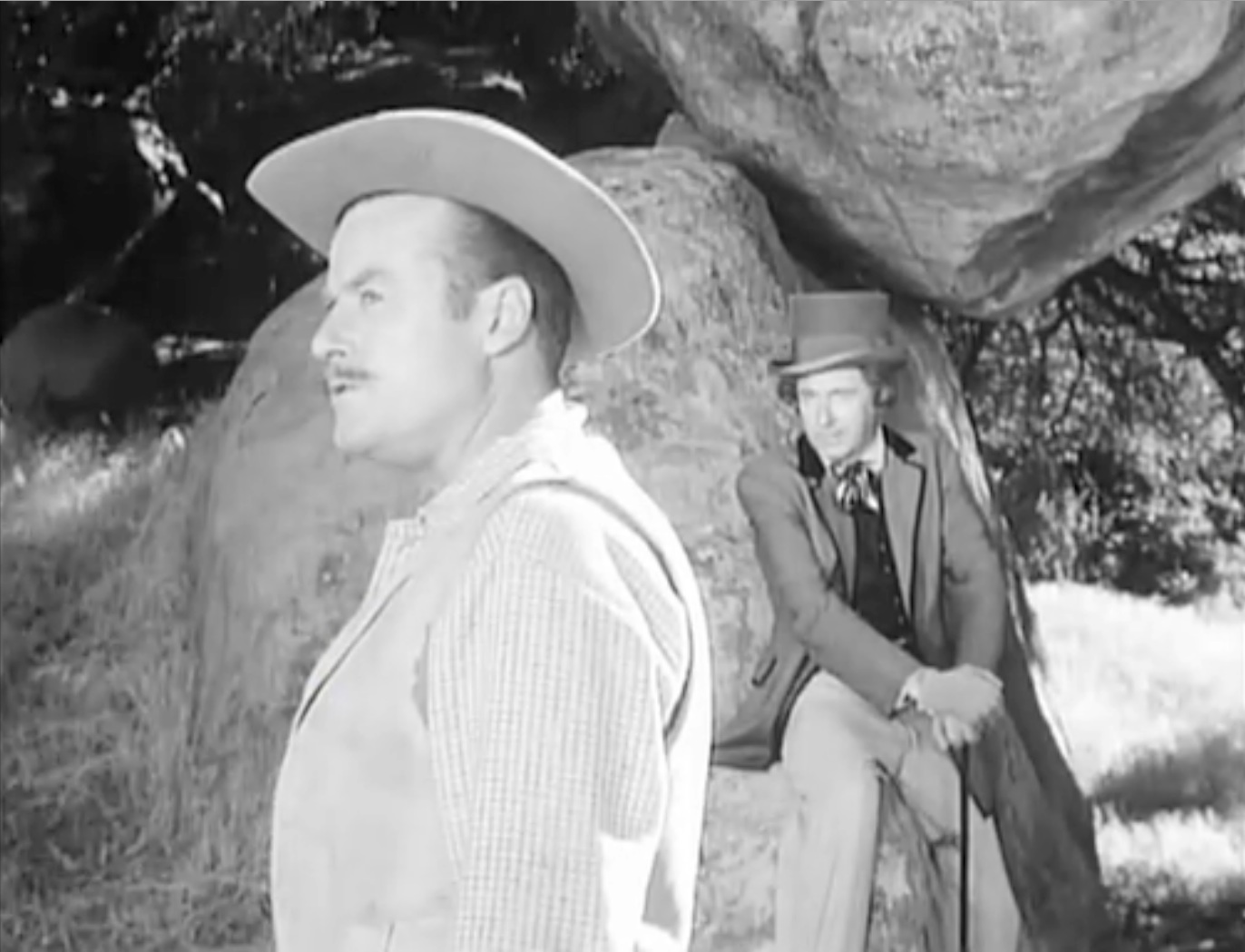
John O'Malley as Oscar Wilde in "Have Gun Will Travel"

Let's get this much settled right up front: It was a TV version of Oscar Wilde, not the real-life Irish-born playwright and poet. The real Oscar Wilde, who wrote "The Importance of Being Earnest" and "The Picture of Dorian Gray," was a sensation in London in the late 19th century before dying in 1900 — a little too early to make his way into TV or movie productions. But he toured the U.S. in the 1880s, visiting the American West when there still was such a thing, and found his way into a few tidbits of Western lore — drinking whisky with miners in Leadville, Colo., and so forth. Years later, during Hollywood's long love affair with the Wild West, a favorite plot device was to snatch famous visitors to the West from real life and put them in either an exaggerated or completely made-up storyline. Oscar Wilde's turn came around in 1958, and as luck would have it, he had his curtain call at Iverson.

Richard Shannon as Boss Rook, with John O'Malley sitting on the Gorge Arch

The character Oscar Wilde, played by Australian actor John O'Malley, had a central role in an episode of "Have Gun Will Travel" called "The Ballad of Oscar Wilde," which premiered Dec. 6, 1958. The story had Wilde kidnapped by a bad guy named Boss Rook, played by Richard Shannon, who held Wilde hostage in the Iverson Gorge.

While awaiting his fate, Wilde cooled his heels on a small boulder that was part of one of the Iverson Movie Ranch's legendary rock structures — the Gorge Arch, legendary in large part because it no longer exists, having been replaced by condos. The arch, which consisted mainly of three large boulders, was big enough to ride a horse through, and for a while in the late 1930s and early 1940s it stood next to the Gorge Cabin. In the setting above, the cabin would have been to the right, out of the shot (but it was no longer in place at the time this show was shot). The two big rocks in the background had a corral and shed in front of them for much of the period that the cabin was in place. The cabin, corral and shed, along with a fake mine entrance that was often seen in the area, were all long gone by the time "Have Gun Will Travel" showed up to tape this episode.


Inevitably, it's the series' hero, Paladin, played by Richard Boone, who rides to Wilde's rescue. At first Paladin, on the right, tries to arrange a prisoner swap, but predictably, he ends up having to shoot it out with Boss Rook.

Rook initially takes cover inside Gorge Arch — giving viewers a rare look at the inside of the arch.

Paladin makes his move, climbing on top of the smaller boulder on the left side of the arch to get the drop on Rook.

Rook slips around to the right side of Gorge Arch, providing an extremely rare detailed view of the huge boulder that makes up that side of the rock structure.

Wilde, at the left, creates a diversion, enabling Paladin to swoop in for the capture. I'm including this shot mainly because it shows the scale, with Paladin perched on the smaller of the Gorge Arch's two "base" rocks.

With the situation finally under control, Wilde and Paladin find time to exchange a few pithy quips for comic relief. Some things never change.


The real Oscar Wilde