Why we love old movie locations — especially the Iverson Movie Ranch

For an introduction to this blog and to the growing interest in historic filming locations such as the Iverson Movie Ranch — the most widely filmed outdoor location in movie and TV history — please read the site's introductory post, found here.
• Your feedback is appreciated — please leave comments on any of the posts.
• To find specific rock features or look up movie titles, TV shows, actors and production people, see the "LABELS" section — the long alphabetical listing on the right side of the page, below.
• To join the MAILING LIST, send me an email at iversonfilmranch@aol.com and let me know you'd like to sign up.
• I've also begun a YouTube channel for Iverson Movie Ranch clips and other movie location videos, which you can get to by clicking here.
• Readers can email the webmaster at iversonfilmranch@aol.com
.

Monday, May 31, 2010

The Iverson Movie Ranch in glorious Technicolor

It's a little bit unusual to see the Iverson Movie Ranch on screen in color — especially good color. When I do see Iverson in color it's typically in the low-grade picture quality of early color efforts for TV. But here are some shots from one of only a handful of productions where Iverson appeared on film in glorious Technicolor: the Gary Cooper movie "Dallas," a Warner Bros. feature from 1950.

It always starts with Garden of the Gods and the two iconic figures: Eagle Beak, or Sphinx, on the right and Indian Head, or Tower Rock, on the left.

"Dallas" is the only production in which I've seen this cabin, which was built right in the middle of Garden of the Gods, somewhere behind the Sphinx. I initially thought it may have been built on the relatively small patch of flat ground where a camera mount was in place, overlooking Iverson Gorge. (The track for that camera mount is still in place today.) But further research determined that the cabin was more likely a little to the west of that spot, probably tucked in behind the Sphinx and a nearby rock known as Phantom. My guess is the cabin was built specifically for "Dallas" and was probably torn down soon afterward. Gary Cooper already had a track record of construction at Iverson, having been responsible for building Iverson Village for his 1945 movie "Along Came Jones." In that case the construction paid lasting dividends for Iverson, as the village was used in countless productions for the next 12 years or so.

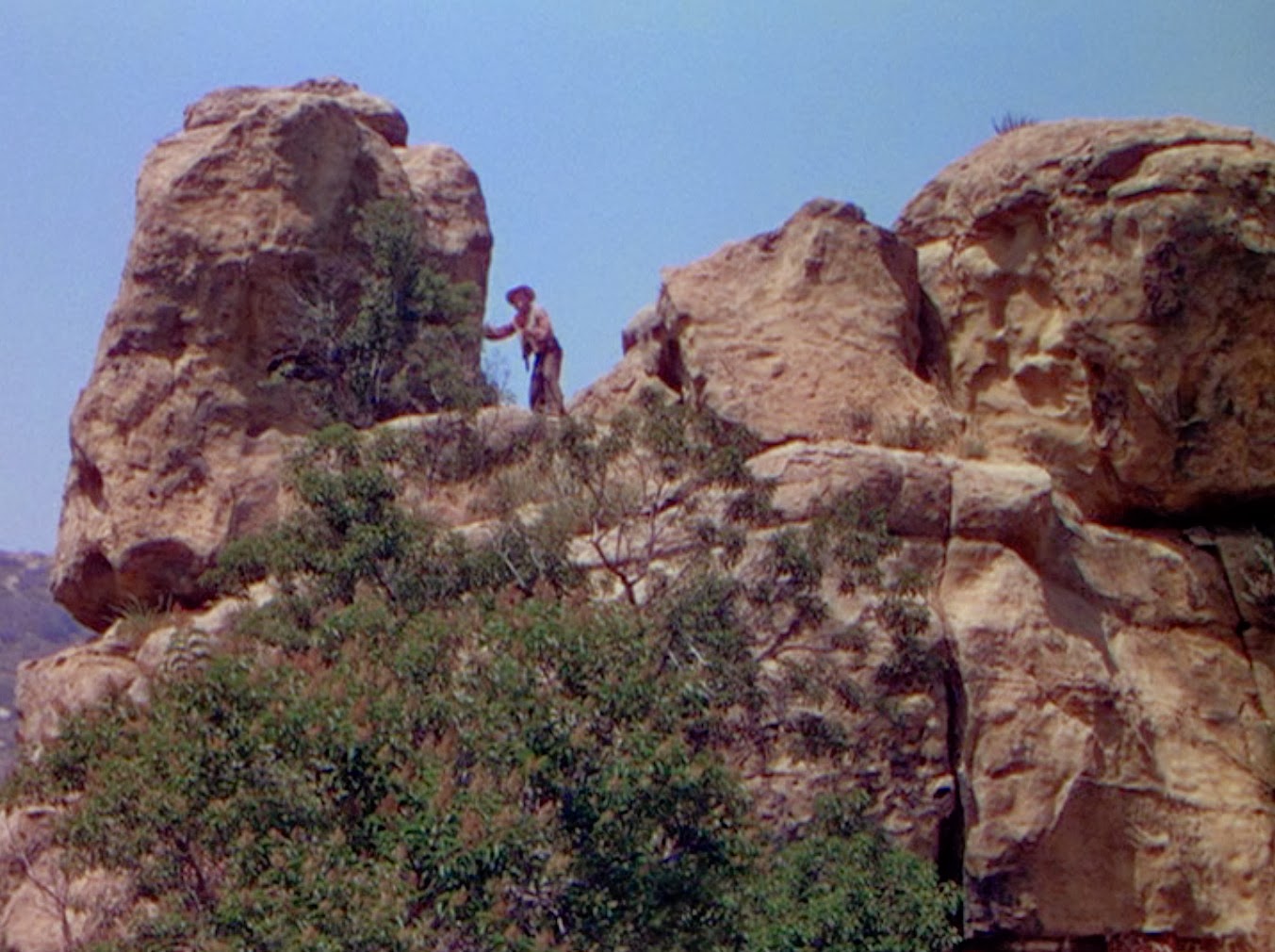
Lookouts were placed strategically on the rocks of Garden of the Gods, which served as an outlaws' hideout in "Dallas." In this shot the lookout is positioned near the base of the Sphinx, or Eagle Beak.

Here's another lookout perched up high, leaning on the rock known as Indian Head or Tower Rock.

That's Cleft Rock toward the left, just to the left of the clouds of gunsmoke. Cleft Rock is a relatively minor structure, but it has a distinctive shape and appears in a number of films and TV shows. My attempts to find it at Iverson proved fruitless for months, but I finally located it thanks to this movie. It's in the North Cluster area, just above Garden of the Gods, near a group of condos. These days it's covered with ivy and barely distinguishable.

Here's a shot of Gary Cooper in Garden of the Gods for his starring role in "Dallas."

Saturday, May 29, 2010

Saddlehorn Relay Station and related structures

"The Roy Rogers Show" (1954)

One of the many structures that came and went at Iverson during the filming era, the Saddlehorn Relay Station is a favorite of researchers, probably in part because it is a fairly complicated structure and in part because it has been a challenge to pin down details about it such as where it was located and when it existed. An early theory suggested that the building was relocated around 1946 or 1947, when it would have been moved a bit farther to the west, but later research indicates that it was probably in one spot all along. The above shot of the building comes from the "Backfire" episode of "The Roy Rogers Show," which originally aired Oct. 10, 1954.

"Escort West" (1959)

This screen shot from the Victor Mature movie "Escort West" shows the Saddlehorn Relay Station at the left, and a number of other buildings that first surfaced around this time, in the right half of the photo. "Escort West," which filmed in 1958 for an early 1959 release, was made near the end of the main filming period at Iverson, and a number of unusual buildings crop up in some of the later productions that didn't end up being around for long. But it appears the small cluster of buildings seen here, sometimes called Saddlehorn Village, lasted through the 1960s.

Here's another shot of the relay station, at right, taken from "Escort West." This one shows Garden of the Gods in the background, with Indian Head and Eagle Beak or Sphinx visible at the top of the photo on the left half.

"Adventures of Captain Marvel" (1941) — Saddlehorn Rock

Saddlehorn Relay Station is one of two main relay stations at Iverson, the other being Grove Relay Station. Saddlehorn Relay Station has also been called a variety of other names, including Heldorado Relay Station and Batman Rock Relay Station. Its location is generally described as near Batman Rock or north of Garden of the Gods. It is also sometimes spotted, obviously, near Saddlehorn Rock, which is shown above.

Monday, May 24, 2010

Classic Rock: "Doglips," aka "Chinless Wonder" — This strange rock formation on the Iverson Movie Ranch starred in countless Westerns in the 1930s-1950s


The rock formation "Doglips," on the Iverson Movie Ranch in Chatsworth, Calif.

Doglips is something Salvador Dali might have conjured up. It's so weird it's hard to believe it happened naturally. Not only is it weird from the angle seen here, which is the "common" view, as seen from Redmesa Road, but it's also weird from just about every other angle.

The same rock from another angle, getting its "Chinless Wonder" on

The rock hid one key element of its personality from me for months, until I was finally able to determine that Doglips was also Chinless Wonder, a rock I had been searching for from the beginning and couldn't find even though it was right under my nose. I love this view of Chinless Wonder/Doglips looking like some kind of cocky cartoon character.


"Jungle Girl" (1941)

Here's another look at Chinless Wonder — in other words, Doglips — as it appears in the old Republic serial "Jungle Girl." It's the dark, sort of monkeyhead-shaped figure that dominates the left half of the shot. You can also catch a glimpse of the Elders just to the right of it, in the background, the light-colored rock more or less in the center of the shot. I've highlighted both of these landmarks in the shot below.

The "Jungle Girl" shot again — with two key features noted

For more on the Chinless Wonder aspect of Doglips, check out this post. And you'll find more about Doglips/Chinless wonder by clicking here or by finding Doglips (or Chinless Wonder) in the long index of labels at the right side of this page.

Here's a partial list of movies, TV shows and serials in which Doglips appears — just a fraction of the total:

Undersea Kingdom (1936)
Ghost-Town Gold (1936)
Zorro Rides Again (1937)
Overland Stage Raiders (1938)
Wall Street Cowboy (1939)
Frontier Pony Express (1939)
Jungle Girl (1941)
King of the Texas Rangers (1941)
The Perils of Nyoka (1942)
Raiders of Ghost City (1944)
Son of Zorro (1947)
The Hawk of Powder River (1948)
Lone Ranger (TV series) (1949-1957)
The Invisible Monster (1950)
Don Daredevil Rides Again (1951)
Sky King (TV series) (1951-1962)
The Roy Rogers Show (TV series) (1951-1957)
Zombies of the Stratosphere (1952)

This post is part of a series on "Classic Rocks" — sandstone giants located on the former Iverson Movie Ranch in Chatsworth, Calif., that became a part of not only America's physical landscape but also its cultural heritage, through featured roles in old movies, cliffhanger serials and early TV shows. Other entries in the series can be seen by clicking here.