Why we love old movie locations — especially the Iverson Movie Ranch

For an introduction to this blog and to the growing interest in historic filming locations such as the Iverson Movie Ranch — the most widely filmed outdoor location in movie and TV history — please read the site's introductory post, found here.
• Your feedback is appreciated — please leave comments on any of the posts.
• To find specific rock features or look up movie titles, TV shows, actors and production people, see the "LABELS" section — the long alphabetical listing on the right side of the page, below.
• To join the MAILING LIST, send me an email at iversonfilmranch@aol.com and let me know you'd like to sign up.
• I've also begun a YouTube channel for Iverson Movie Ranch clips and other movie location videos, which you can get to by clicking here.
• Readers can email the webmaster at iversonfilmranch@aol.com
.

Thursday, July 5, 2012

A treasure trove of Iverson Movie Ranch and Brandeis Movie Ranch video clips

Iverson Movie Ranch researcher and Western movie expert Jerry England has been loading up his YouTube channel with great clips of old movies that showcase Iverson. It's worth keeping an eye on his channel, and if you're as into it as I am, you'll want to subscribe. Here's a sample of the work Jerry has been doing.

The clip below comes from the 1942 Republic serial "Perils of Nyoka," which is in my pantheon of the all-time greatest Iverson productions. See for yourself ...


The "Perils of Nyoka" sequence was shot on the old Upper Iverson and features the swinging bridge, whose location was pinpointed just a few years ago. The bridge was set up above the creek near Turtle Rock — one of the most prominent landmarks on the Upper Iverson's widely filmed South Rim. Turtle Rock can be seen a number of times in the clip, including around the 12-second mark. The rock was a short distance to the south of the bridge and can still be readily spotted today — if you're lucky enough to gain access to what is now a pretty exclusive gated residential area.


Moving to the Lower Iverson, this second "Nyoka" clip includes another of the movie ranch's most prominent features — Nyoka Cliff, named after this serial. This scene didn't originate the term "cliffhanger," which goes back in the movies at least as far as the silent classic "The Perils of Pauline" in 1914 — and even farther, to the newspaper serials of the 19th century and Thomas Hardy's "A Pair of Blue Eyes." But "Perils of Nyoka," one of the most successful film serials of its day, went a long way toward perpetuating, in a literal sense, the idea of the cliffhanger.

Here's a bit of the 1923 Buster Keaton silent film "Three Ages," where the Iverson Gorge and Garden of the Gods serve as an appropriately rocky background for caveman shenanigans:


Jerry has also been researching the Brandeis Movie Ranch, which was also located in Chatsworth, Calif., immediately to the west of the former Upper Iverson. Because the two movie ranches were adjacent, there's a fair amount of overlap when researching one or the other.

Here are a couple of clips showcasing Brandeis ...


This one is from "Outlaws' Paradise," a low-budget 1939 Western starring Tim McCoy.


Here's another Brandeis clip, from "Roamin' Wild," a 1936 Tom Tyler B-Western from Reliable Pictures Corp. This one features Hickeyville, the Brandeis Western town, which is seen in only a few movies. Brandeis wasn't in operation nearly as long as its neighbor to the east, the Iverson Movie Ranch.

You may also want to check out Jerry's blog, which includes a wealth of material about Iverson.

Thursday, June 14, 2012

Look who dropped in on the Iverson Ranch: It's a bird, it's a plane, it's ... George Reeves in the 1950s TV series "Adventures of Superman"

The iconic 1950s TV series "Adventures of Superman" is widely thought to be shot in part at the Iverson Movie Ranch, but until recently a confirmed sighting had eluded me. Then Superman aficionado Dave Spiceland tipped me off that the episode "Panic in the Sky," which first aired Dec. 5, 1953, as part of the show's second season, contains some stuff that looks a lot like Iverson. Sure enough, it turns out the episode has a couple of scenes shot on the old Upper Iverson.

I understand the episode is a fan favorite, with an unusual storyline that has the entire planet in peril and sends Superman into space — twice. When an asteroid threatens to destroy Earth, Superman flies up there to face it head-on and initially manages to divert the thing and send it into orbit. But the effort leaves him in bad shape, suffering from a concussion and amnesia. (What's worse, he later has to go back up and tussle with the big brute again.) In the above shot, a woozy Superman has just landed back on Earth, too disoriented to know where he is. But we know he's on the South Rim of the old Upper Iverson, as the next few shots will reveal.

Once Superman stands up we see a familiar rock behind him. I call this one Notch Rock — part of a distinctive set of rock towers that have been called Easter Island or the Totem Rocks.

Here's a shot of the Totem Rocks/Easter Island in modern times, with Notch Rock hard to miss near the center of the shot.

Superman manages to get changed into his Clark Kent outfit — where he stashed the gear while he was off wrangling the asteroid seems like a plot hole, but no need to nitpick. That's the legendary Wrench Rock filling up much of the right half of the shot. (Update: It's not a plot hole after all. Thanks to "Superman" fan Steve Brant, who explained how it works. See comments.)

This is what the rest of Wrench Rock — aka Indian Head, aka Upper Indian Head, aka Bobby — looks like these days. Another shot of it, from the other side, appears at the top of this blog.

Another glimpse of Wrench Rock, on the left, with an askew George Reeves as Clark Kent.

A woman in an old jalopy turns up just in time to rescue Clark and give him a lift to town. That's part of a rock feature I call the Tomb on the left and a portion of the Slates on the right.

In the background is the Cliff, also known as the T-Cliff. The whole Iverson sequence is shot in one small area.

Off they go. I believe the actress is Jane Frazee.

The final Iverson shot in the sequence includes Gold Raiders Rock, top right. The small rock was cemented onto the top of the larger rock around 1950, and it remains in place today.

Gold Raiders Rock today, from the other side.


I have yet to become an expert on "The Adventures of Superman," but I've heard season two is the best for Iverson content. Above are some Amazon links (updated in late 2018), where you can find a complete DVD set of all six seasons of the show (the first link) along with various Amazon rental and digital purchase options.

Thursday, May 31, 2012

Robert Mitchum brings film noir to the Garden of the Gods

It was relatively rare for film noir to be shot at the Iverson Movie Ranch, where the staples were B-Westerns in particular, along with war movies, desert adventures and some sci-fi. But the movie ranch did see action in a few film noirs, including the acclaimed 1949 Robert Mitchum movie "The Big Steal."

"The Big Steal" (1949) — Jane Greer and Robert Mitchum on the Iverson Movie Ranch

Garden of the Gods stands in for the hills of Mexico in one scene late in the movie, with a key shootout taking place that puts Mitchum and his leading lady Jane Greer in peril.

The scene plays out mainly in the central Garden of the Gods area, near the camera mount and Overlook Point. The rocks that show up during the shootout are basically all still in place, in a section of the former Iverson Movie Ranch that has been preserved as a park.

A romp through Garden of the Gods often turns up that big rock with the horizontal crack, which tends to be a helpful identifier. I call it Moray Eel.

Not that it's easy to miss, but just to avoid confusion, Moray Eel is identified here.

Here's another look at Moray Eel and that same area from a recent visit to the site. This area was used a lot in the movies.

A colorized version of "The Big Steal" has also made the rounds. This is what Moray Eel and its surroundings look like in that version.

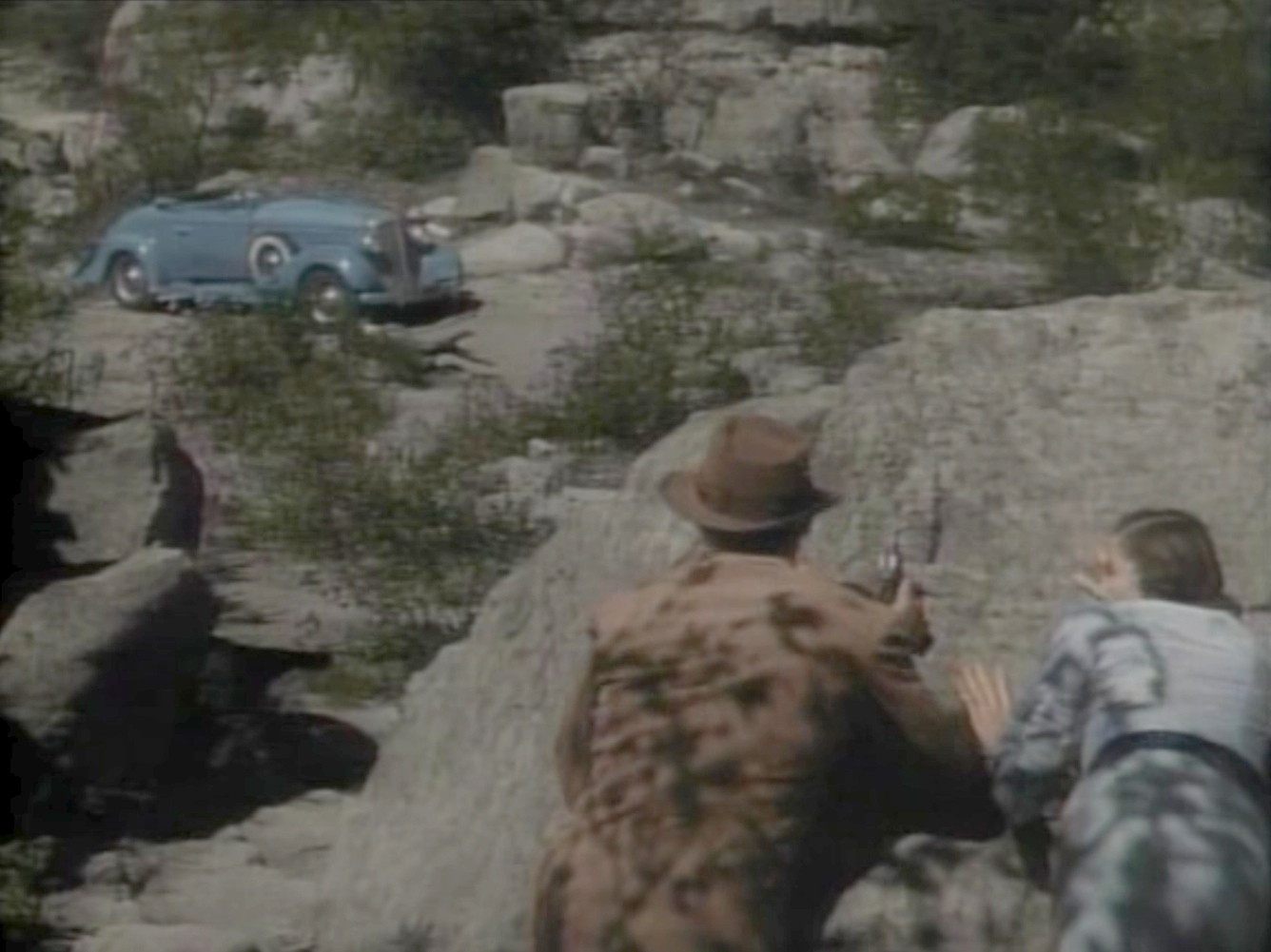
One of the hallmarks of film noir is the great-looking old cars, and "The Big Steal" is no exception. Here they drove the old convertible right up into the middle of Garden of the Gods, where it became part of the shootout.

Colorizing tends to miss the point of film noir, but that convertible does look good in baby blue.

Another angle on the Garden of the Gods shootout in "The Big Steal."

More Mitchum — putting up a fight in Garden of the Gods.

With Sphinx in the background, one of the bad guys gets the drop on Mitchum.

And it's all over — the whole Iverson scene lasts only about five minutes.

The legacy of "The Big Steal's" location shoot at the Iverson Movie Ranch includes a rock in Garden of the Gods that some people call Mitchum Rock. I started calling it that for the purposes of my research, and it seems to have caught on.


Here are a couple of options if you feel like picking up a copy of "The Big Steal" — try the above links, although at this point I seem to only be able to find it in relatively pricey DVD sets.

Sunday, May 27, 2012

John Ford gets a postage stamp

John Ford's appreciation for the Iverson Movie Ranch in Chatsworth, Calif., as a filming location never got as much publicity as his love for Monument Valley on the Utah-Arizona border — where he created a series of film images that became emblematic of the American West. But he was a regular at Iverson, directing some of the most important productions shot at the ranch and skillfully interweaving Iverson's rocky terrain with images filmed elsewhere to create a richer and more complex library of Western imagery. I have always considered him an important member of the Iverson "family," and I wanted to celebrate the release of Ford's new U.S. postage stamp.

Here it is — the new John Ford "forever" first-class stamp, depicting a scene inspired by "The Searchers" along with a rendition of the director. The movie scene appears to be based on the film's opening sequence, with Monument Valley in the background and a figure presumably inspired by John Wayne in the foreground. Wayne, by the way, was another Hollywood legend who worked at Iverson a time or two.

The Ford stamp is part of a set of four new stamps honoring American directors, including Frank Capra, Billy Wilder and John Huston. The set is officially designated the Great Film Directors (Forever) stamps by the U.S. Postal Service, and you can buy them now from usps.com.

The John Ford stamp continues a tradition of U.S. postage stamps celebrating the American West, including the above Sitting Bull stamp. Blogger Bennett Owen, inspired by the announcement last year of the Ford stamp, put up a nice post rounding up some of the most compelling Western-themed stamps over the years, which you can read by clicking here. I'll go ahead and post a few more of the images below, because they're mighty cool. Here you go ...


While Ford didn't shoot "The Searchers" at Iverson, his Iverson filmography includes some terrific movies. Among them:

"Stagecoach" (1939), often called the quintessential American Western. I did an extensive blog post on "Stagecoach" some time ago, found here, which breaks down the Iverson filming locations seen in the movie. You can find more about "Stagecoach" in various places throughout the blog by clicking "Stagecoach" in the long alphabetical index on the right side of the page, or by clicking here. One note about "Stagecoach" that I didn't mention last time is that the first appearance of John Wayne in the movie — an introduction that has been cited as one of the best ever for a screen actor — was created using a composite of Monument Valley footage and Iverson Movie Ranch footage. The stagecoach is seen traveling through scenery that is mostly Monument Valley with a little Iverson in the mix, but when the camera settles in on Wayne during his first encounter with the stage, the rocks seen behind him are at Iverson.

This screen grab from the John Wayne entrance sequence in "Stagecoach" is from a colorized version of the movie, although the movie itself was shot in black and white.

Another frame from the same sequence, but in the original black and white. The rocks behind Wayne were found in the Upper Gorge on the Iverson Movie Ranch, and for the most part were destroyed in the late 1980s to make way for condos.

"Wee Willie Winkie" (1937) — This Shirley Temple war movie (anti-war, really) about the British colonization of India was an important project in its day, and John Ford shot it largely at Iverson. The production included the building of elaborate sets at the movie ranch, and some of that construction became the foundation for other sets that remained in use throughout much of the filming era at Iverson.

Victor McLaglen and Shirley Temple at work on the Lower Iverson in John Ford's "Wee Willie Winkie." The movie comes up regularly on this blog, and you can read more about it by clicking here (or by looking up "Wee Willie Winkie" in the alphabetical index at the right side of the page).

Here's a promo still from "Wee Willie Winkie" that provides a good look at part of the elaborate "India fort" set built for the movie on Sheep Flats, on the Lower Iverson. The picture is courtesy of movie location expert Jerry England and his great blog, "A Drifting Cowboy," which you can read by clicking here.

"The Grapes of Wrath" (1940) — John Ford's definitive movie on the westward migration during the Dust Bowl is one of my favorite movies of the 1940s.

The movie only contains a little bit of Iverson — mainly the above shot, which looks out on the San Fernando Valley from Iverson. At that time the Valley was still mostly farms, and the shot depicted the migrant family's first look at California's rich farmland — farmland that held the prospect of jobs in the field. Click here for more about this shot and about "The Grapes of Wrath."


The above links can be used to shop for John Ford's Iverson movies on Amazon.

Sunday, May 13, 2012

L.A. band the Lonely Wild immortalizes Chatsworth's rocky hills in two music videos

The members of a young L.A.-based band called the Lonely Wild climbed Stoney Point — just across Topanga from the site of the former Iverson Movie Ranch in Chatsworth, Calif. — to perform a couple of their songs for music videos, which they've posted on YouTube.

The Lonely Wild 

Here's "Morning Song," with glimpses of the San Fernando Valley (including an unexpected pan at the end), some of the hills above Chatsworth (south of Iverson Ranch) and plenty of cool rocks in the background:


This next one's called "Hail." You can catch glimpses of Garden of the Gods and the southeast corner of the Lower Iverson in the background (for example, at 0:51, in the top right corner) along with some of the familiar background hills often seen in Iverson movie and TV footage, such as Pyramid Peak (top right corner, 0:43) and Boat Hill (top right corner, 0:59). Also visible in this video are Elders Peak and the rock formation known as the Elders (directly behind the drummer in the first shot of the band), above Chatsworth Park:


You can check out the Lonely Wild website here.